In line with the shift to future mobility
AI education hub established
Tailored AI training at facility dedicated to suppliers
'Growing together with parts suppliers'
![An exterior view of the Hyundai Motor Group Global Mutual Growth Partnership Center, a training facility dedicated to parts suppliers [Hyundai Motor/Kia]](https://wimg.heraldcorp.com/news/cms/2026/08/27/news-p.v1.20260827.9f220f1bcb5f485dae0b5d85d8faf4b4_P1.jpg)
Hyundai Motor and Kia are establishing a dedicated AI education hub to help small and midsize parts suppliers strengthen their AI-based manufacturing quality competitiveness, amid rapid change sweeping the future mobility industry — from electric vehicles and software-defined vehicles to AI.
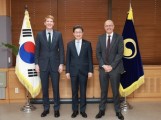
The two automakers announced Thursday that they held an opening ceremony for the "AI-Specialized Joint Training Center" at the Hyundai Motor Group Global Mutual Growth Partnership Center, a supplier-dedicated training facility in Gyeongju, North Gyeongsang Province. Attendees included Yoon Jun-ho, executive vice president of Hyundai Motor and Kia's purchasing strategy division, Korea Human Resources Development Service President Lee Byung-chan, and representatives of major suppliers.
The AI-Specialized Joint Training Center serves as a structured AI transformation support platform, providing quality-, process- and data-driven, job-focused AI training tailored to each supplier's needs. It is designed to help parts suppliers that have centered their operations on internal combustion engines make a smooth transition into high-value-added future vehicle component makers built around AI and data.
The center is being developed as a model public-private partnership that combines Hyundai Motor and Kia's advanced training infrastructure, supplier network and specialized education expertise with government policy support.
This year, Hyundai Motor and Kia plan to prioritize hands-on AI training for about 900 employees at first- and second-tier parts suppliers. Starting next year, the companies plan to significantly expand the number of trainees and the scope of eligible suppliers, accelerating AI transformation across the entire parts supply chain.
The center moves beyond conventional classroom instruction to focus on real-world applicability, operating through a four-part framework: assessing each supplier's AI readiness and capability level; delivering job-specific, step-by-step tailored AI training; conducting problem-based learning exercises using actual defect data from suppliers' own factories; and running culture-building activities such as forums and seminars to spread AI transformation practices.
Core curriculum offerings include a generative AI module for automating the creation of work standards and quality-related documents, an AI vision inspection course to automate quality checks on the factory floor and maximize defect detection, and a quality risk management program covering big data analysis of manufacturing processes and prevention of potential hazards.
Particularly notable is the problem-based learning component, in which suppliers use actual process data from their own factories to build AI models and develop quality-improvement solutions — a design intended to reduce defect rates on the shop floor while also driving productivity gains.
In addition, Hyundai Motor and Kia plan to successfully establish quality-focused AI training this year before expanding the program to cover all supplier job functions — including production, R&D, procurement and management — with the aim of leading the creation of an AI co-prosperity ecosystem spanning the future mobility industry.
"To lead the future mobility market, it is essential to internalize technology on the shop floor in ways that achieve quality completeness and productivity innovation," a Hyundai Motor and Kia official said. "In the belief that the AI competitiveness of our parts suppliers is Hyundai Motor and Kia's global competitiveness, we will continue to support our suppliers' successful AI transformation and mutual growth through the AI-Specialized Joint Training Center."
Meanwhile, Hyundai Motor Group is expanding its business scope to become a "physical AI company" that directly manufactures and sells robotaxis and humanoid robots. The group plans to begin commercializing a robotaxi based on the Hyundai Motor Ioniq 5 electric vehicle this year, and from 2028 will deploy its Atlas humanoid robot on production lines while simultaneously launching mass production of 30,000 robots annually in the United States.
likehyo85@heraldcorp.com