Hoban files merger notification with Fair Trade Commission as largest shareholder
Cho Won-tae signals additional stake purchase in Hanjin KAL
Korea Development Bank's 10.58% stake seen as decisive variable
March shareholder meeting expected to be turning point
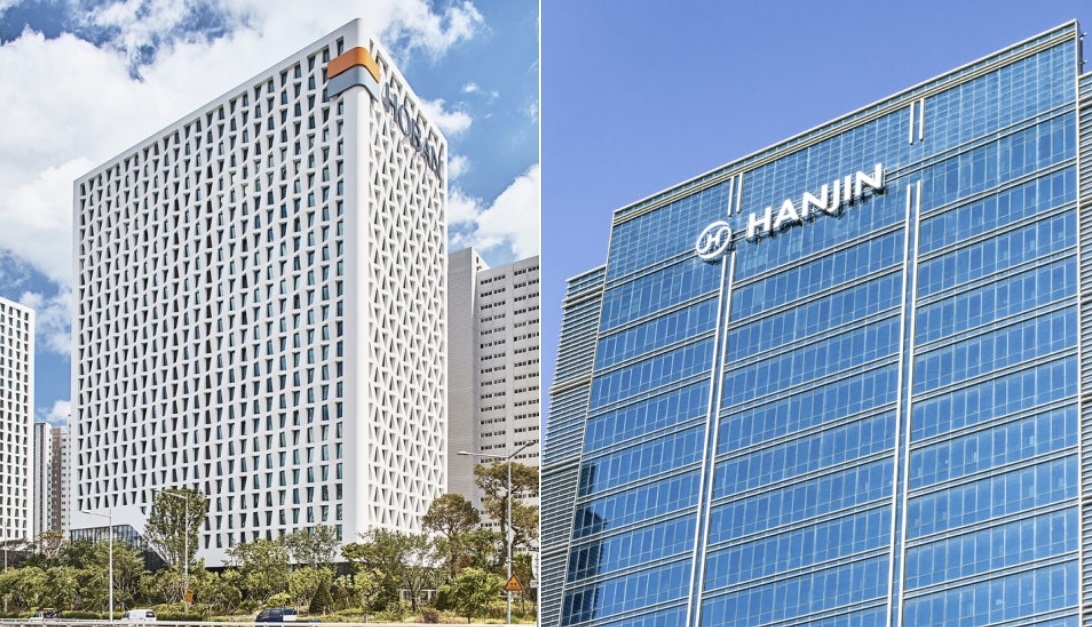
A fresh battle for control of Hanjin KAL is intensifying as Hoban Group continues to accumulate shares and has filed a merger notification with the Korea Fair Trade Commission as the company's largest shareholder, prompting Hanjin Group Chairman Cho Won-tae to announce a countermove through additional stake purchases.
According to industry sources, Cho signed a share purchase agreement Monday to acquire 325,000 common shares of Hanjin KAL at 114,000 won ($85) per share. The total transaction is valued at 37.05 billion won. The purchase is scheduled to take place between Dec. 3 and Jan. 1 through a block deal.
If the transaction is completed as planned, Cho's personal stake will rise from the current 3,869,612 shares (5.75%) to 4,194,612 shares (6.23%), an increase of 0.48 percentage points. The combined stake held by Cho and related parties would also expand from 20.57% to 21.06%.
Hanjin Group said the additional purchase was a matter that had been in preparation for some time and was unrelated to Hoban's share acquisitions.
Cho described the move in a regulatory filing as part of efforts to "strengthen responsible management." Industry observers, however, widely interpret the purchase as a defensive response to Hoban Group's rise to the top shareholder position. Having consistently accumulated Hanjin KAL shares, Hoban has now surpassed Cho's camp in ownership, lending weight to the view that Cho is in effect mounting a counteroffensive to protect management control.
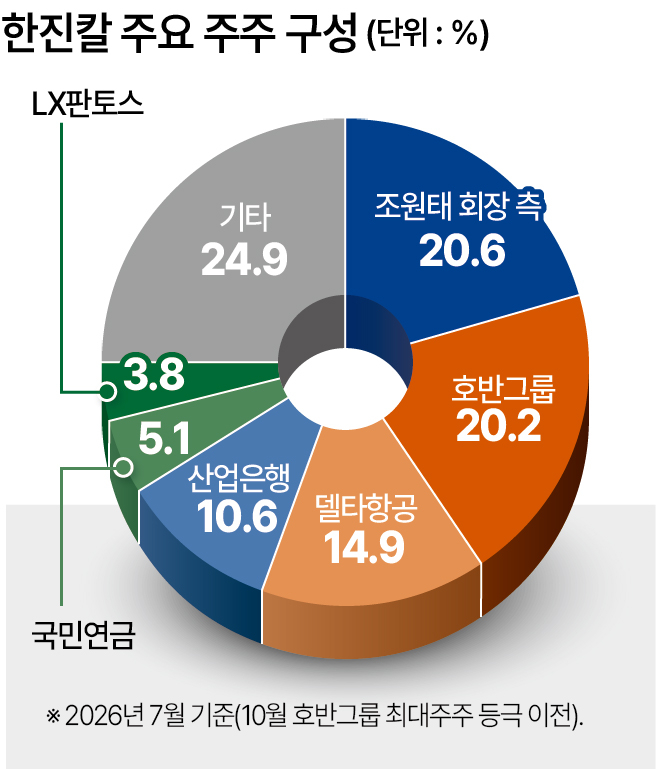
Hoban Group acquired additional Hanjin KAL shares to narrowly surpass the roughly 20.6% combined stake held by Cho and related parties, and subsequently filed a merger notification with the Fair Trade Commission.
Hoban is understood to have claimed the top shareholder position roughly four years after acquiring the stake held by private equity fund KCGI in 2022, which had made it the second-largest shareholder. As of July, Hoban's stake in Hanjin KAL stood at 20.15%, just 0.42 percentage points behind Cho's camp at 20.57%.
While Hoban Group has characterized its Hanjin KAL share purchases as a "simple investment," some observers believe a formal declaration of intent to participate in Hanjin Group's management may be imminent.
Once Cho completes his additional share purchase in response to Hoban's ascent to the top shareholder position, the combined stake on his side will also expand, adding a new variable to the ongoing ownership contest between the two parties.
With the share competition reigniting, the shareholder meeting scheduled for March is expected to serve as a pivotal moment in determining who controls the company. Three independent directors recommended by Korea Development Bank currently sit on the Hanjin KAL board, and all three are set to see their terms expire in March. The possibility that Hoban could nominate its own independent directors and seek board representation cannot be ruled out. There is also speculation that Hoban, which has ample cash reserves, could move to acquire additional shares through a tender offer or expand its pool of friendly shareholders.
Hanjin Group maintains that its management position is secure when friendly stakes are tallied together — including Delta Air Lines (14.90%), which operates a joint venture with Korean Air, five companies including LX Pantos and GS Retail, and private equity funds Daeshin and Eugene. Japan Airlines has also recently acquired Hanjin KAL shares, further broadening the group's circle of allies.
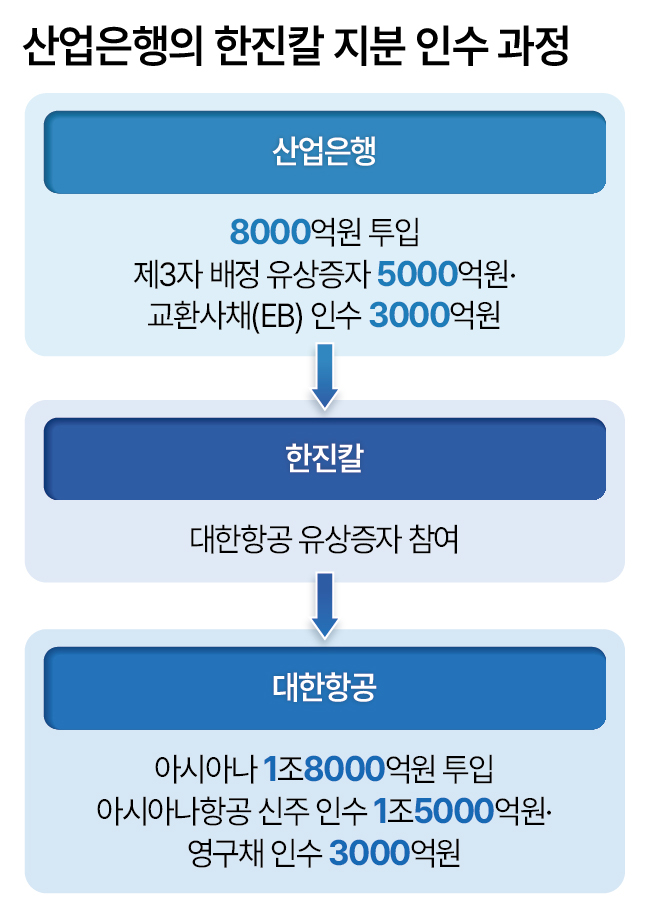
As the contest for the top shareholder position intensifies, the 10.58% stake held by Korea Development Bank is increasingly seen as a critical variable in determining who ultimately controls Hanjin KAL. Analysts note that the bank in effect holds the casting vote, as the outcome will hinge on whether Cho's allies or Hoban Group ends up acquiring that stake.
Korea Development Bank invested 500 billion won in a Hanjin KAL rights offering in 2020 to support Korean Air's acquisition of Asiana Airlines, securing a 10.58% stake. With the restructuring of the aviation industry — the original purpose of that investment — now nearing completion, the bank has growing justification to explore ways to exit its remaining position.
However, selling to Cho's allies could draw criticism that the state-run bank helped incumbent management entrench itself, while selling to Hoban could spark controversy over a policy bank playing a decisive role in a change of corporate control. Some observers therefore expect Korea Development Bank to put the stake up for open bidding.
"With Hoban filing a merger notification with the Fair Trade Commission and Cho moving to buy additional shares, the share acquisition competition between the two sides has in effect reignited," an industry official said. "Both parties are framing their moves as either a 'simple investment' or part of 'responsible management,' but the power struggle over control is unlikely to end anytime soon."
likehyo85@heraldcorp.com