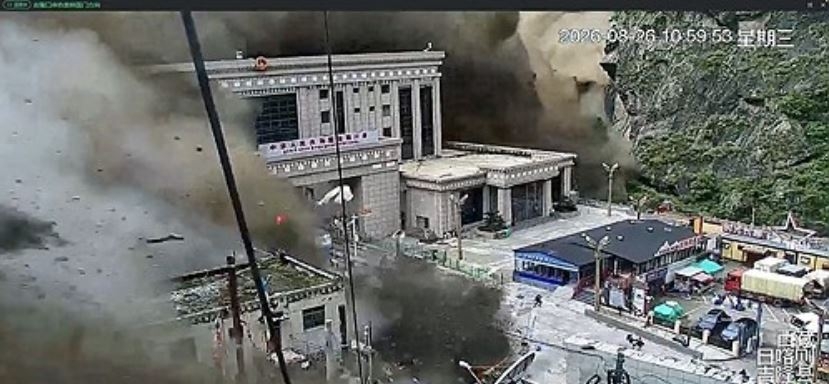
A massive flood has struck the Bagmati Province area of north-central Nepal, leaving hundreds missing — among them eight South Koreans who lost contact while working at a local hydropower plant construction site. Korean residents in Nepal say the flood struck without warning and with a ferocity unlike anything they have seen before.
Cha Seung-won, chairman of the Korean Association in Nepal, said he was stunned by the scale of the disaster. "I have lived in Nepal for about 10 years, and I have never seen a flood of this magnitude," he told Yonhap.
Cha acknowledged that floods had occurred before near the border with China's Tibet Autonomous Region, but said nothing had prepared him for what he witnessed this time. "There have been floods in that border area before, but nothing on this scale," he said.
The hardest-hit area is Rasuwa district in Bagmati Province, a mountainous border zone roughly 120 kilometers north of the capital Kathmandu that sits along the Himalayan range bordering China's Tibet Autonomous Region. Poor road conditions mean the drive from Kathmandu takes well over half a day.
A similar flash flood struck the same area last August, when a glacial lake in the adjacent Tibetan highlands overflowed due to high temperatures in the mountain region, killing nine people.
Cha said the Korean community in Nepal numbers around 650 registered overseas residents, most of whom are members of the Korean Association.
He said Rasuwa district has no registered Korean residents, but that South Koreans deployed to work at a hydropower plant there are among those now missing. "There are no registered Koreans in Rasuwa, but Koreans sent there for the hydropower plant have gone missing this time," he said.
According to Nepal police and the tourism authority, 22 deaths have been confirmed so far. A total of 384 tourists are listed as missing, including 291 foreigners and 93 Nepali nationals.
South Korea's Ministry of Foreign Affairs confirmed that eight South Korean employees of Korea South-East Power (KOEN) and Doosan Enerbility, who were working on the hydropower plant construction in Rasuwa, have lost contact. An additional 10 South Koreans affiliated with Doosan Enerbility are stranded at the site and awaiting rescue.
Moon Gwang-jin, a Korean resident of Kathmandu, raised concerns that the official missing-persons count may not reflect the full scale of the disaster. "The 384 missing people currently tallied are those registered through travel agencies," he said. "There are quite a few independent tourists who travel to the affected area without going through a travel agency, and there is no way to account for them."
The Rasuwa area is a popular destination for Himalayan trekkers. Independent travelers who did not book through agencies would not appear in official statistics, meaning the true number of missing could be higher.
The terrain is also hampering search efforts. The Bhote Koshi River runs through many narrow gorges, and the floodwaters were reportedly powerful enough to collapse concrete bridges. There are fears that some of the missing may have been swept far downstream.
Moon said the floodwaters, at their current speed, were expected to cross into India by Wednesday night. "If the water keeps moving at this pace, it is expected to cross the border into India by Wednesday night," he said. "There is a strong possibility that the missing will not be found within Nepal."
Authorities and residents believe the flooding was caused not by heavy rainfall within Nepal but by the sudden collapse of a glacial lake or glacial dam on the Tibetan side of the border. "We heard that this flood was not caused by heavy rain in Nepal but by something like a glacial dam suddenly bursting on the Chinese Tibetan side, so none of us saw it coming," Moon said. "Some of the missing are people we know personally, and everyone is in shock."
The Korean Association in Nepal is working with the South Korean Embassy in Kathmandu to check on the safety of Korean nationals across the country. "We are going region by region with the embassy to confirm whether Koreans are safe and whether anyone is unreachable," Cha said. "At this point, we have not confirmed any additional missing Koreans beyond the eight reported in the news."
Flash floods and glacial lake outbursts can strike the Himalayan mountain zone with little warning, making advance prediction and evacuation extremely difficult. Poor communications and road infrastructure near the border region are expected to further delay rescue operations and the accounting of missing persons, making a swift response from local and diplomatic authorities all the more urgent.
rainbow@heraldcorp.com