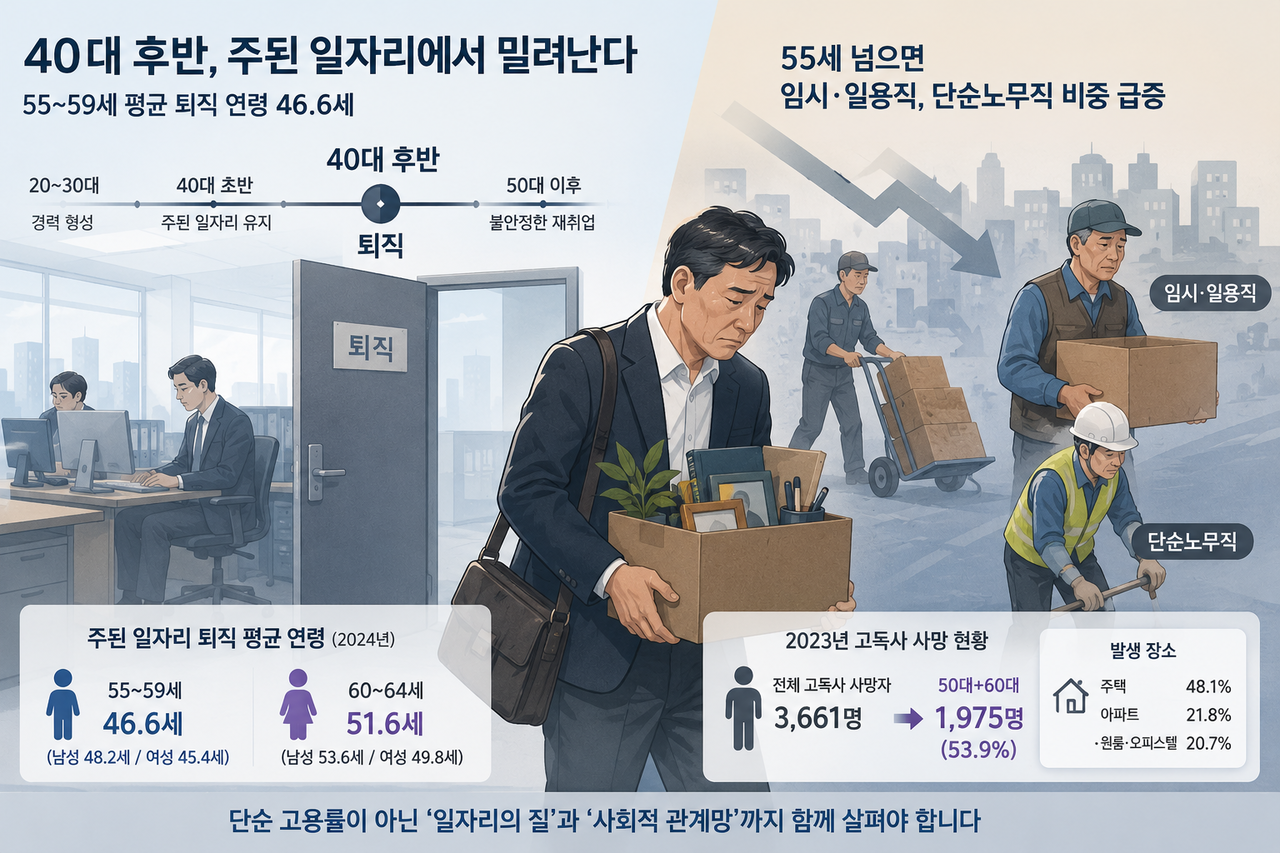
Although South Korea's legal retirement age is 60, workers in practice begin losing their longest-held "primary jobs" as early as their late 40s, a new study has found. After leaving those positions, most do not find comparable work — instead, they tend to move into temporary, daily-wage or low-skilled manual jobs. As debate over raising the retirement age intensifies, researchers warn that simply extending the statutory limit will do little to ease employment insecurity among middle-aged workers.
According to a report released Wednesday by the Korea Institute for Health and Social Affairs — titled "Demand-Side Indicator Research for Analyzing the Performance of Social Security Policy in Response to Demographic Change: Focusing on the Middle-Aged" — the average age at which workers between 55 and 59 left their primary job was 46.6 as of 2024. For those aged 60 to 64, the average departure age from their primary job was only 51.6.
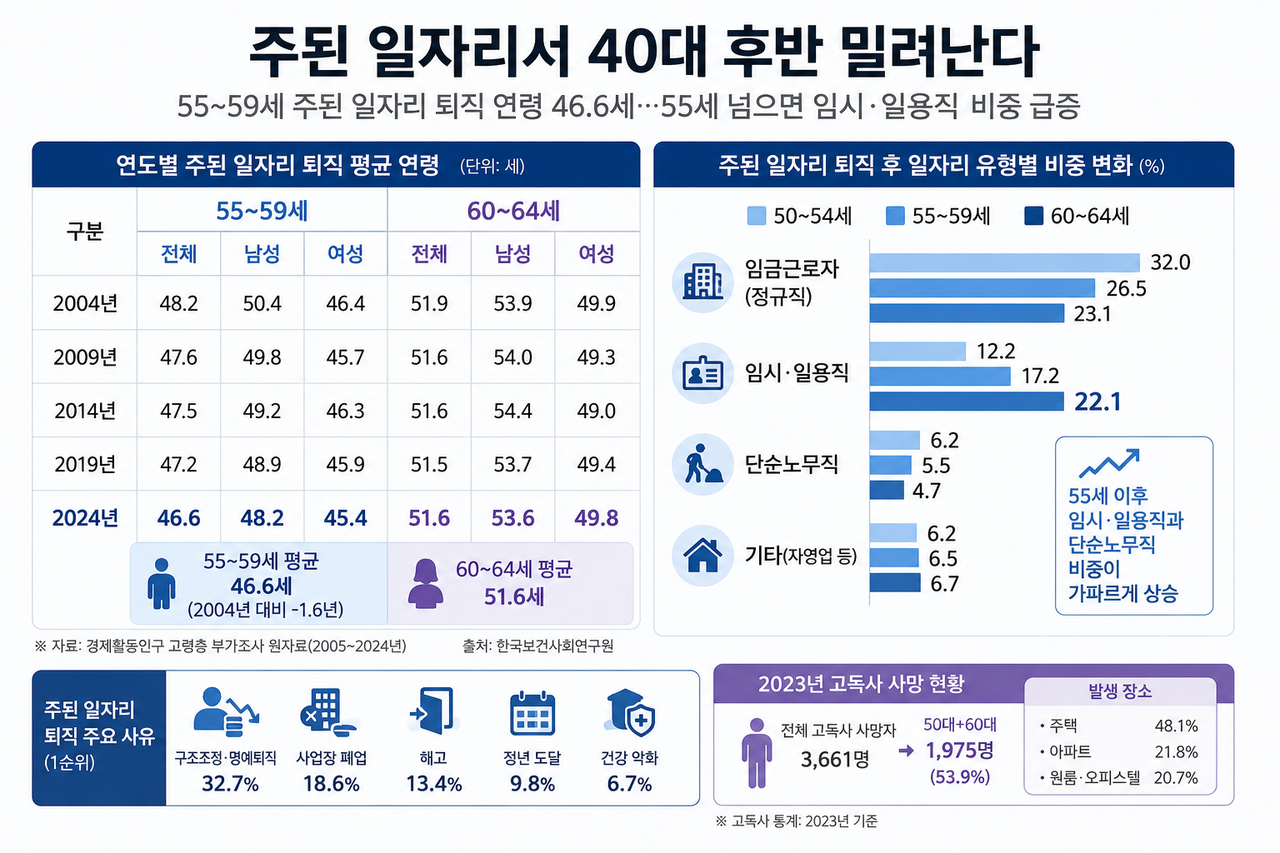
Both figures fall well short of the legal retirement age of 60. The average primary-job departure age for the 55–59 age group has declined steadily — from 48.2 in 2004 to 47.6 in 2009, 47.5 in 2014, 47.2 in 2019, and 46.6 in 2024. Workers in that cohort are leaving their main jobs 1.6 years earlier than they did two decades ago.
The gender gap was also pronounced. In 2024, men aged 55 to 59 left their primary jobs at an average age of 48.2, while women in the same age group did so at 45.4 — 2.8 years earlier. Among those aged 60 to 64, men departed at 53.6 and women at 49.8, a gap of 3.8 years.
Earlier Ministry of Statistics data similarly show that the average primary-job departure age for workers between 55 and 64 has hovered around 49. The most common reasons for leaving were involuntary — corporate restructuring, business closures and dismissals accounted for the largest share. The findings suggest that a significant number of middle-aged workers face structural pressure to exit the labor market well before the legal retirement age.
The situation after leaving a primary job is particularly concerning. Workers in their early 50s still hold relatively high shares of salaried and permanent employment, but around age 55 the proportion in temporary, daily-wage and low-skilled manual positions rises sharply. Rather than moving into comparable roles that draw on accumulated experience, many workers shift into jobs with lower wages and less employment security.
The report noted that while the overall employment rate for middle-aged workers has risen compared with the past, job quality deteriorates rapidly with age. A high employment rate among older workers can create the appearance of robust labor-market participation while masking a cycle of early departure from primary jobs followed by unstable re-employment.
Employment insecurity is also intertwined with social isolation. The report found that people aged 50 to 64 who face a combination of single-person households, no income, economic inactivity, poor housing conditions and limited mobility are at similarly high risk of social isolation as those aged 65 and older.
Particularly striking, people in their 50s and 60s accounted for 53.9 percent of the 3,661 solitary deaths recorded nationwide in 2023. Men made up 84.1 percent of all such deaths. The most common location was a house, at 48.1 percent, followed by apartments at 21.8 percent and studio apartments and officetels at 20.7 percent.
Researchers said that when middle-aged workers lose their primary jobs, they risk losing not only income but also the social networks they had maintained through the workplace. Middle-aged men living alone who simultaneously experience job loss, income decline and deteriorating health are particularly vulnerable to a rapid deepening of social isolation, the researchers warned.
The findings have prompted calls to move beyond simple headcounts and employment rates when measuring the effectiveness of middle-aged employment policy. The researchers proposed using intermediate performance indicators such as the employment-rate gap between the 50–54 and 55–59 age groups, the share of temporary and daily-wage workers by age bracket, the rate of primary-job retention, and differences in job tenure.
On social isolation, the report said assessments should go beyond whether a person lives alone and incorporate a "relationship deprivation rate" — the share of people with no regular contact with family or non-family members — as well as a "multidimensional support deficit rate," measuring the proportion of people who have no one to turn to for emotional comfort, financial help or household assistance when ill.
"Intermediate performance indicators must be introduced that can capture real changes as experienced by the people these policies are meant to serve," the researchers said, urging policymakers to identify the precise point at which employment conditions and social networks among middle-aged workers begin to deteriorate sharply.
fact0514@heraldcorp.com