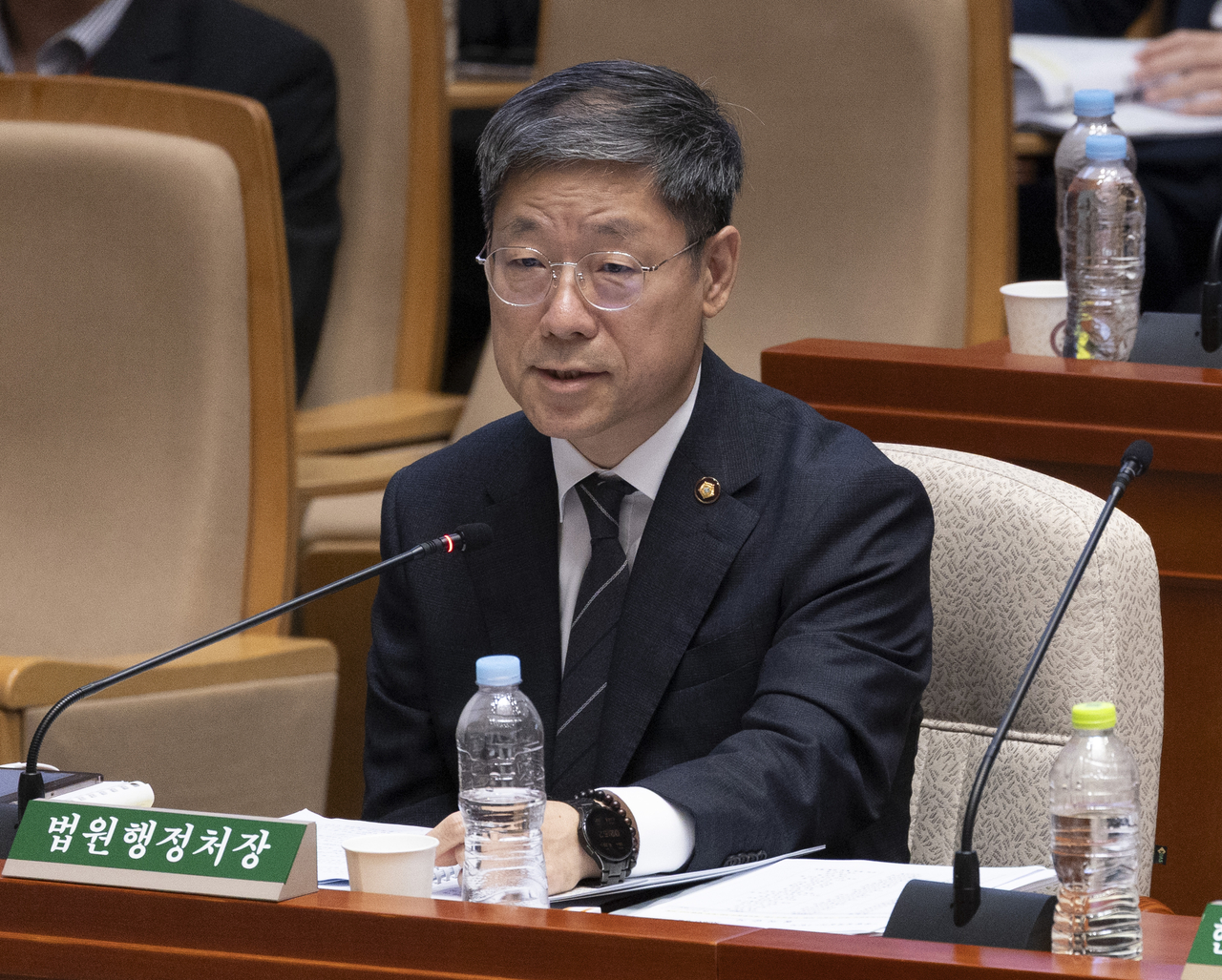
Court Administrator No Gyeong-pil said Tuesday that "there is a need to show respect for the chief justice," pushing back against complaints from within the ruling party that some lawmakers had been referring to Chief Justice Jo Hee-dae simply as "Mr. Jo."
No made the remarks while responding to questions from People Power Party lawmaker Yun Yong-geun at a comprehensive policy hearing of the National Assembly's budget and accounts committee.
When Yun asked whether the correct form of address for the head of the judiciary was "Chief Justice Jo Hee-dae" or "Mr. Jo Hee-dae," No initially said he did not think it was appropriate for him to answer. But when Yun pressed — asking whether it was really too much to attach the title of chief justice when addressing the head of the judiciary — No replied, "I believe there is a need to show respect for the chief justice."
Earlier, Democratic Party of Korea leader Kim Min-seok had referred to Chief Justice Jo on Wednesday as "Mr. Jo Hee-dae, the worst chief justice since liberation." The remark came in response to Jo's decision to formally recommend two new Supreme Court justice candidates to President Lee Jae Myung in writing, without meeting him in person.
Jo submitted written nominations to President Lee on Monday — recommending Sohn Bong-gi, a senior judge at the Daegu District Court, to succeed former Justice Noh Tae-ak, who retired in March, and Kim Seong-su, a senior judge at Seoul High Court, to succeed Justice Lee Heung-gu, who is set to retire next month.
The nominations were unusual in that Jo did not meet with the president in person, instead submitting them in writing. It has long been customary for Cheong Wa Dae and the Supreme Court to coordinate on candidates before the chief justice meets the president to formally submit the nominations.
The Constitution and the Court Organization Act stipulate that Supreme Court justices are appointed by the president upon the recommendation of the chief justice, with the consent of the National Assembly. In this case, however, Jo bypassed the customary visit to Cheong Wa Dae and submitted the nominations in writing. The move brought a simmering conflict between the two sides into the open, observers noted, as the presidential office and the Supreme Court had spent months unable to narrow their differences over the successor to Justice Noh.
On the written nominations, No said Tuesday that "while there is the spirit of the Constitution, the longstanding practice of respecting the president's appointment prerogative also needs to be respected." Lawmaker Yun criticized those who had raised the prospect of impeaching the chief justice, saying, "Both the president and the Democratic Party are subject to the Constitution," and that "dismissing the chief justice's dignity and invoking impeachment just because things are not going their way is an act of denying the rule of law and trying to bring the judiciary to its knees — a repudiation of the Constitution."
Democratic Party lawmaker Jo In-cheol criticized the written nominations, saying, "In plain terms, this is about forcing something through — sending it unilaterally without any agreement." He added that "it will be ordinary citizens who suffer, as they will be unable to have their cases heard promptly." Jo then asked No whether he would be willing to withdraw the written submission and restart negotiations from scratch. No replied that "the final decision on whether to proceed with the nomination rests with the chief justice."
yg@heraldcorp.com