
![A visitor tries out a beauty device at a Medicube pop-up store operated by APR in Hong Kong in December 2024. [APR]](https://wimg.heraldcorp.com/news/cms/2026/08/25/news-p.v1.20260825.dd35742ba11f448082ad4ea9b7b02556_P1.jpeg)
Beauty devices are taking over consumers' vanity tables, evolving from niche products known only to skincare enthusiasts into everyday staples of personal care routines.
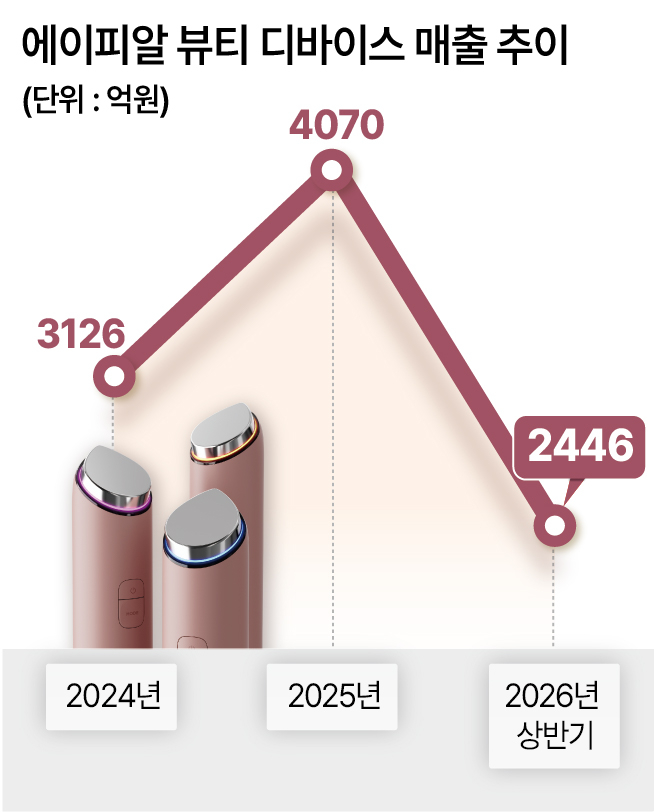
Industry data show sales at beauty device makers are soaring. APR, the sector's leading player, posted 244.6 billion won ($177 million) in beauty device sales in the first half of this year, up 35.2 percent from the same period last year. Since launching its first beauty device in 2021, the company has set a new annual sales record every year. Last year's sales reached about 407 billion won, and another record looks likely this year.
Home appliance company Athome has also grown rapidly on the strength of its aesthetics brand THOME, which includes beauty devices. THOME posted 35 billion won in sales last year and has set a target of 150 billion won this year. EOA, a brand nurtured through CJ OnStyle's incubation program CJ On-Cubating, recorded about 5 billion won in orders in the first half of this year. Beauty device orders on CJ OnStyle rose 12 percent last month compared with the same month last year.
The price barrier has also fallen. Beauty devices were once dominated by products priced well above 1 million won, each built around a single specialized function — making them the domain of high-involvement buyers such as regular spa clients. More recently, entry-level devices combining multiple functions have proliferated in the 200,000 to 300,000 won range, and some companies have gone further, releasing ultra-affordable models priced under 100,000 won to attract younger consumers.
Consumers increasingly view the devices as cost-effective alternatives to dermatology clinic procedures that can run into the millions of won. A woman in her 40s who bought an APR device during a recent discount event said she had been getting lifting treatments costing around 3 million won once a year but decided to switch to a device because the cost had become a burden. A woman in her 30s who uses Athome's Tom the Glow said she was satisfied with the time and money she saves by skipping trips to the dermatologist.
Companies are also making strategic bets on beauty devices, drawn by the opportunity to build an ecosystem linking their devices with cosmetics and app services. APR's cosmetics and beauty division sales grew roughly 100-fold — from 160.6 billion won in 2021, when it launched its first device, to the 1 trillion won range in 2025. The company's AGR app, which syncs with its devices, surpassed 1.5 million cumulative global downloads in January this year. KleanNara, a maker of packaging materials and tissue products, has also recently announced its formal entry into the beauty device market as a new growth engine.
The growth is backed by data. According to Meritz Securities, the global home-care beauty device market is projected to expand from about 7 trillion won in 2024 to 45 trillion won by 2030. Samil PwC Management Research Institute expects the domestic market to grow from about 2 trillion won last year to nearly 8 trillion won by 2035.
"As more affordable products hit the market, demand from general consumers for beauty devices is growing significantly," one industry official said. Another said the trend can be seen as an extension of the mainstreaming of "longevity" — the pursuit of a longer, healthier life — adding that the wave of new product launches by major companies could also fuel continued growth among smaller manufacturers.

soho0902@heraldcorp.com




