![Seoul Mayor Oh Se-hoon visits a private redevelopment project site in the Segye and Cheongpa-dong area of Yongsan-gu, Seoul, where fast-track integrated planning redevelopment and Moa Town projects are underway. [Joint press corps] [Yonhap]](https://wimg.heraldcorp.com/news/cms/2026/08/25/rcv.YNA.20260811.PYH2026081107220001300_P1.jpg)
In a push to accelerate housing supply, the ruling party and government are pursuing a plan to transfer permit authority over redevelopment and reconstruction projects of 500 units or fewer to district mayors and other heads of basic local governments. The ruling camp argues the move would ease a bottleneck caused by Seoul city hall's concentration of approval powers over small-scale projects, but industry insiders are pushing back, warning of increased review uncertainty and the risk of haphazard development.
According to the Ministry of Land, Infrastructure and Transport, the ministry will begin reviewing amendments to the Act on the Improvement of Urban Areas and Residential Environments — the legal framework governing redevelopment — needed to transfer permit authority over small-scale projects. The review follows the ruling party-government decision, as any transfer of authority requires changes to the relevant legislation.
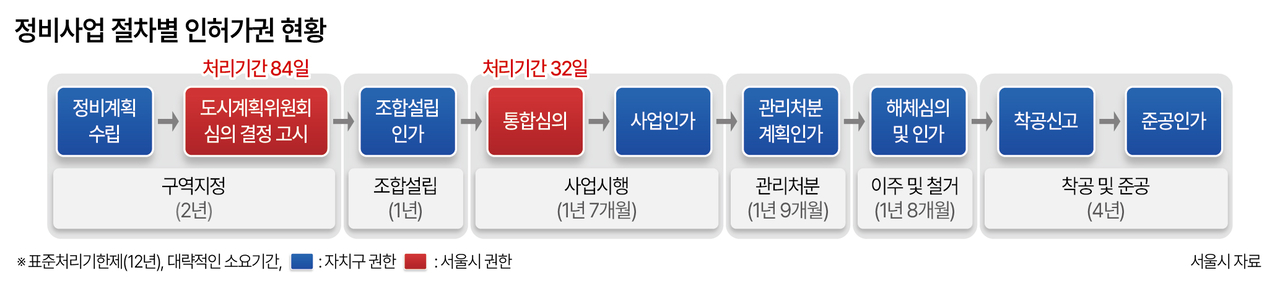
Seoul's redevelopment process currently consists of nine broad stages. Of these, two stages that occur before project authorization — the Urban Planning Committee deliberation and public notice (approximately 84 days to process) and the integrated review (approximately 32 days) — fall under Seoul city hall's permit authority. Accordingly, the power to designate redevelopment zones rests with the city. The remaining seven stages — drawing up improvement plans, approving association formation, approving management and disposal plans, demolition review and authorization, groundbreaking notification, and completion authorization — are handled under district-level permit authority.
The ruling party and government believe that expanding district-level authority over matters such as redevelopment zone designation would streamline administrative procedures and accelerate housing supply. Lowering the entry threshold for redevelopment projects is also cited as a benefit.
Industry insiders, however, warn that the shift could create staffing problems in practice, as well as increase the risk of haphazard development and review unpredictability. Their concern is that if all 25 autonomous districts conduct their own Urban Planning Committee reviews, different standards could be applied across the city.
"Seoul city hall's integrated review involves about 30 committee members, but if 25 districts each run their own process, you would need roughly 750 people," one real estate expert said. "The districts are not immediately equipped with the staff to handle this workload, and the number of projects and review cycles will vary from district to district — the predictability of reviews could actually fall, creating more confusion."
There are also concerns that unchecked expansion of district mayors' authority could lead to a proliferation of designated redevelopment zones with little regard for broader planning. Redevelopment is a long-term undertaking, typically taking more than a decade from zone designation to completion authorization. Once a redevelopment zone is designated, certain activities — including new construction — are restricted, meaning the supply of non-apartment housing in the area can actually tighten before new apartment buildings go up.
![Minister of Land, Infrastructure and Transport Kim Yun-deok and Seoul Mayor Oh Se-hoon are scheduled to meet again this week, following their meeting last week, to discuss housing supply issues in Seoul including the Yongsan Park site. [Yonhap]](https://wimg.heraldcorp.com/news/cms/2026/08/25/rcv.YNA.20260823.PYH2026082305170001300_P1.jpg)
"In districts with few redevelopment projects underway, complaints from residents of specific sites can place considerable pressure on the district mayor," said an official in the redevelopment industry. "There is a real risk of vote-chasing administration. If the coordinating and checking function that Seoul city hall has played is weakened, you could end up with Seoul fragmented into 25 pieces, each with zones sprouting up unchecked."
Seoul city hall has called for a full reconsideration of the authority transfer, arguing it would undermine the consistency of the city's urban planning vision. On Monday, the city issued a statement opposing the transfer, saying redevelopment projects "require comprehensive review of overall urban infrastructure — including water and sewage systems and roads — alongside urban planning support such as floor-area ratios and height limits to ensure project viability." The statement added that transferring zone designation authority to the districts "would significantly erode public trust in the city's urban management policies."
![Minister of Land, Infrastructure and Transport Kim Yun-deok and Seoul Mayor Oh Se-hoon shake hands after concluding talks on Seoul's housing issues, including housing supply using the Yongsan Park site, at a restaurant in Seoul on Thursday. [Yonhap]](https://wimg.heraldcorp.com/news/cms/2026/08/25/rcv.YNA.20260820.PYH2026082009360001300_P1.jpg)
Kim Je-gyeong, director of Toomi Real Estate Consulting and an urban planning expert, said dispersed small-scale redevelopment projects operating independently would inevitably produce worse outcomes and weaker project viability than large-scale developments. "The capacity to secure public infrastructure such as parks and roads, let alone extract public contributions like affordable housing, would be limited — and the end result would be an expansion of haphazard development," he said.
Some observers have raised the possibility that the ruling camp's push to transfer authority could serve as a bargaining chip to narrow differences between the ministry and Seoul city hall over housing supply. Given that the city has strongly opposed a range of government proposals — including housing development on the Yongsan Park site, the Taereung Country Club site, and greenbelt releases — the permit authority adjustment could be used as leverage to bring Mayor Oh on board.
Oh and Land Minister Kim Yun-deok are set to meet Wednesday morning at an undisclosed location in Seoul for a second round of talks on housing supply at the Yongsan Park site. Their first meeting on Thursday ended without agreement, and attention is now focused on whether this round will produce a concrete blueprint for housing supply.
hope@heraldcorp.com