
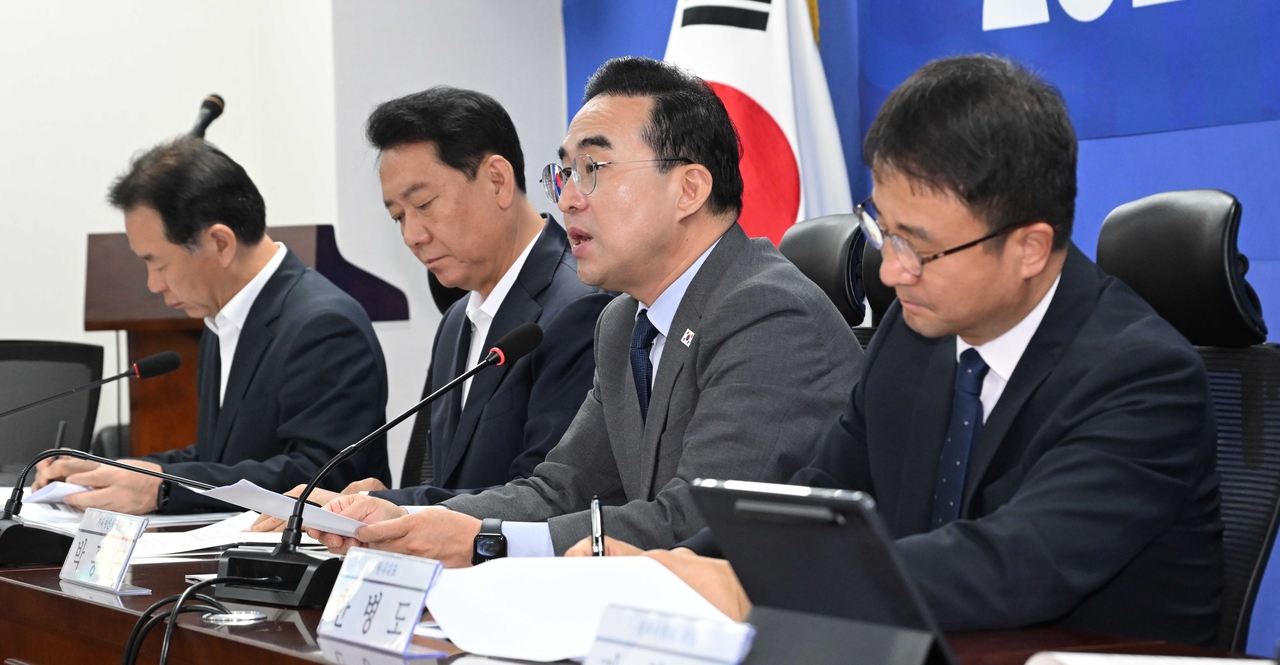
The Democratic Party of Korea met with the government Tuesday to discuss the 2027 budget proposal, urging that it reflect a clear national investment direction — including three major mega-projects and growth led by youth and regional communities. The government said it would focus next year's budget on fully supporting the three mega-projects and AI, and on expanding future growth engines.
"The 2027 budget proposal must clearly lay out the direction of national investment that will drive South Korea's great leap forward," Democratic Party floor leader Han Byung-do said at the party-government consultation at the National Assembly Members' Office Building. "Above all, fiscal resources must be concentrated on securing leadership in future industries."
Han added that national tax revenue is expected to rise sharply next year, buoyed by a semiconductor boom. "With greater fiscal room available, we need to set priorities on where and how much to invest first, and devise a smart approach to strategically channeling resources into diverse fiscal needs — including youth, regionally led growth and future strategy," he said.
Kwon Chil-seung, chair of the party's policy committee, said active fiscal engagement would be essential to support not only South Korea's great leap forward but also a broader transformation. "Strategic investment is needed to help South Korea advance in the global AI race, as well as mega-project investment for the country's future over the next 30 years," he said.
Kwon also called for strategic budget allocations to support regionally led growth, and said investment was needed to actively address pressing challenges — including expanding youth employment, guaranteeing income across life stages, and tackling structural problems in coastal communities through initiatives such as the "sunshine income village" program. He also noted that the budget includes funds to complete repayment of public money injected during the IMF financial crisis.
Minister of Planning and Budget Park Hong-keun said the government would establish a new future-response fund to avoid spending the increased tax revenue from the semiconductor boom on one-time expenditures. The fund would serve as a strategic investment platform to support a rebound in the potential growth rate and as a fiscal stabilizer to ease revenue volatility, he said.
Park added that the government had pursued high-intensity expenditure restructuring alongside the large tax revenue increase to promote efficient fiscal management. "In particular, we fundamentally reformed mandatory spending — including overhauling the structure linking education grants to domestic tax revenue for the first time in 55 years — and achieved meaningful results," he said.
Park said the investment priorities of the 2027 budget are full support for the three mega-projects and AI, expansion of future growth engines, comprehensive support for youth at each stage of development, addressing K-shaped polarization and promoting inclusive growth, and ensuring public safety and peace on the Korean Peninsula. "We will support South Korea's own AI models in building global competitiveness and open an AI-based society where everyone can benefit from AI," he said.
addressh@heraldcorp.com




