![[Reuters]](https://wimg.heraldcorp.com/news/cms/2026/08/24/rcv.YNA.20260817.PRU20260817273701009_P1.jpg)
Korean investors have been net selling Nvidia ahead of the company's earnings release early Thursday, signaling a more cautious stance toward AI stocks. The yield on 10-year US Treasury bonds has held around 4.7 percent. Massive capital outlays flowing into AI data centers, combined with rising earnings expectations, have weighed on sentiment. Whether this earnings report confirms that AI investment is translating into improved profitability — and where interest rates head after the Jackson Hole meeting — is expected to determine the direction of AI stock investment going forward.
According to SEIBRO, the securities information portal of the Korea Securities Depository, domestic investors net sold approximately 3.64 trillion won ($2.63 billion) worth of Nvidia this month. Over the same period, they also net sold SOXL — a triple-leveraged semiconductor ETF — worth about 10.49 trillion won, Palantir at about 6.66 trillion won and Microsoft at about 5.16 trillion won. The trend reflects a broad retreat from leveraged products and individual AI and technology stocks.
The weakening appetite for individual technology stocks is also visible in retail investors' ETF buying patterns. According to Koscom ETF Check, the top net purchase by retail investors over the past week was "TIGER US S&P500," an index-tracking product, at 146.2 billion won. With elevated US Treasury yields increasing the valuation burden on growth stocks, investors appear to be shifting toward diversified exposure through benchmark indexes such as the S&P 500 and Nasdaq 100, rather than making direct bets on individual AI names.
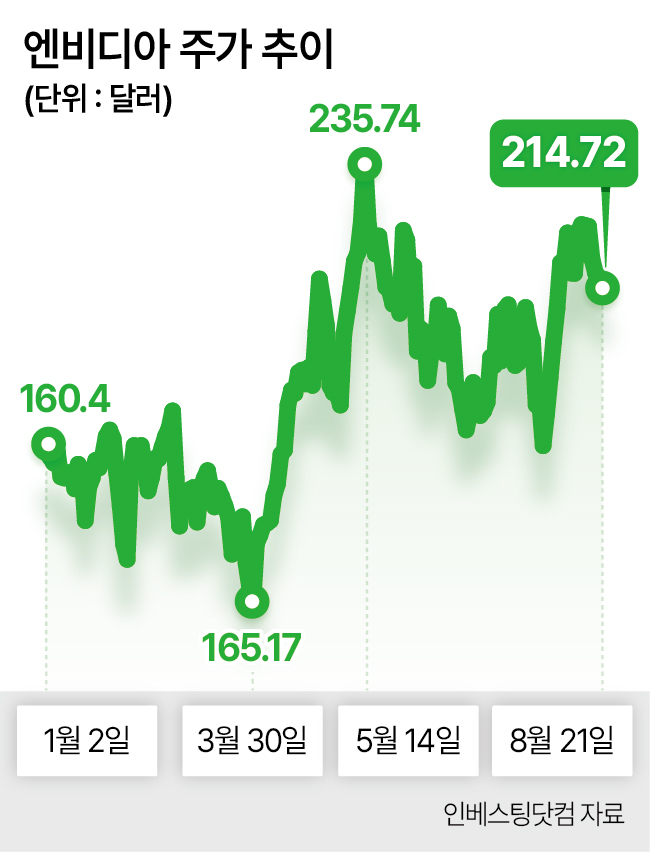
The cooling sentiment toward individual AI stocks reflects a shift in what the market now demands. Investors are less focused on headline earnings figures and more on whether the current growth trajectory can be sustained. Alphabet and Microsoft both beat market expectations, yet their share prices fell immediately after their earnings releases as concerns mounted over the capital expenditure burden tied to expanding AI investment. Nvidia faces the same scrutiny: this earnings report must show not only how much the company earned, but whether AI investment will continue to drive profit growth.
Adding to market unease is the fact that Nvidia is also helping to finance the AI infrastructure buildout of OpenAI, one of its own GPU customers. Nvidia has stepped in with investment and guarantees as OpenAI constructs its data centers. Questions are emerging over whether this amounts to "circular financing" — Nvidia's funding effectively boosting OpenAI's AI spending and, in turn, its own GPU demand. Ultimately, the key question is whether current GPU demand is being driven by genuine AI service revenue.
Nvidia's upcoming earnings and the Jackson Hole meeting are expected to offer the market some answers. Investors are watching closely to see whether Nvidia's profits are keeping pace with its surging investment, and what signals the Federal Reserve sends on interest rate cuts. Nvidia's equity investment over the past four quarters totaled $66.9 billion, exceeding the $47 billion it returned to shareholders through dividends and buybacks. Given the scale of that investment, whether this earnings report shows actual profit growth and improved profitability will be critical.
Interest rate direction deserves as much attention as the earnings themselves. If the 10-year US Treasury yield stabilizes without breaching its recent high, investor interest could continue to flow toward AI value-chain and infrastructure-related stocks that stand to benefit from expanding AI investment and improving profitability. If yields push above that recent high and continue rising, however, investment attention may shift away from companies making large-scale growth bets toward those with stronger shareholder returns and higher capital efficiency.
"If the 10-year Treasury yield does not exceed its recent high after Nvidia's earnings and the Jackson Hole meeting, AI value-chain and infrastructure-related companies are worth watching," said Lee Jae-man, a researcher at Hana Securities. "If rates do rise above the recent high, investors should pay closer attention to companies that can boost their financial leverage and improve return on equity through shareholder returns, rather than those investing heavily for growth."

kacew@heraldcorp.com