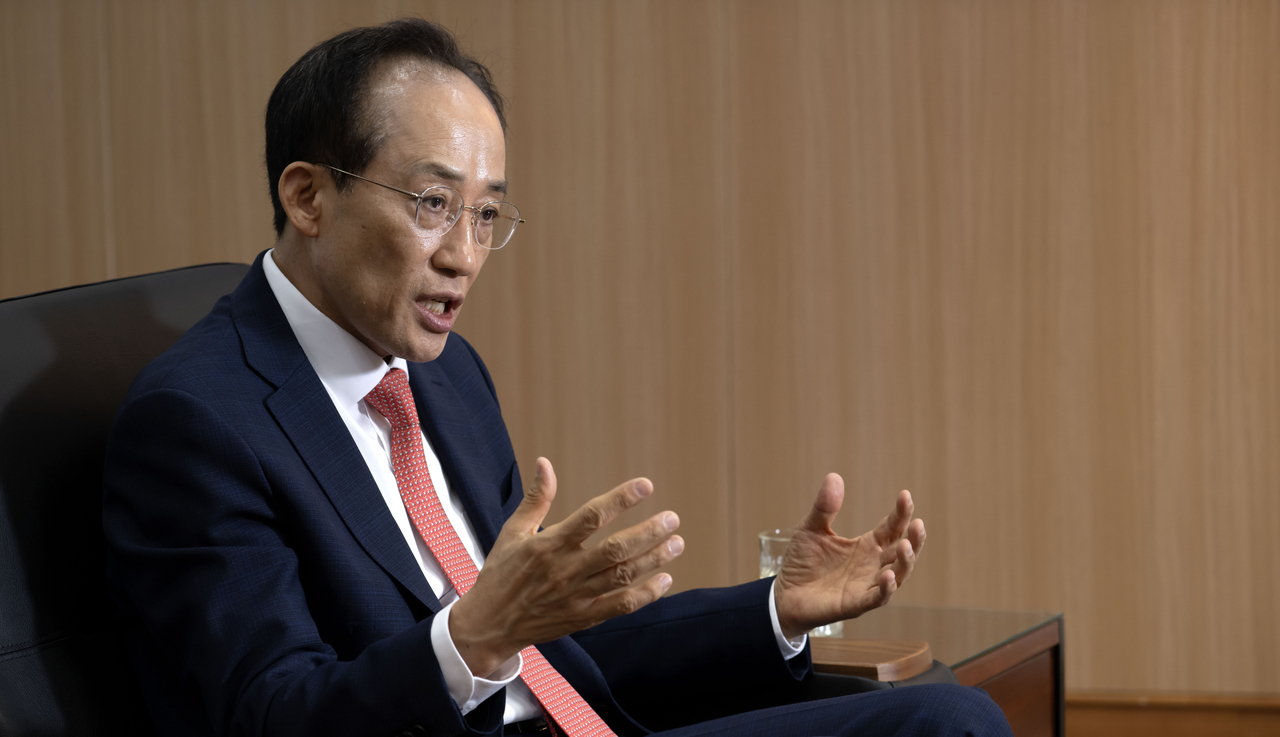
Daegu Mayor Choo Kyung-ho has unveiled a plan to use the second round of public agency relocations as a catalyst for building a future industrial ecosystem in the city. Rather than simply adding to the number of public institutions, the strategy is to attract financial and research institutions that can connect with local industries — including robotics, mobility and AI — and create an ecosystem spanning corporate support, research and development, and talent cultivation.
The government is expected to announce its second-round public agency relocation plan soon. Daegu has been working to attract financial institutions, including the Industrial Bank of Korea, as well as industry and R&D-related bodies such as the Korea Institute for Advancement of Technology.
Daegu is particularly focused on the synergy between relocating agencies and local industries. The city is home to a concentration of small and mid-sized companies in robotics, mobility, AI, machinery, metals and components. City officials believe that bringing in financial institutions to support corporate lending and research institutions to back technology development would both strengthen the competitiveness of existing industries and accelerate the growth of advanced sectors.
"We are not asking just any public agency to come down unconditionally," Choo said in an interview at the Sanggyeok annex of Daegu City Hall on Friday. "What we are saying is that if financial institutions focused on supporting small and mid-sized businesses relocate here, that would be a great fit for the local industrial ecosystem. If R&D institutions join as well, they can create synergies by working in tandem with local industries."
Daegu is also actively promoting the industrial base of the Daegu-North Gyeongsang Province region as part of its pitch to attract agencies. Officials point to diverse industrial infrastructure spanning semiconductors, robotics, nuclear energy, forestry, agriculture and culture, and note that the planned Daegu-North Gyeongsang Province new airport and Yeongil Bay port would further secure transportation and logistics links connecting the region domestically and abroad.
The city is also paying close attention to settlement conditions, widely cited as one of the key challenges in relocating public agencies outside the Greater Seoul area. Because employees moving from the metropolitan area must often bring their families, officials say housing, education, transportation and cultural amenities all need to be in place for people to genuinely put down roots in the region.
"Daegu offers the best location in the country," Choo said. "There may be vague anxieties about a new base and concerns about education, transportation and housing, but Daegu has the advantage of relatively lower housing prices compared with Seoul and the metropolitan area."
Choo said the city intends to factor in the living conditions of employees and their families when selecting sites for relocating agencies. "If relevant institutions show interest in Daegu, we will not simply send them to the outskirts — we want to provide optimal locations where they can settle with their children's education in mind," he said. "We need to present an environment where people can live and work in Daegu without anxiety, and that is what will make relocating agencies take notice."
Choo also highlighted the city's accessibility to the Greater Seoul area and its leisure offerings as competitive advantages. "It takes about one hour and 40 minutes to Seoul by KTX, so access to the metropolitan area is excellent, and broadly speaking, the sea is also about an hour away," he said. "Choosing Daegu can only be a good choice."
To secure the talent that relocating agencies will need, the city plans to make full use of local universities. The strategy involves cultivating industry-ready talent through institutions such as the Daegu Gyeongbuk Institute of Science and Technology, Kyungpook National University, Keimyung University and Yeungnam University, and building a structure that connects local companies with the incoming public agencies.
"The large comprehensive universities in the region are continuously producing high-caliber talent," Choo said. "The Daegu area has a concentration of advanced machinery industries closely tied to that talent pool, making the city outstanding not only for economic activity but also in terms of electricity, water and land availability."
mp1256@heraldcorp.com