![An aerial view of Daegyo Apartment in Yeouido, Seoul [provided by the Daegyo Apartment Reconstruction Association]](https://wimg.heraldcorp.com/news/cms/2026/08/21/news-p.v1.20250228.90f467ca59d443be9e8b7669c19bb167_P1.jpg)
Reconstruction complexes in Yeouido, Seoul are entering the resident relocation phase at an unusually rapid pace. Industry observers say major construction companies, backed by the strong profitability of these projects, have stepped in to arrange supplemental relocation financing — accelerating timelines that were already shortened through fast-track integrated planning and trust-based development schemes.
According to the urban redevelopment industry on Friday, the Daegyo Apartment reconstruction association sent relocation notices to its members earlier this week. The relocation period runs from Oct. 1 through March 31 next year. The association aims to complete the move-out, proceed with demolition and break ground by late 2027.
Daegyo Apartment is the fastest-moving reconstruction project among Yeouido complexes. It received management and disposal plan approval on May 19 — roughly two years and four months after the association was established in January 2024. The project will replace the existing 576 units with "Raemian Wights," a new complex of up to 49 stories and 912 units. Samsung C&T's construction division is the contractor. The association selected Hana Bank as its primary relocation loan provider through competitive bidding.
During the contractor selection process last year, Samsung C&T's construction division offered to arrange relocation financing — combining the standard bank loan and supplemental funds — up to a loan-to-value ratio of 100%. Under this arrangement, members who cannot cover their costs through the standard bank loan alone can access additional funds secured through the contractor's own credit.
Hanyang Apartment in Yeouido is also preparing to relocate, following closely behind Daegyo. Hanyang received management and disposal plan approval on July 30 and plans to begin relocations in October or November. The project will redevelop the existing 588 units into a complex of up to 57 stories and 992 units. KB Real Estate Trust is the project developer and Hyundai E&C is the contractor, with the premium "DH" brand to be applied.
Hanyang also cut its permitting timeline significantly, receiving approval roughly two months after filing its management and disposal plan application in late May. When Hyundai E&C won the Hanyang contract in 2024, it similarly made financing terms a central part of its bid. Reflecting Yeouido's status at the time as an unregulated zone, the company proposed covering a combined loan-to-value ratio of 100% — 70% through the standard bank loan and an additional 30% arranged by Hyundai E&C.
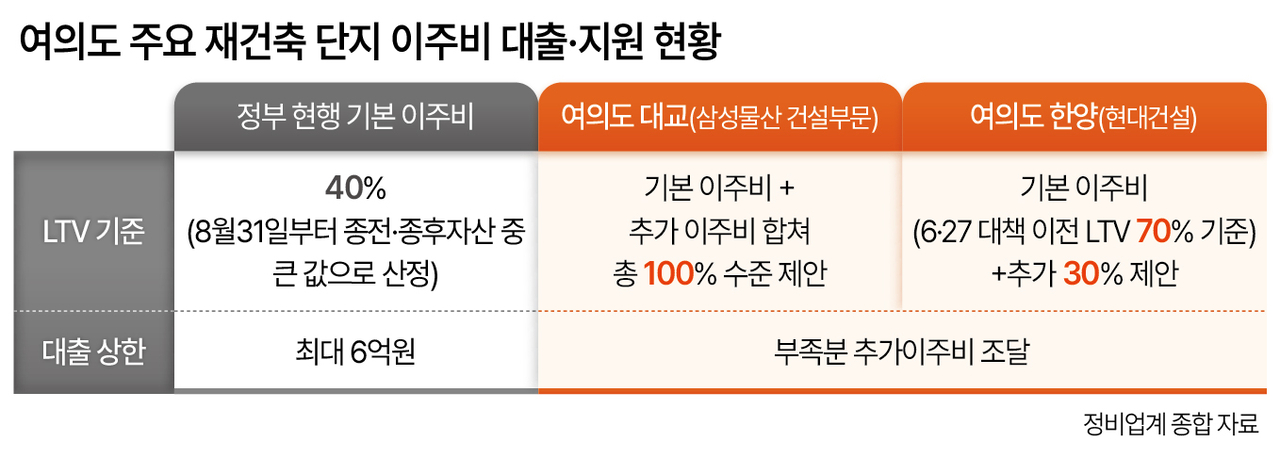
However, relocation loan regulations have tightened since those bids were submitted, and both complexes are now moving residents this year under stricter rules. Following the June 27 household debt measures, relocation loans for redevelopment projects are capped at 600 million won ($431,000). After the Oct. 15 measures announced last year designated all of Seoul as a regulated zone, the applicable loan-to-value ratio for Yeouido was cut from 70% to 40%. The government subsequently differentiated mortgage caps for high-value home purchases — ranging from 200 million to 600 million won depending on the property price — but the 600 million won ceiling on relocation loans was kept regardless of property value.
The government recently concluded that relocation financing constraints could slow the pace of redevelopment projects and adjusted some of the related rules. Under a housing supply package announced Wednesday, starting next Sunday the loan-to-value ratio for relocation loans will be calculated using whichever is higher — the pre-reconstruction assessed value of the existing unit or the post-reconstruction assessed value — as the collateral base.
Previously, the loan-to-value ratio was calculated solely on the pre-reconstruction assessed value. Going forward, lenders will be able to use the post-reconstruction assessed value, which is typically higher. Financial authorities expect the change to increase average relocation loan eligibility by about 30%.
The 40% loan-to-value cap for regulated zones and the 600 million won ceiling on relocation loans will remain in place, however. For association members whose financing needs exceed the standard loan limit, whether a contractor can arrange supplemental relocation funds will be a key variable.
The government also unveiled a measure to support supplemental relocation financing. Starting in January, the Korea Housing Finance Corp. plans to introduce a new guarantee product covering supplemental relocation loans.
Against this backdrop, the contractor selection process for Yeouido reconstruction projects has increasingly favored large builders with the financial capacity to provide supplemental relocation support. At Mokhwa Apartment, Samsung C&T has submitted consecutive sole bids, making a negotiated contract increasingly likely. At Gwangjang Apartment complex 38-1, Hyundai E&C was the only company to attend two rounds of project briefings, raising the prospect of a negotiated contract there as well.
Some observers warn that the gap in financing conditions between high-value projects backed by major contractors and less profitable redevelopment sites could translate into widening disparities in relocation and construction timelines.
Ham Young-jin, head of the real estate research lab at Woori Bank, said that in areas such as Yeouido, arranging relocation financing up to a loan-to-value ratio of 100% based on the pre-reconstruction assessed value could yield more than 1 billion won in supplemental funds alone. "At that level, residents would have little difficulty finding alternative rental housing nearby, which would help accelerate the pace of redevelopment," he said.
He added, however, that because supplemental relocation funds are arranged through credit extended by large construction companies, contractors have no choice but to be selective about which projects they support. "Redevelopment sites with weaker profitability may find it difficult to secure the same level of financial support," he said.

quq@heraldcorp.com