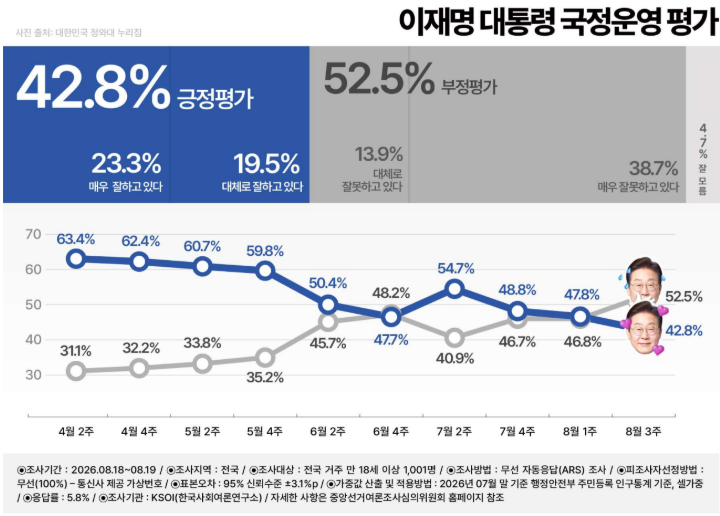
A poll released Thursday showed President Lee Jae Myung's approval rating falling to 42.8%, the lowest since he took office. The figure dropped 5 percentage points from the previous survey, conducted in the first week of August, which recorded 47.8%.
The Korea Society Opinion Institute (KSOI) surveyed 1,001 adults aged 19 and older nationwide on Tuesday and Wednesday, finding that approval of Lee's job performance stood at 42.8%. The rating has consistently declined in the same recurring poll: 54.7% in the second week of July, 48.8% in the fourth week of July, 47.8% in the first week of August, and 42.8% in the third week of August.
The disapproval rating rose 5.7 percentage points from the previous survey to 52.5%. It, too, has climbed consistently — from 40.9% in the second week of July to 46.7% in the fourth week of July, 46.8% in the first week of August, and 52.5% in the third week of August.
KSOI said the decline appeared to stem mainly from the erosion of Lee's core support base, including moderates, voters in their 40s and 50s, and progressive-leaning respondents.
In the same poll, "economic recovery" ranked both as the area where respondents most believed Lee was performing well and the area where they most believed he was falling short. On the positive side, economic recovery led at 16.6%, followed by diplomacy and security at 14.9%, welfare and labor at 7.7%, and national unity at 5.3%.
On the negative side, economic recovery also topped the list at 19.1%, followed by rooting out insurrection forces at 16.1%, national unity at 13.9%, and diplomacy and security at 10.1%.
Party support ratings rose for both the Democratic Party of Korea and the People Power Party. The Democratic Party gained 1.4 percentage points from the previous survey to reach 42.5%, while the PPP also gained 1.4 percentage points to reach 32.0%. The gap between the two parties held steady at 10.5 percentage points, unchanged from the previous poll.
On the Democratic Party's numbers, KSOI said the party's national convention had reversed a downward trend, but added that the convention effect from the launch of the new leadership appeared minimal. The institute noted that support among the party's core demographic of voters in their 40s and 50s had declined, and that the gap with the PPP among moderates had also narrowed.
Respondents were more pessimistic than optimistic about how newly elected Democratic Party leader Kim Min-seok would manage the party. The poll found 38.0% held a positive outlook on his leadership against 44.0% who held a negative one, suggesting the convention outcome had not translated into broad expectations for Kim.
However, KSOI noted that positive sentiment was clearly visible among Democratic Party supporters, and said the early test of Kim's leadership would be whether he could heal internal divisions and build stable cooperation among the party, government and presidential office — a goal the new leader had championed during the convention under the banner of "party-government-office alignment."
When asked what role the Democratic Party's new leadership should prioritize, respondents ranked cooperation with the opposition first at 24.8%, followed by internal party unity at 17.6%, party-government-office cooperation at 16.7%, and advancing reform at 15.7%. KSOI interpreted the results as reflecting a dual public expectation: that the ruling party's new leadership both support the administration's governance and help ease political confrontation.
The survey was conducted via automated response system using virtual mobile numbers provided by the three major telecommunications carriers. It carries a 95% confidence level, a margin of error of plus or minus 3.1 percentage points, and a response rate of 5.8%. Further details are available on the National Election Survey Deliberation Commission website.
raining@heraldcorp.com