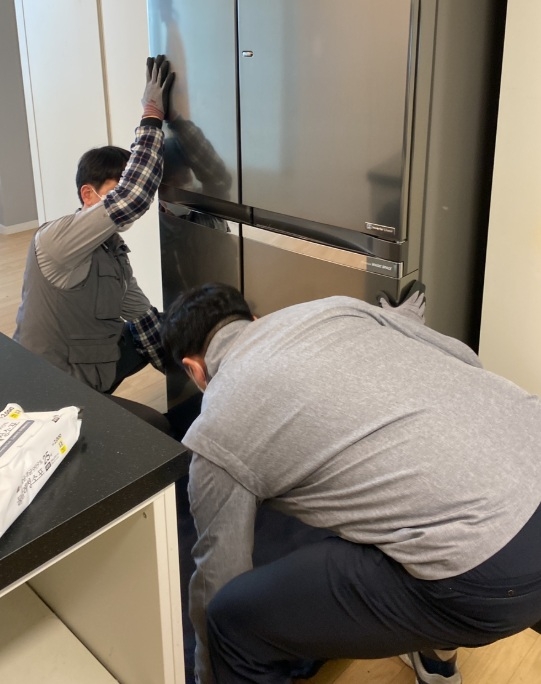
Consumers who purchase large home appliances such as refrigerators, washing machines and air conditioners will be able to ask delivery workers to take away their old units at the time of installation.
The Ministry of Climate, Environment and Energy announced Thursday that it will hold a legislative notice period for proposed amendments to the enforcement rules of the Waste Management Act and the Electronic Products Resource Circulation Act, running from Friday through Oct. 1.
Under the proposed changes, retailers and manufacturers with recycling obligations would be required to collect, free of charge, discarded units of the same product category when a consumer purchases a new appliance.
The draft amendment to the Electronic Products Resource Circulation Act enforcement rules specifies 11 categories of large appliances subject to mandatory free collection: refrigerators, washing machines, air conditioners, treadmills, electric massage chairs, televisions, photocopiers, dish dryers and dishwashers, electric water purifiers, vending machines, and clothes dryers and care machines.
The ministry said the revision would eliminate confusion in the field and make it easier for consumers to dispose of old home appliances.
The draft amendment also adds new items to the list of materials handled by future waste resource collection centers — including drive motors, fuel cells, wind turbine nacelles and blades, and ESS units, all key components of electric vehicles, hybrid vehicles and hydrogen vehicles. Currently, such centers mainly handle spent batteries from electric vehicles and waste panels from solar power facilities.
The draft amendment to the Waste Management Act enforcement rules would restrict the recycling of spent lithium, electric vehicle and drive batteries as raw materials to cases where those materials are used in domestic manufacturing. Under current rules, recycled raw materials must be used solely for product manufacturing purposes, which leaves room for their use in overseas manufacturing.
The nickel content threshold for recycling spent battery raw materials would be raised from 10 percent to 13 percent by weight, and standards on hazardous substance content in raw materials would be removed.
The Waste Management Act amendment would also extend the transport and storage standards currently applied only to spent electric vehicle batteries to cover spent batteries from hybrid vehicles, hydrogen vehicles, construction machinery, agricultural machinery and ESS units.
The proposal further calls for stricter safety measures for transporting and storing damaged or deformed "high-risk spent batteries," requiring them to be placed in sealed containers filled with absorbent material, kept with spill-response equipment on hand, and subjected to insulation measures.
The Electronic Products Resource Circulation Act enforcement rule amendment is set to take effect Dec. 10, while work on the Waste Management Act enforcement rule amendment is expected to be completed by the end of the year.
thlee@heraldcorp.com