
![Members of the Yongsan Park Preservation Residents' Association hold a rally in front of Yongsan Children's Garden in Seoul on Wednesday. [Yonhap]](https://wimg.heraldcorp.com/news/cms/2026/08/20/rcv.YNA.20260819.PYH2026081921160001300_P1.jpg)
The government has said it is reviewing the use of sites within Yongsan Park for large-scale housing supply, but the unique nature of the land means actual move-in could be at least a decade away, industry observers say.
The government is currently pushing to build large numbers of homes across four sites: Yongsan Children's Garden, Yongsan Park itself, the International Business District, Camp Kim and the former US military transportation unit compound. Of these, Camp Kim is the only site where the government and the Seoul Metropolitan Government have broadly aligned on the scale of housing supply — yet even that parcel has yet to break ground since its return in 2020.
Camp Kim, classified as a "scattered peripheral site" under the Special Act on Yongsan Park, is still undergoing contamination cleanup following its return by US forces in December 2020. The discovery of cultural artifacts during the process delayed the project by roughly a year, and the government now estimates that groundbreaking could come no earlier than 2029 — nine years after the handover.
Groundwater contamination around Camp Kim remains particularly severe. According to the Seoul Metropolitan Government, total petroleum hydrocarbons (TPH) in the Camp Kim groundwater stood at 46.1 milligrams per liter as of May — about 31 times the remediation standard of 1.5 mg/L or below. The city has spent 11.7 billion won ($8.34 million) cleaning up groundwater around Noksapyeong Station and Camp Kim since 2001 through last year, yet the work is still ongoing.
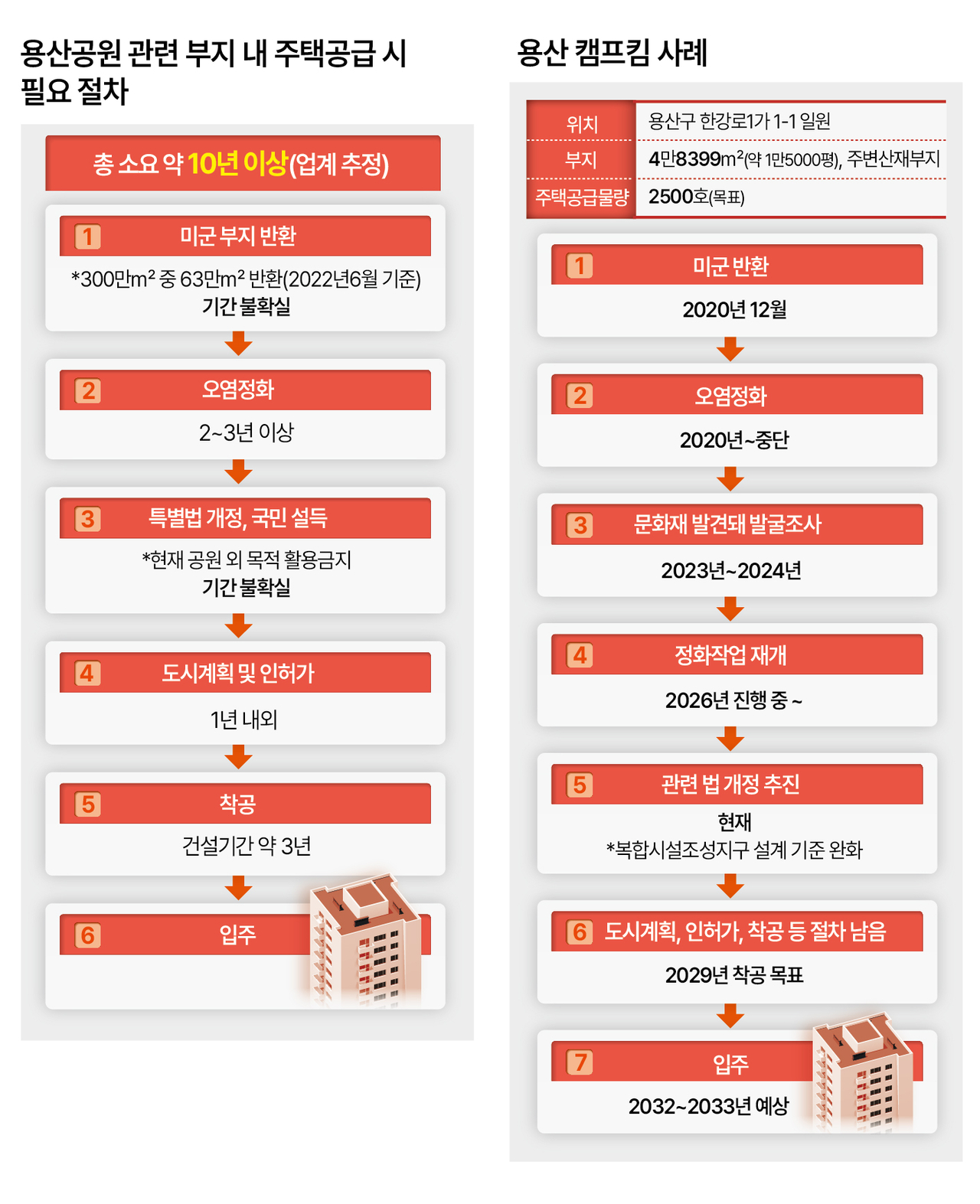
Housing construction on the main park site is outright prohibited under the Special Act on Yongsan Park, and the land has not yet been fully returned by US forces — another obstacle to any rapid timeline. Industry experts say that even after a site is handed back, the full sequence takes a minimum of 10 years: contamination cleanup (two to three years), revision of the special act, urban planning and permitting (about one year), construction (at least three years) and finally move-in.
Unexpected delays are also possible once development actually begins. Ha Jun-kyung, a senior fellow, appeared on TV Chosun's "News Parade" on Wednesday and said the ground beneath sites such as Yongsan Children's Garden "is heavily contaminated, and if it is to be used for housing, the soil will have to be excavated" and "hauled away elsewhere for remediation." His remarks implied that the true extent of contamination may not be known until digging actually starts.
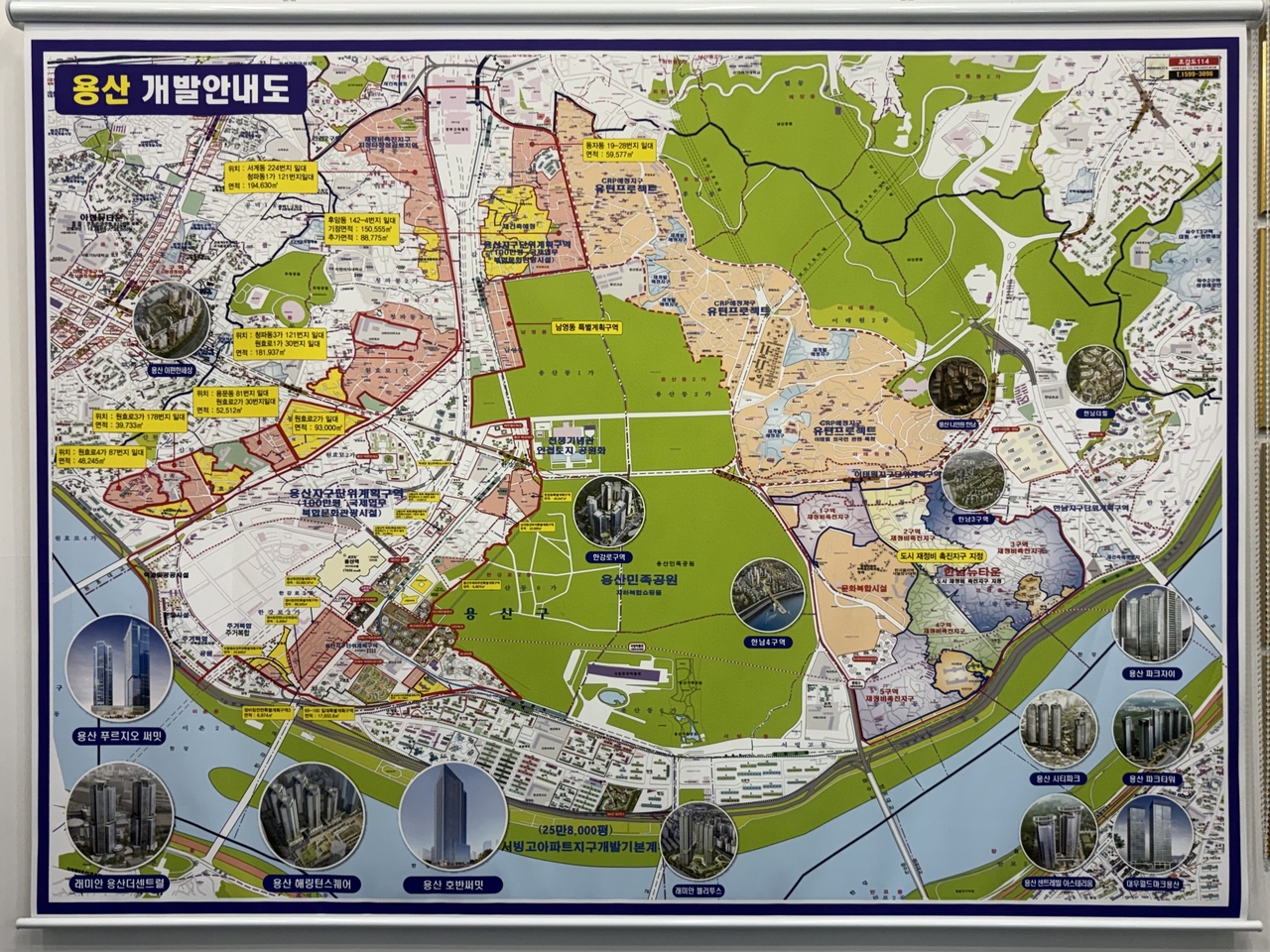
Even if the government opts for a workaround — building only on already-returned parcels — overcoming opposition from local governments and residents will not be quick. As the minister noted, some portions of the roughly 3 million-square-meter total Yongsan site do lack green-space functions.
But those areas, while not currently green space, could serve as such. Incorporated parcels such as the military apartment complex and the former Defense Acquisition Program Administration (DAPA) site were designated as ecological green corridors linking Namsan and Yongsan Park under the Ministry of Land, Infrastructure and Transport's revised 2021 comprehensive master plan. The temporarily opened officers' quarters are also currently used as a multipurpose cultural space for the public, meaning a change in function would eliminate that facility.
The Democratic Party said it would conduct its own polling on the Yongsan Park housing supply proposal, but Yongsan-gu residents have already made their opposition clear. Funeral wreaths were placed at the children's garden in protest of the government's announcement, and on Wednesday more than 500 people gathered at nearby Huimang Park to demand the withdrawal of the plan to develop housing on the park site.
![Location of sites including the military apartment complex. [Ministry of Land, Infrastructure and Transport 2021 Comprehensive Master Plan revision]](https://wimg.heraldcorp.com/news/cms/2026/08/20/news-p.v1.20260820.0617009935d54cea8ad0dbb8c55610e5_P1.jpg)
Yongsan Park is Seoul's largest green space and carries the designation of a national park, meaning the backlash could grow into a nationwide controversy. Even public housing there would be difficult to defend against charges of privatizing park views and access — a so-called "lottery supply" that benefits only a lucky few. The former DAPA site and military apartment complex that the minister mentioned occupy the highest ground in the park, commanding views across the entire Yongsan Park area. Whether it is appropriate for a handful of residents to monopolize the vistas of a national park meant for all citizens is a question of public interest that is unlikely to go away.
Doubts also surround the actual impact on housing supply. Lee Eun-hyung, a research fellow at the Korea Research Institute for Construction Policy, said that "even assuming two complexes the size of Helio City in Songpa-gu — a mega-development of roughly 10,000 units on about 350,000 square meters — could fit on the site, it is hard to see that stabilizing Seoul's housing market over the long term." Lee added that a large-scale youth housing supply "might affect the small-unit market in Yongsan to some degree, but the impact on the mid-size units that people actually want would be minimal," warning that the result could be "not price stability, but a glut of units nobody wants."
Within the industry, voices are growing that a more realistic alternative would be to strengthen support for existing redevelopment projects and third-generation new towns, given the constraints on both speed and volume at the Yongsan site.
Park Hap-su, an adjunct professor at Konkuk University's Graduate School of Real Estate, said that "even the parcels currently lacking green-space functions are all slated to become part of the park," adding that "it is hard to understand why, in violation of that principle and with housing supply projects already under way elsewhere, a site with no fixed timeline is being newly brought into the picture." Another real estate expert said that "relocating the Ministry of National Defense from Yongsan and selling off that land would generate proceeds of 18 trillion won, enough to acquire sites for 90,000 units on the outskirts," and called for "a cold-eyed assessment of which choice actually delivers volume and speed."
hope@heraldcorp.com




