
The government is moving away from tracking unemployment benefit recipients' job-search activities by headcount and toward a points-based "employment activity mileage" system that rewards effort and difficulty — crediting interviews and vocational training more heavily than routine tasks.
A pilot targeting repeat unemployment benefit recipients is set to launch in September, with the full mileage system and eligibility criteria to be built out from 2027. Once a recipient accumulates enough points, benefits will be paid out automatically, and AI will screen for fraudulent or perfunctory job-search activity.
The Ministry of Employment and Labor unveiled the plan Thursday in its "National Employment Service Innovation Strategy." Under the plan, routine administrative tasks will be handed off to AI and computer systems, and all 102 employment centers nationwide will be restructured to focus on job counseling and placement matching. Individual pilot programs will run in the second half of this year, an integrated pilot covering one or two regions is planned for 2027, and the model will roll out to other employment centers across the country from 2028.
More than 2 million job seekers visit employment centers each year, yet a single unemployment benefit case worker handles an average of more than 70 benefit-approval tasks per day, leaving little room for in-depth, individualized counseling. The government says this administrative burden has been the main obstacle to providing tailored support.
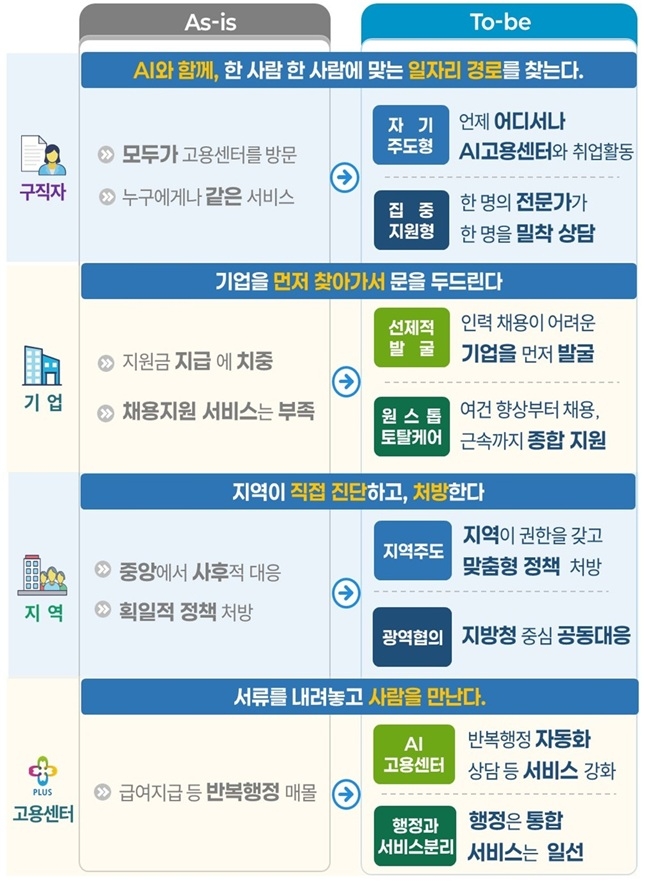
The government's first priority is reforming how job-search activity is verified under both the unemployment benefit program and the National Employment Support Program.
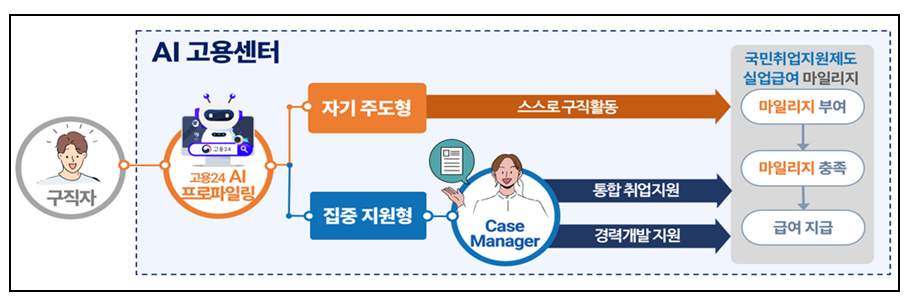
Each job seeker will set a target point score as part of an individual action plan, then accumulate mileage each time they engage in actual employment activities — counseling sessions, job interviews, vocational training and the like. Activities that demand more time and effort, such as vocational training or interviews, will carry higher point values than simpler tasks. Once the target mileage is reached, benefits or allowances will be paid automatically.
AI-assisted monitoring will also be strengthened. The system will analyze job seekers' activity records and flag cases suspected of being fraudulent or merely going through the motions, allowing staff to focus their scrutiny on those specific cases rather than reviewing every recipient's activity one by one.
The Ministry of Employment and Labor plans to run a related pilot focused on repeat unemployment benefit recipients in September. From 2027, a mileage function will be built into the Go24 employment platform, alongside revisions to benefit-approval and job-search recognition rules and the establishment of point criteria for each type of activity.
AI to classify job seekers; intensive counseling time up from 18 to 73.8 minutes
The mileage system is designed to work in tandem with the government's "My AI Employment Center" initiative.
The Go24 platform will be revamped so that AI can classify job seekers as either "self-directed" or "intensive support" types, drawing on survey responses, work history and employment administration data. Those who can manage their own job search will be guided toward online channels, while those who need professional help will receive concentrated counselor attention.
Under the National Employment Support Program, the government expects roughly 75 percent of participants to fall into the self-directed category and about 25 percent into the intensive support category. For unemployment benefit recipients, the intensive support share is projected to be under 10 percent. Given that about 1.7 million people receive unemployment benefits each year and about 300,000 participate in the National Employment Support Program, the government estimates that roughly 200,000 job seekers annually will need intensive in-person support.
Intensive support participants will be assigned a case manager who conducts one-on-one in-depth counseling and assesses the job seeker's competencies using an AI-based diagnostic tool called Job Care. The case manager will then provide close support covering not only vocational training, certification and job placement but also career transitions and long-term career development.
The plan does not call for large-scale new hiring. Instead, existing counseling staff will take on the case manager role with enhanced professional training. Employment centers nationwide employ about 4,900 people — roughly 1,900 are public service counselors and about 3,000 are civil servants, of whom approximately half hold vocational counseling positions.
A pilot of the National Employment Support Program run at the Daejeon Employment Center since May showed measurable results from redirecting counseling resources toward intensive support participants.
Some 86.8 percent of participants rated the pilot positively. Average in-person counseling time for intensive support participants rose more than fourfold, from 18 minutes to 73.8 minutes, and 95 percent of their sessions were conducted face to face. Among self-directed participants, by contrast, 94.4 percent of sessions were conducted remotely.
A total of 554 job-search activities were recorded during the pilot. Of those, 22.8 percent were psychological assessments, training sessions or center programs, while 77.2 percent were activities carried out independently by participants — including job applications, interviews and enrollment in private training courses.
Grant screening to be automated; 'AI hiring assistant' to support recruitment and retention
Administrative workloads at employment centers will also be sharply reduced.
Expanded data-sharing between government systems will allow unemployment benefit and corporate subsidy application forms to be filled out automatically, and grant screening will be automated in stages. A program to detect anomalies will also be deployed. The ministry is also considering scaling back some functions — including maternity protection and work-life balance subsidies — from 2027.
Administrative tasks such as evaluating contracted service providers, handling complex or unusual complaints, managing computer-system inquiries and investigating benefit fraud will be consolidated at the regional office level, freeing front-line employment centers to concentrate on job counseling and hiring support.
To support this shift, the employment service delivery structure will be reorganized into a three-tier hierarchy: headquarters, regional offices and employment centers.
Headquarters will oversee national employment policy guidelines and the employment service platform. Regional offices will handle metropolitan-level job program planning, labor market analysis and coordination with related agencies. The 102 front-line employment centers will focus on services such as dedicated job-seeker support and corporate recruitment assistance.
The approach to supporting businesses will also change. Where employment centers have historically concentrated on disbursing employment incentive grants, they will now proactively identify companies with hiring needs and provide support from recruitment through to employee retention.
By analyzing job postings on Go24 and administrative data from the employment insurance system, the centers will identify companies that repeatedly post the same vacancies, take an unusually long time to fill positions or see new hires leave quickly. On-site visits to industrial complexes and individual companies will complement this data-driven outreach.
Companies' hiring difficulties will be categorized by root cause — weak recruitment and selection skills, poor working conditions, or a shortage of suitable talent. Firms struggling to write job postings will receive a "recruitment clinic," those with issues around wages, working hours or the work environment will be connected to relevant support programs, and companies unable to find the right people will receive referrals of vocational training graduates and intensive-support job seekers.
The Go24 Firm Care AI feature will also be enhanced. Companies will be able to enter keywords and have AI draft a job posting, analyze the industry and required occupations, and suggest suitable candidates along with the reasons for each recommendation. Eligible employment subsidies will be recommended at the same time. A revamp of the related corporate recruitment page is set to begin in the second half of this year.
Regions to adjust national standards; youth age brackets and training requirements to be tailored locally
Regional employment policy will shift from uniform, centrally directed program delivery to a locally led model.
Regional offices will use employment insurance and other administrative data to analyze local industrial transitions and employment conditions, then work with local governments, labor and management representatives, and related agencies to design area-specific job policies. To underpin this, the government plans to enact legislation on regional employment revitalization and establish metropolitan-level consultative bodies.
Existing central government programs will also be made adjustable so that eligibility requirements and support periods can be tailored to local conditions. For example, in areas developing new industries — such as Jeonju's future mobility sector — the eligible age range for youth hiring subsidies could be expanded, while in regions facing industrial transition crises, such as Yeosu and Taean, requirements could be relaxed to allow workers to receive retraining before they lose their jobs.
The government will also pursue a block-grant model, allocating lump-sum budgets to regions so they can design and run their own job programs. Linked to local government settlement support initiatives, the approach would bundle vocational training tailored to local hiring demand, onboarding support for new hires and assistance with putting down roots in the region into a single package. Seven region- and industry-specific employment centers are already operating nationwide, having launched in February.
The personnel and evaluation systems at employment centers will also be overhauled. The existing "counseling" job series will be renamed "employment services," with defined career paths allowing staff to develop expertise in job-seeker support, vocational training or corporate assistance. Center directors will in principle be appointed from among those with employment service experience. Performance evaluations will move away from simple placement numbers toward measures of genuine service effort — the quality of job-seeker counseling and improvements in companies' working conditions.
In the second half of this year, the government will run individual pilots covering the My AI Employment Center initiative and a one-stop corporate recruitment total-care service. In 2027, it will select one or two regions for an integrated pilot that combines administrative and service separation with expanded online functions. From 2028, the pilot model will be rolled out to employment centers in other regions in stages.
"Employment centers must now hand routine, repetitive administrative work over to AI and fill that space with services that connect people to jobs," Labor Minister Kim Young-hoon said. "We will build employment centers into partners that walk alongside every citizen through their entire working life — from graduation to retirement."
fact0514@heraldcorp.com