![An image representing owner-executives. [Getty Images Bank]](https://wimg.heraldcorp.com/news/cms/2026/08/05/news-p.v1.20260805.377bd313314142a78bfc61b22b181809_P1.jpg)
As markets swing wildly, chairmen, chief executives and presidents of major companies have been buying shares in their own firms in growing numbers. Large open-market purchases by institutional investors such as the national pension fund once drew the most market attention, but owner-executives' buying sprees are now turning heads. Market watchers are reading the moves as an "undervaluation signal," interpreting them as a sign that insiders believe their companies' shares are trading below intrinsic value.
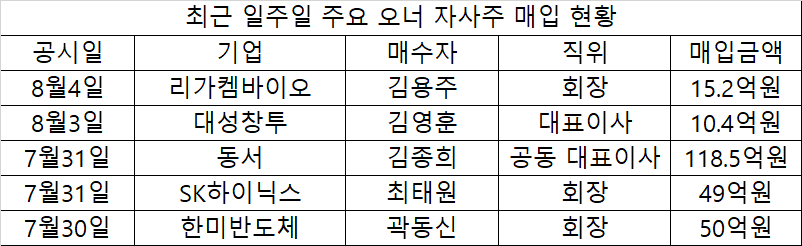
According to the Financial Supervisory Service's DART system, five cases were recorded in the week from July 28 to Tuesday in which a chairman, chief executive or president bought 1 billion won ($700,000) or more of their own company's shares on the open market under a personal name, excluding purchases made through institutions or corporate entities. Among the buyers: Kim Yong-ju, chairman of LigaChem Biosciences, who purchased 1.52 billion won worth of shares; Kim Young-hoon, chief executive of Daesung Private Equity, who bought 1.04 billion won worth; Kim Jong-hee, co-chief executive of Dongsuh, who acquired 11.85 billion won worth; and Kwak Dong-shin, chairman of Hanmi Semiconductor, who bought 5 billion won worth. Chey Tae-won, chairman of SK Group, purchased 4.9 billion won worth of SK Hynix shares.
Owner-executive share purchases have been rising noticeably of late. The number of open-market purchases of 1 billion won or more made personally by chairmen, chief executives and presidents stayed in single digits through the first half of the year — six in January, one in February, seven in March, six in April and five in May. The figure jumped to 11 in June and then hit 13 in July, the highest monthly total this year. This month, two such disclosures had already been filed through Tuesday. As stock market volatility has increased, more owner-executives are putting their own money on the line.
A common thread among the recent buyers is that most moved after their companies' share prices had already pulled back. Over the past month — from July 3 to Tuesday — SK Hynix shares fell 27.89 percent and LigaChem Biosciences dropped 23.09 percent. Hanmi Semiconductor declined 7.52 percent and Dongsuh slipped 0.59 percent. Only Daesung Private Equity bucked the trend, rising 1.86 percent over the same period.
LigaChem Biosciences offered a direct explanation for Chairman Kim Yong-ju's purchase. A company official said the acquisition reflected Kim's "conviction in the company's platform competitiveness and the medium-to-long-term value of its pipeline, despite the recent share price decline driven by rapid changes in the macro environment," adding that it was a decision rooted in responsible management. The company pledged to continue enhancing shareholder value through clinical progress and technology transfer deals.
It is worth distinguishing between an owner's personal share purchase and a company's buyback. When an owner buys shares personally, the executive commits their own funds directly — an act of responsible management. A corporate buyback and cancellation, by contrast, is a shareholder-return policy carried out using company funds.
Markets tend to read an owner's personal purchase as an insider's signal about the company's true worth. Kang So-hyun, a research fellow at the Korea Capital Market Institute, said executives "hold more information about a company's intrinsic value than outside investors do," adding that "if an insider buys company shares under their own name, it can be interpreted as a stronger signal that the company is undervalued."
Analysts caution, however, that an owner's share purchase alone cannot guarantee a subsequent rise in the share price. Without fundamental support — improved earnings, new orders or business growth — any price-lifting effect may be limited. Kang noted that investors "are at an informational disadvantage relative to insiders due to the asymmetry between internal management and outside shareholders," and said that "if the insider's judgment that the company is undervalued turns out to be correct, they are likely to continue holding the stake — but if not, the incentive to keep holding may not be strong."
hajun825@heraldcorp.com