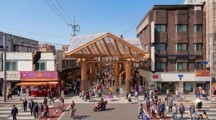
![A mixed-use development building recently completed at Hanoi's Starlake City, a project being developed by Daewoo Engineering & Construction. [Provided by Daewoo Engineering & Construction]](https://wimg.heraldcorp.com/news/cms/2026/08/19/news-p.v1.20260424.7ac3610becf949d9a646096932b61878_P1.jpg)
If you stick to simple lump-sum contracts, you have to secure profitability through cost-cutting or technical skill within a fixed budget. Contractors are shifting to the developer model because construction alone simply doesn't pay.
South Korean construction companies, long focused on lump-sum and EPC (engineering, procurement and construction) contracts, have of late been overhauling their business models to become "global developers" that lead investment and operations as well. The government is also backing the shift — combining contractors' technical expertise with financing and creating dedicated funds — to reposition Korean builders as comprehensive project leaders covering design, investment and operations.
From land acquisition to financing and development: Korean contractors reinvent themselves as developers
According to the Ministry of Land, Infrastructure and Transport, an analysis of domestic construction companies' overseas contract awards over the five years from 2020 to 2024 found that lump-sum contracts accounted for the largest share — 93% of the total. Cases where companies also pursued investment-led development made up no more than 7%.
South Korean builders first ventured overseas in 1965, when Hyundai E&C won a road construction contract in Thailand. Over the roughly 60 years since, the industry has climbed to fifth place globally by contract value, with cumulative overseas awards reaching $1 trillion. Yet until about two years ago, the overwhelming majority of that work remained simple lump-sum construction carried out to a client's specifications.
Industry officials say the limitations of the lump-sum model are stark. In the construction contracting market, emerging economies such as China and Turkey are surging by competing aggressively on cost. And because profitability must be squeezed out of a fixed budget, operating margins are structurally low.

In response, South Korean construction companies are declaring a shift to the higher-value developer model as a matter of survival in global markets. Daewoo Engineering & Construction is a leading example. The company recently announced its ambition to compete as an "integrated data center developer" — a strategy that goes beyond simple construction to encompass development, building and operations.
Daewoo Engineering & Construction's push into the AI sector as a developer draws on hands-on experience accumulated outside pure contracting. Its Vietnam Starlake City development, which began in the early 2000s, is a flagship example of overseas developer-led work: the company took the lead on land acquisition, compensation, permitting and financing across a 1,863,000-square-meter site.
"An apartment project wraps up in about three years, so you can lock in short-term returns," a Daewoo Engineering & Construction official said. "But a developer-type project — land acquisition, permitting, compensation, development — takes 10 to 20 years. It requires a long-term commitment from the people inside the company."
GS Engineering & Construction moved early in this direction, acquiring an eco-friendly subsidiary, GS Inima, and building out an investment-development model that handles everything from planning and financing to construction and long-term operations and maintenance for renewable energy plants. More recently, it entered the developer market for a new town project in Saudi Arabia — the Riyadh Dahya Al-Fursan project, roughly twice the size of Bundang — through its development subsidiary GS REDC. Working with Saudi Arabia's National Housing Company, it is developing a residential complex of 2,400 units on a site of about 186,000 square meters. The total project is valued at up to 30 trillion won ($21.3 billion).
In the United States, the company successfully completed "The Seventh," its first self-developed residential complex in Silicon Valley, and is now advancing a follow-on project called "400 Roq."
Hyundai Engineering has also recently demonstrated its developer capabilities by securing large-scale financing for a solar power project in the United States. The company signed a project financing agreement worth 460 billion won, with Korea Development Bank, Credit Agricole CIB, OCBC Bank and Siemens Financial Services participating as lenders.
The funds will go toward building the Hillsboro Solar Power Plant in Hill County, Texas, with a generation capacity of 200 MW. Commercial operations are targeted to begin by the end of next year, and once complete the plant is expected to produce about 476 gigawatt-hours of electricity annually.
Hanwha Engineering & Construction is also pursuing a business transformation to drive the data industry through the developer model. A prime example is the Changwon IDC cluster — a project being advanced in collaboration with the city of Changwon, the Korea Industrial Complex Corporation, LG CNS and asset management firms, covering everything from site development and project structuring to construction and future operations.
'Profits from both construction and development': PIS Fund backs cumulative W2.2tr in support
Domestic contractors see the shift to the developer model as a direct path to stronger profitability. "Simply put, it's a structure where the contractor also takes on the role of the project developer and captures the developer's profit as well," an official at a major construction company said. "Since you own the land, you can profit from selling the site, and since you can also handle the construction yourself, it builds your capabilities as a developer."
The government is also working to cultivate this "high-value flagship model" by strengthening policy financing for domestic contractors. The Ministry of Land, Infrastructure and Transport established the Global Plant, Infrastructure and Smart City (PIS) Fund through the Korea Overseas Infrastructure and Urban Development Corporation (KIND), aiming to move companies beyond simple lump-sum contracting toward investment-led development projects backed by financing. The ministry also plans to expand early-stage consulting participation in cooperation with multilateral development banks, structuring project terms to favor Korean companies from the outset.
The ministry has significantly expanded KIND's paid-in capital and eased investment limits to increase government-to-government infrastructure projects. The first phase of the PIS Fund has completed investments totaling 1.5 trillion won, bringing cumulative investment to 2.2 trillion won.
"The PIS Fund's second phase has completed the formation of a blind fund worth 700 billion won and is currently deploying capital," a KIND official said. "Detailed disbursement figures fall under confidentiality provisions of our investment agreements and cannot be disclosed."
hss@heraldcorp.com