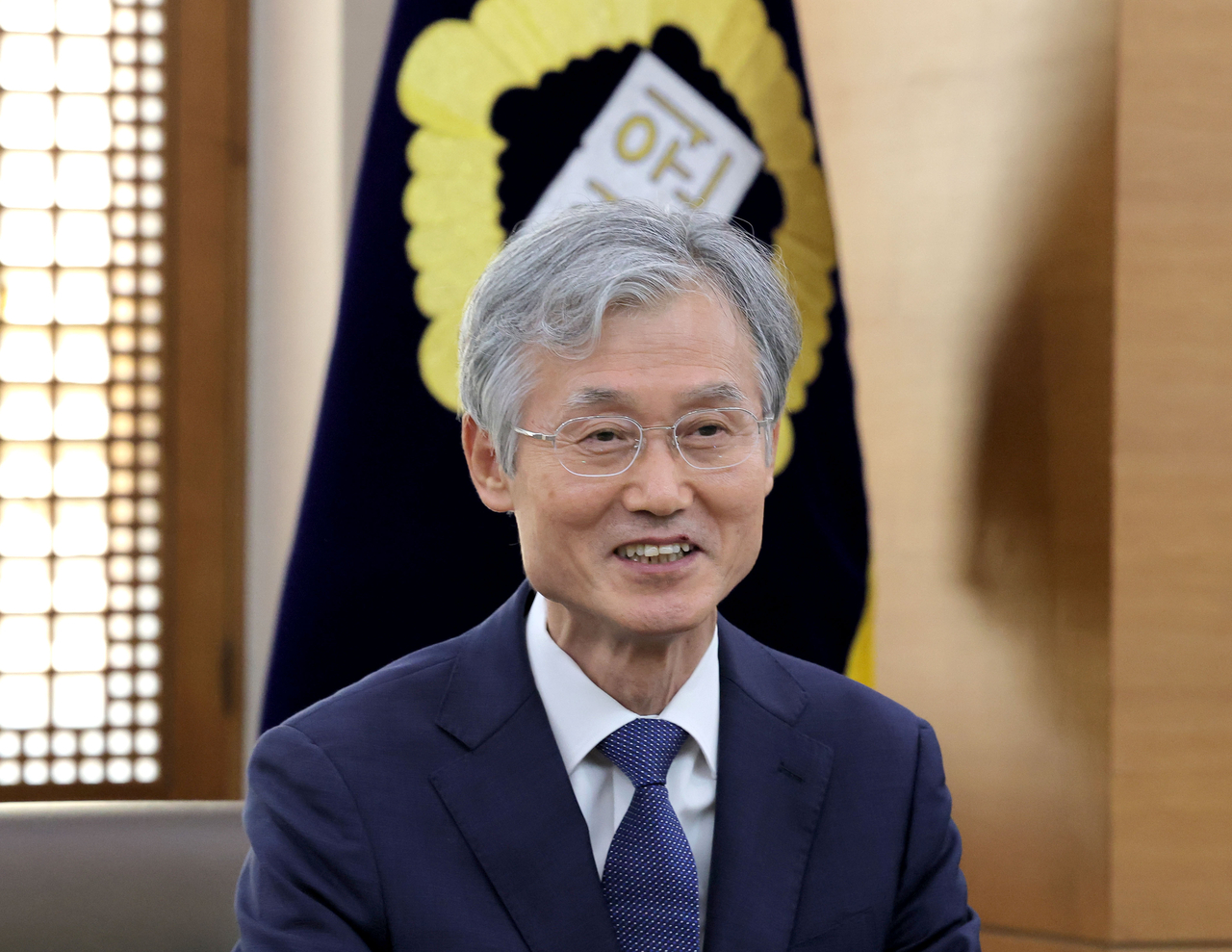
Chief Justice Jo Hee-dae has formally nominated Daegu District Court Senior Judge Son Bong-gi and Seoul High Court Senior Judge Kim Seong-su as Supreme Court candidates to President Lee Jae Myung. The move broke with convention: rather than coordinating with Cheong Wa Dae in advance and delivering the nominations in person, Jo submitted them in writing without prior consultation, raising the prospect of a fresh clash between the presidential office and the judiciary.
The Supreme Court said Tuesday that Jo had nominated Son as the successor to former Justice Roh Tae-ak, who retired in March, and Kim as the successor to Justice Lee Heung-gu, who is set to retire Sept. 7.
Under the Constitution, Supreme Court justices are appointed by the president upon the chief justice's recommendation, subject to National Assembly approval. While the nomination authority rests with the chief justice, established practice had been for both sides to agree on a candidate beforehand, after which the chief justice would visit the president in person to submit the recommendation.
Jo did not visit Cheong Wa Dae and instead submitted the nominations in writing. Notably, no prior consultation took place between the presidential office and the judiciary over the successor to Roh — a seat that has been vacant for five months.
The search for Roh's replacement had been mired in difficulty since early this year. In January, the Supreme Court justice candidate recommendation committee put forward four names — Seoul High Court judges Kim Min-gi and Park Sun-young, and senior judges Yun Seong-sik and Son — but Jo repeatedly deferred making a formal nomination.
Cheong Wa Dae was said to favor judge Kim Min-gi while the Supreme Court leaned toward senior judge Yun Seong-sik, and the two sides failed to bridge their differences. Roh ultimately retired in March without a successor in place, leaving the seat vacant for more than five months.
With Justice Lee Heung-gu's Sept. 7 retirement approaching and the prospect of two simultaneous vacancies looming, Jo moved to nominate both candidates at once. Whether President Lee will proceed with the appointment process remains uncertain, however, given that the nominations were made without prior coordination.
No president has ever rejected a chief justice's Supreme Court nomination, but that record reflects a history in which both sides agreed on candidates beforehand. Some within the ruling camp had previously floated the idea of impeaching Jo over his delays in making nominations, and the unilateral move could reignite that pressure.
Son, a native of Busan, graduated from Korea University's law school and built his career primarily in the Daegu and Ulsan regions. He was appointed chief judge of the Daegu District Court in 2019 through a court president candidate recommendation process and has been put forward as a Supreme Court candidate since 2021. His nomination is believed to be the first time a sitting district court senior judge has been formally recommended for the Supreme Court.
Kim, a native of Hampyeong in South Jeolla Province, graduated from Hanyang University's law school. In 2015, he presided over the appeal of former National Intelligence Service director Won Sei-hoon, who had been indicted for the agency's interference in a presidential election, and handed down a three-year prison sentence, ordering Won taken into custody in the courtroom. He also convicted defendants in the riot at Seoul Western District Court in January, which erupted in protest over the issuance of an arrest warrant for former President Yoon Suk Yeol.
Both nominees graduated from universities other than Seoul National University and are regarded as politically neutral with strong practical legal expertise. Observers noted that nominating Son, who built his career mainly in the Yeongnam region, alongside Kim, who hails from Honam, reflects a deliberate effort to broaden the geographic and educational diversity of the court's composition.
The Supreme Court said the two candidates were selected by weighing "specialized legal knowledge, rational and impartial judgment, commitment to judicial independence and the protection of fundamental rights, and a willingness to safeguard the socially vulnerable and minorities."
If President Lee submits the two nominees' appointment consent motions to the National Assembly, they must clear confirmation hearings and a plenary vote. Passage requires a majority of registered Assembly members to be present and a majority of those present to vote in favor.
The process from nomination to final appointment typically takes more than a month, yet Justice Lee's retirement is only about three weeks away, making a temporary two-seat vacancy on the court all but unavoidable. A prolonged appointment process could also delay proceedings and sentencing in several high-profile cases before the Supreme Court's en banc panel — including three sets of allegations against first lady Kim Keon Hee and insurrection-related charges against former Prime Minister Han Duck-soo and former Minister of Interior and Safety Lee Sang-min.
sjy@heraldcorp.com