![The headquarters of the Bank of Japan in Tokyo [Reuters]](https://wimg.heraldcorp.com/news/cms/2026/08/18/news-p.v1.20260816.209013b3297d4c92ab32710d529f3877_P1.jpg)
Japan's long-term interest rates have soared to their highest level in 30 years, as investors dump Japanese government bonds amid growing concerns over fiscal expansion under Prime Minister Sanae Takaichi and mounting expectations of another Bank of Japan rate hike.
The surge is not just Japan's problem. Japan is the world's largest foreign holder of US Treasuries, and as Japanese government bonds now offer higher yields on their own, Japanese investors have less reason to hold American debt. With the US 30-year Treasury yield already topping 5.3% for the first time in 19 years, there are fears that capital flows originating in Japan could push US long-term rates even higher.
According to the Nikkei on Tuesday, Japan's benchmark 10-year government bond yield rose 0.025 percentage point from Monday to 2.945% during trading — its highest level since September 1996, nearly 30 years ago.
A rise in bond yields means a fall in bond prices. As fewer investors seek to buy Japanese government bonds, existing bond prices decline and the yield demanded by investors rises accordingly.
The first reason investors are shunning Japanese government bonds is the government's spending push. Markets are increasingly worried that the Takaichi administration's aggressive fiscal policy will further erode Japan's fiscal health. For the fiscal year 2027 budget, the government has decided to remove spending caps on budget requests related to growth and crisis management.
A sharp increase in government spending would likely require a corresponding increase in bond issuance to cover the cost. A larger supply of bonds in the market pushes prices down and yields up. Investors are already selling bonds in anticipation of that expanded issuance, driving yields higher ahead of the fact.
The second reason is the possibility of an additional BOJ rate hike. Reuters reported on Aug. 14 that the BOJ is considering raising rates as early as its September policy meeting, as a weaker yen pushes up import prices and stokes inflation concerns.
What markets are watching is not simply whether the BOJ will raise rates once more. If the central bank hikes again in September — just three months after its June increase — it would signal that the pace of future rate increases could be faster than expected, and that the eventual terminal rate could be higher than currently anticipated.
When rates are expected to rise further, investors have less reason to hold long-term bonds issued at today's lower yields. As a result, selling pressure has spread beyond medium-term bonds sensitive to policy rates to longer-dated bonds with maturities of 10 years or more.
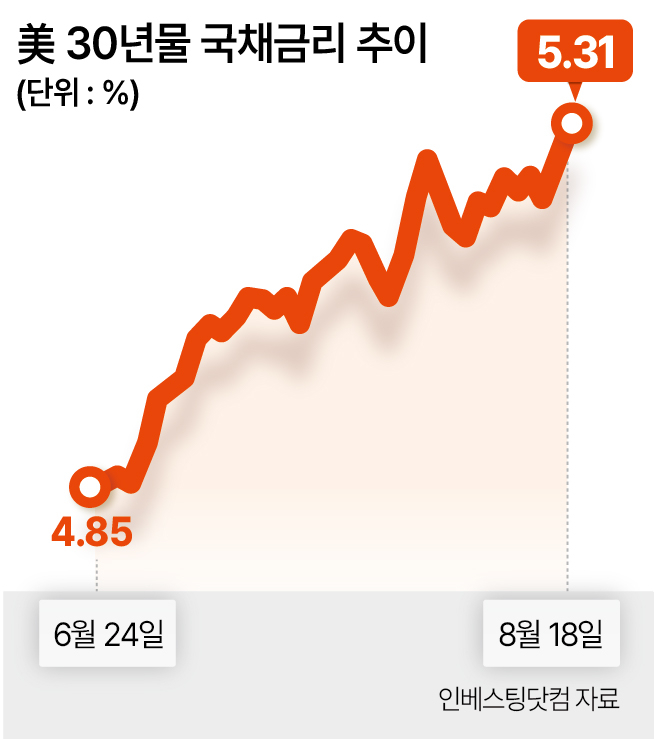
Rising US interest rates are also feeding back into Japan's bond market.
On Monday, the US 30-year Treasury yield briefly climbed to 5.31%, its highest level since 2007 — a 19-year peak. The move reflects mounting concern over America's massive fiscal deficit and the prospect of ever-greater Treasury issuance to finance it.
Ultimately, the United States and Japan are experiencing strikingly similar dynamics at the same time. In both countries, investors worried about expanding government spending and growing bond supply are selling long-term government debt, pushing yields higher in tandem.
The deeper concern is that Japan's rising yields could in turn push US rates even higher.
For decades, Japan's ultra-low domestic interest rates drove Japanese investors to seek higher returns abroad, leading them to accumulate US Treasuries and other foreign bonds on a massive scale. Japan is currently the largest foreign holder of US Treasuries.
But with Japan's 10-year yield approaching 3%, the calculus is shifting. Investing in US Treasuries requires bearing currency-hedging costs to guard against dollar-yen fluctuations. By contrast, higher Japanese bond yields now allow investors to earn a meaningful return at home without taking on that hedging burden.
Even if Japanese investors do not immediately engage in large-scale repatriation — selling US Treasuries and bringing funds back to Japan — simply reducing new purchases of US debt could strain the market. That is because one of the key buyers of US Treasuries would be stepping back from its historically active role.
The pressure is compounding for the United States, which already faces growing urgency to secure demand for its own bonds. The government must continue issuing Treasuries in large volumes to cover its fiscal deficit, while US companies ramping up AI and data center investment are simultaneously flooding the market with corporate bonds.
Investors can choose between US Treasuries and high-grade corporate bonds offering attractive yields — and Japanese government bonds are now emerging as yet another alternative. To retain Treasury investors, the US government may increasingly need to offer higher yields than before.
Ultimately, Japan's rising rates could set off a chain reaction: Japanese bond selling → higher Japanese yields → reduced appeal of US Treasuries for Japanese investors → weaker demand for US Treasuries → higher US long-term yields. With America's fiscal instability now compounded by Japan's rising rates and potential capital repatriation, upward pressure on global long-term interest rates is intensifying.
sjy@heraldcorp.com