South Korea's major petrochemical companies saw factory utilization rates broadly decline in the first half of this year as Middle East war risks disrupted raw material procurement. The firms managed a brief return to profit during the period, aided by a surge in refining margins tied to regional conflict and government support, but concerns over a second-half earnings deterioration remain, pushing companies to accelerate sweeping business restructuring.
Semiannual reports filed Tuesday by four domestic petrochemical companies — LG Chem, Lotte Chemical, Hanwha Solutions and Kumho Petrochemical — showed average utilization rates at major facilities fell across the board in the first half. The decline reflected a combination of chronic oversupply driven by China's continued capacity expansion and raw material procurement disruptions stemming from the Middle East conflict.
Lotte Chemical's naphtha cracker, the core unit of its basic chemicals division, saw its utilization rate fall from 81 percent in 2024 to 73 percent last year and further to 60.7 percent in the first half of this year. Its PET facility rate dropped from 47.2 percent in 2024 to 25.1 percent last year and 19.8 percent in the first half of this year. At its Malaysian subsidiary LC Titan, the naphtha cracker utilization rate declined from 55.2 percent in 2024 to 45 percent last year and 40.2 percent in the first half of this year.
LG Chem's petrochemical division utilization rate fell from 83.4 percent in 2024 to 78.1 percent last year and 73.6 percent in the first half of this year. Kumho Petrochemical's average utilization rates for its synthetic rubber and synthetic resin divisions in the first half were 68.19 percent and 54.05 percent, respectively. Hanwha Solutions said it made partial utilization adjustments for its toluene diisocyanate products in the second quarter due to worsening raw material procurement conditions caused by geopolitical risks in the Middle East.
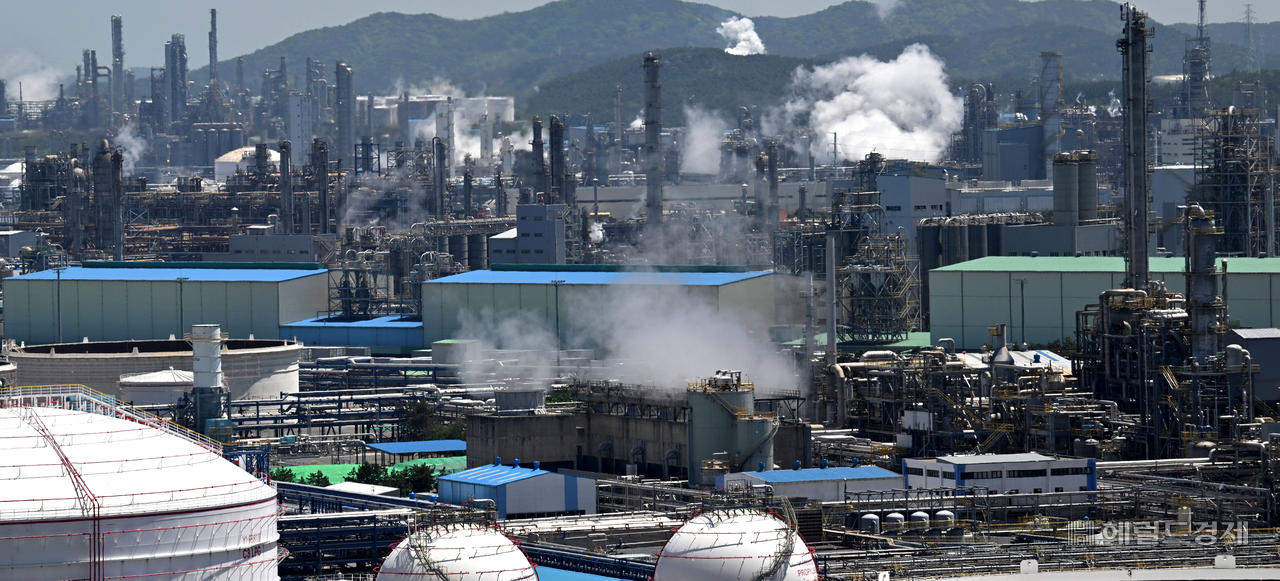
![The Yeosu National Industrial Complex in South Jeolla Province. [Yonhap]](https://wimg.heraldcorp.com/news/cms/2026/08/18/rcv.YNA.20260722.PYH2026072216930005400_P1.jpg)
Despite falling utilization rates, major petrochemical companies posted operating surpluses in the first half. The industry, however, views the improvement as driven by temporary factors rather than a structural recovery in demand.
LG Chem's petrochemical division posted operating profit of about 591.3 billion won ($418 million) in the first half of this year, while Lotte Chemical's basic chemicals division posted about 55.8 billion won and Hanwha Solutions' basic materials division posted 121.2 billion won — all swinging to a profit compared with the same period last year. Kumho Petrochemical also maintained its surplus, posting first-half operating profit of 398.4 billion won.
In its semiannual report, LG Chem said of its petrochemical division that "sales declined in the second quarter due to the shutdown of Yeosu NCC Plant 2, but profitability improved thanks to a positive lagging effect from rising raw material prices and wider spreads." The company projected that profitability pressure would increase in the third quarter due to a negative lagging effect from falling raw material prices and rising logistics costs.
Lotte Chemical said prices for polyethylene and polypropylene products in its basic chemicals division "showed strength in the first quarter due to rising raw material prices driven by geopolitical risks from the Middle East, but weakened in the second quarter as supply normalization and sluggish demand converged."
![The Ulsan-Mipo Industrial Complex. [Provided by SK Energy]](https://wimg.heraldcorp.com/news/cms/2026/08/18/9/news-p.v1.20260622.05c8252f8ded4adf983f0ed9aeea18ac_P1.jpg)
Even as the brief profit rebound fades, the second-half outlook remains dim, and companies are focusing on adjusting naphtha cracking capacity, winding down marginal businesses and reorganizing their corporate structures. Lotte Chemical completed the physical spin-off of its Daesan plant in June and will launch an integrated entity with HD Hyundai Chemical in September, marking the start of full combined operations. Under the arrangement, the newly established company from the Daesan spin-off will be absorbed into HD Hyundai Chemical, with Lotte Chemical and HD Hyundai Oilbank each holding a 50 percent stake in the combined entity.
Hanwha Solutions, Lotte Chemical, Yeocheon NCC and DL Chemical received government approval in July for their business restructuring plans filed under the Special Act on Revitalizing Corporate Vitality. Under the plan, Yeocheon NCC will receive in-kind contributions of DL Chemical's polyethylene business and Hanwha Solutions' Yeosu polyethylene and petroleum resin operations, and will merge with Lotte Chemical's spun-off subsidiary — covering Yeosu NCC and basic materials — to launch a unified entity.
Lotte Chemical is also pursuing the sale of its Malaysian subsidiary LC Titan after divesting its stake in a Pakistani PTA subsidiary last year, as individual companies continue to rebalance their business portfolios. LG Chem is currently in talks with GS Caltex on integrating their naphtha cracking facilities within the Yeosu industrial complex. In a recent conference call, LG Chem said it would "complete final approval of the business restructuring through a strategic partnership with a refiner and establish a collaboration model by year-end to accelerate improvement of the business fundamentals."

keg@heraldcorp.com