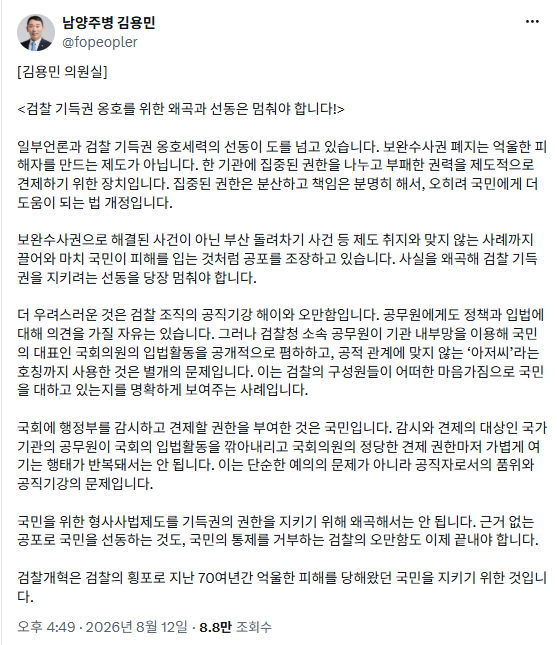
Lawyers representing the victim in the so-called Busan spinning-kick case in a state compensation lawsuit urged the National Assembly on Tuesday to pass supplementary legislation in connection with the revised Code of Criminal Procedure, which centers on abolishing prosecutors' supplementary investigation powers. They also criticized a claim by Democratic Party of Korea Rep. Kim Yong-min that the case was not resolved through prosecutors' supplementary investigation, saying his assertion "does not accord with the facts."
The statement was issued Tuesday by Oh Ji-won, lead counsel for the legal team representing victim Kim Jinju (a pen name), along with attorneys Han Ju-hyun, Jo Yun-hui and Jeon Min-gyeong.
The legal team first rebuffed a post Kim had published on X, formerly Twitter, on Aug. 12. In that post, titled "Distortion and agitation in defense of prosecutorial vested interests must stop," Kim said critics were "stoking fear as if citizens were being harmed" by citing cases such as the Busan spinning-kick incident — which, he argued, was not resolved through supplementary investigation powers — to make examples that did not fit the purpose of the system.
The legal team pushed back directly. "The spinning-kick case is indeed one in which prosecutors used supplementary investigation to at least partially correct the police's shoddy investigation," they said. "The lawmaker's post, which denies this and implies the case had nothing to do with supplementary investigation, does not accord with the facts."
The lawyers said police had forwarded the suspect to prosecutors on charges of grievous bodily harm. "Even though sexual assault was suspected, investigators relied solely on the victim's account — who was suffering from memory impairment immediately after the incident — and neglected to secure additional evidence," they said. "This failure in the initial investigation was clearly acknowledged in the court's ruling."
They added that prosecutors had then established intent to kill through further investigation of the suspect and indicted him on charges of attempted murder rather than grievous bodily harm. "Prosecutors secured a statement proving intent to kill, not merely grievous bodily harm, through additional questioning of the suspect, and requested that police conduct a DNA re-examination to verify evidence related to the sexual assault," the team said.
The lawyers also acknowledged the limits of the prosecution's work. "The victim and her counsel have broadly argued that prosecutors were also at fault for missing the charge of rape with intent to kill," they said. "But it remains a clear fact that the prosecution's murder indictment partially remedied the police's inadequate investigation."
The legal team called on the National Assembly to enact supplementary legislation to fill the investigative gap that will arise before the revised code takes effect. "Please properly examine the risks and possibilities of regression in victim protection and the right to remedy, and prepare supplementary legislation," they said. They also urged lawmakers to "create a structure in which police conduct investigations directly — at least for certain serious crimes such as murder, robbery, sexual violence, various fatal incidents, and cases involving child or disabled victims — while prosecutors can simultaneously direct or check that work."
The lawyers also raised the need for measures to strengthen victims' procedural rights in trials after the abolition of the prosecution service and the launch of a new public indictment agency. "Please devise concrete alternatives for how prosecutors at the new agency can effectively represent and protect victims in court," they said. "If there is no trust in prosecutors, the possibility of victims advocating for themselves must be kept open — for instance by introducing a victim-participation system that strengthens victims' rights."
yg@heraldcorp.com