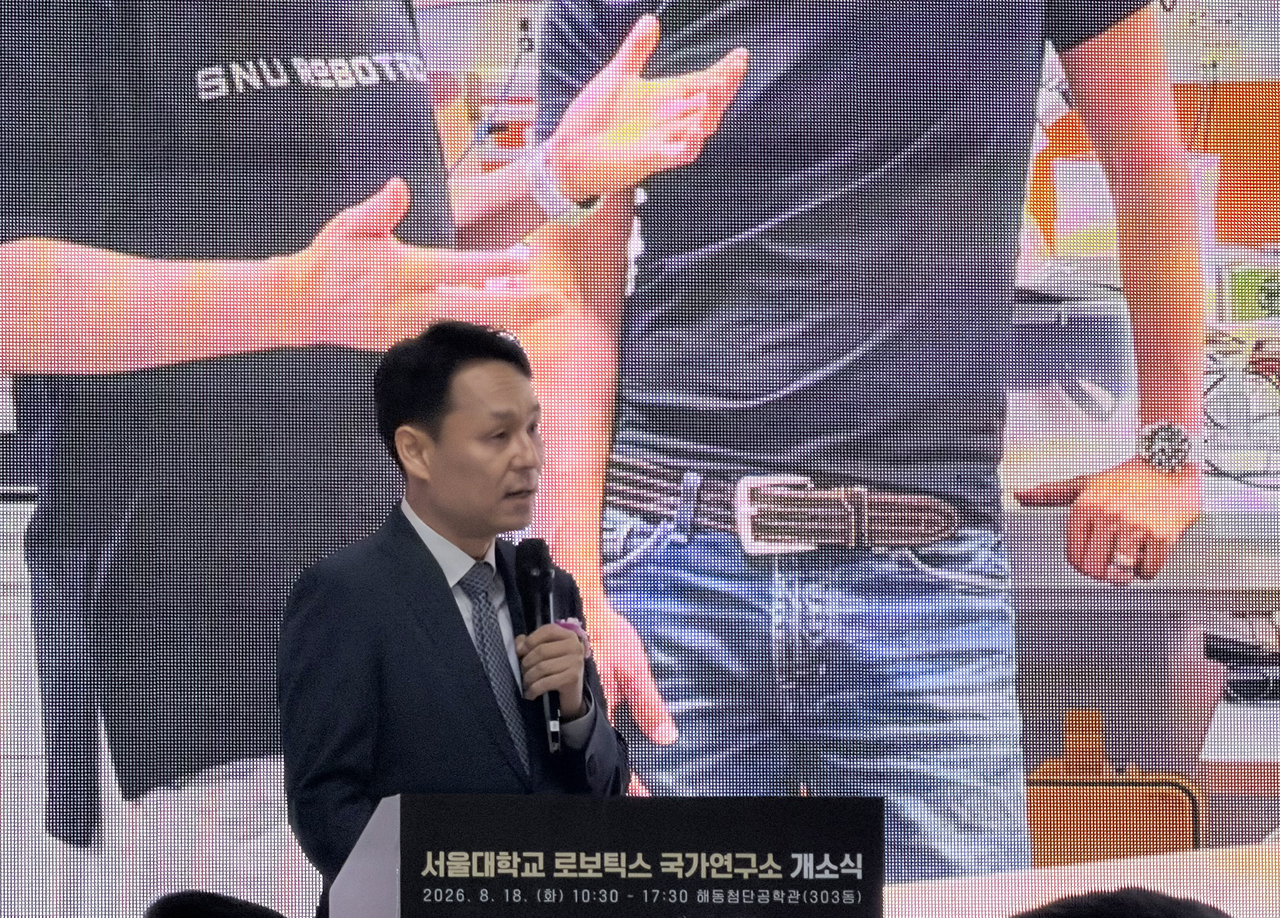
Seoul National University has launched a national research laboratory dedicated to developing next-generation physical AI technology and building a robotics startup ecosystem.
SNU held an inauguration ceremony Tuesday at Haedon Advanced Engineering Building on its Gwanak campus. A national research laboratory — designated under the National Research Lab 2.0 program — is a university-based research institution established to lead fundamental research. Each selected lab receives 10 billion won ($7.07 million) annually for 10 years.
Cho Gyu-jin, director of the SNU Robotics National Research Laboratory, unveiled the lab's vision at the ceremony. "We will take on the challenge of human-centered physical AI robotics," he said. "We will create technology oriented toward people — through robots whose very form and materials become part of their intelligence, allowing them to adapt to their environment."
Cho added that the planned robotics research building would be "not just a structure, but a living robotics ecosystem where world-class researchers and students gather and research flows into industry."
SNU plans to finalize the design of the robotics research building in the second half of this year. The facility is set to rise five to seven stories on the parking lot site behind Haedon Advanced Engineering Building.
SNU President Yu Hong-lim said he believes the lab "will become a cradle for a new future for humanity — enhancing physical AI and human activity." He expressed hope that the lab "will bind together the whole of SNU and go on to play a role in serving humanity and society."
The SNU Robotics National Research Laboratory was established after being selected in June as a 2026 national research laboratory under the basic research program jointly run by the Ministry of Education and the Ministry of Science and ICT.
SNU plans to deploy more than 80 faculty members from diverse disciplines to build an interdisciplinary research framework.
The lab will pursue human-centered physical AI research across three areas: lifestyle robots that assist with daily living, wearable robots that augment or extend physical function, and medical robots that perform diagnosis and treatment inside the body.
The lab also plans joint research with overseas institutions and companies, including Nvidia. To support the commercialization of research and spinoff ventures, it will establish an industry-academia startup support center within the lab and use it as a base for robotics entrepreneurship.
newday@heraldcorp.com