![Minister of Trade, Industry and Energy Kim Jung-kwan (second from right) poses for a photo with US Commerce Secretary Howard Lutnick (third from right) and signatories at the signing ceremony for the Korea-US Shipbuilding Partnership Initiative MOU, held at the US Department of Commerce in Washington, D.C., on May 8 (local time). [Ministry of Trade, Industry and Energy]](https://wimg.heraldcorp.com/news/cms/2026/08/18/news-p.v1.20260818.563b7dccc536457b9c3f7cf3707b86a9_P1.jpg)
South Korea's negotiations over investment in the United States are growing increasingly complicated. The government had been working toward a late August or early September announcement of the first project under its $350 billion US investment pledge — a commitment made as a follow-up to Korea-US tariff negotiations — with energy projects such as a gas-fired combined-cycle power plant leading the field. New variables have emerged, however, with reports that Washington has pushed for memory chip investment as well. The talks have grown more tangled still as security issues — including a possible reduction in joint Korea-US military exercises — have entered the picture, turning what began as a trade negotiation into a far more complex equation. Above all, US frustration over what it sees as a slower-than-expected pace of investment has put Seoul in a bind: move too fast and commercial viability suffers; move too slowly and tariff pressure could mount.
Kim Jung-kwan, minister of trade, industry and energy, met with US Commerce Secretary Howard Lutnick in Washington on Monday (local time) to discuss investment issues, the ministry said Tuesday.
Speaking to reporters at Dulles International Airport near Washington on Sunday, Kim said "a variety of specific issues are emerging at the final working level" and explained that he had made the trip because "there is a need to sort everything out comprehensively" as the government targets a late August to early September announcement of the first project.
Asked whether there had been pressure that tariffs could be raised if investment commitments were delayed, Kim said he had not received any such pressure.
Politico reported Monday (local time), citing sources familiar with the Korea-US negotiations, that "the negotiations are moving more slowly than Trump administration officials had expected and remain unresolved." One source added, "They are the slowest negotiators we have ever seen."
Commerce Secretary Lutnick also signaled impatience with the pace of investment last month at the opening ceremony of the Korea-US Shipbuilding Cooperation Center in Washington, saying he would judge progress "by the number of ships built, not by words or MOUs."
Politico also referenced the Personal Information Protection Commission's record fine of 624.6 billion won ($441 million) against Coupang Inc over a personal data breach, saying the development "vividly illustrates Trump's recent tendency to conflate security and economic issues, suggesting that frustration in one area is spilling over into others."
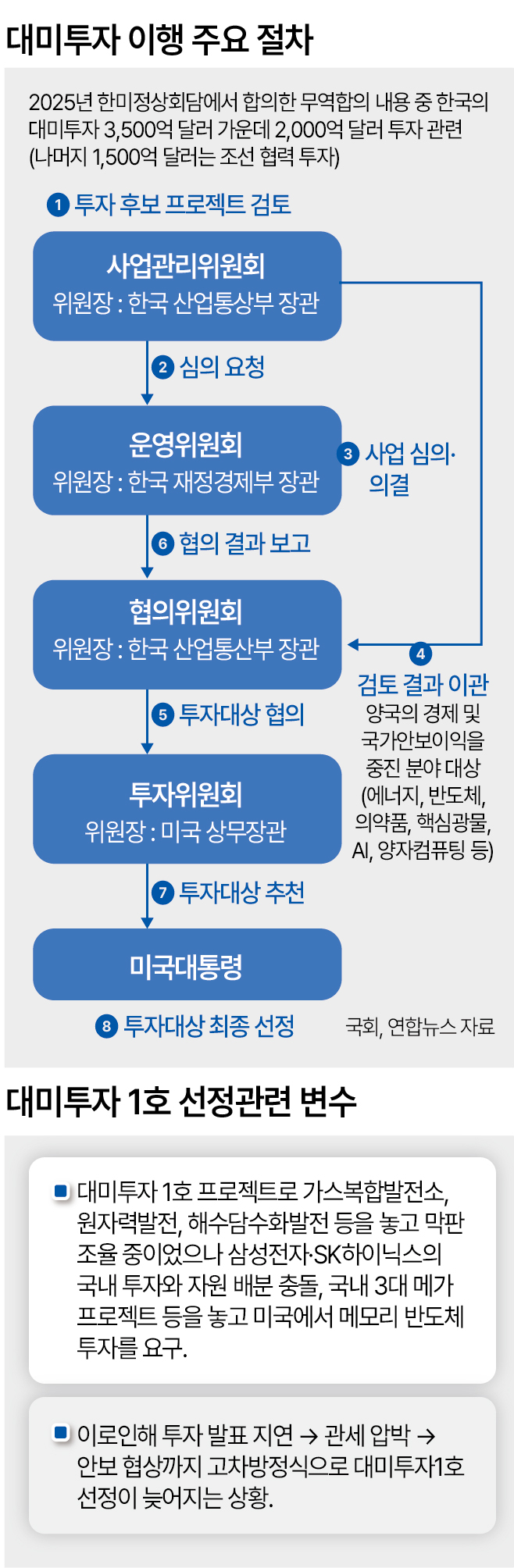
The project most prominently discussed as the first US investment initiative is a gas-fired combined-cycle power plant in Texas. The project carries a total cost of $19.8 billion and a capacity of around 6.3 gigawatts, structured to secure profitability by supplying electricity to nearby AI data centers. It has been regarded as relatively commercially viable because of the stable revenue stream tied to those data centers.
Yet five months after the special act on US investment cleared the National Assembly, the first project has still not been finalized. The outlines of projects one through three under the Korea-US tariff negotiation framework are understood to have taken shape — a gas-fired combined-cycle power plant, a data center and a carbon capture and storage facility.
The second project is understood to involve a data center construction project in Texas, and the third a carbon capture and storage infrastructure project in the mountainous western United States. The data center project is being considered as a co-investment with a major US technology company, while the CCS project is being examined as a hub in the Wyoming area — which has high carbon dioxide storage potential — linking CO2 pipelines with compression and storage facilities.
The government is also understood to be reviewing participation in a seawater desalination project in the western United States and a small modular reactor project being pursued by a US nuclear energy company identified only as "Company N."
The central problem is commercial viability — specifically, who bears responsibility if the investments fail to generate returns. This uncertainty is slowing investment decisions even as the risk of renewed tariff pressure grows. The situation has been further complicated by President Donald Trump's remarks about sharply scaling back joint Korea-US military exercises, expanding the negotiations beyond trade and investment to encompass security issues as well.
Against this backdrop, the United States has added memory chip investment to its demands — a development that emerged shortly after Samsung Electronics and SK Hynix announced plans for 800 trillion won in investment in South Korea's Honam region, introducing a new variable into the negotiations. Analysts say the intertwining of trade and security talks is adding strain to the management of the Korea-US alliance.
At a closed-door trade meeting at Cheong Wa Dae on Aug. 13, the US demand for memory chip investment is understood to have been a central point of discussion. The government had until recently prioritized energy as the first US investment project, but the US side's strong push for memory chip production facilities in the United States is said to have shifted the dynamics of the negotiations.
Cheong Wa Dae and the Ministry of Trade, Industry and Energy drew a line Tuesday, saying "it is not true that semiconductors are being discussed as a candidate for the first strategic investment project in the United States." The government said it "has been maintaining ongoing communication with the US side regarding strategic investment projects" but that it "cannot confirm the specific details of Korea-US discussions on strategic investment in the United States."
Semiconductor investment is a fundamentally different proposition from energy projects. Meaningful investment requires the participation of Samsung Electronics and SK Hynix, and both companies are already pursuing large-scale domestic investment. Any additional or expanded commitment to the United States would need to be weighed against the capacity of South Korea's domestic semiconductor cluster and the financial headroom of the companies involved. Semiconductor production facilities also require years from investment decision to operation, making it difficult to show near-term results on US investment.
Concern has also grown over whether the abrupt resignation of Yeo Han-koo — the former head of the Ministry of Trade, Industry and Energy's trade negotiation bureau who led the non-tariff negotiations — on Saturday signals trouble for the Korea-US talks. Trade authorities, however, believe his departure will not directly affect the US investment negotiations, noting that he had not been involved in the relevant consultative bodies.
Experts say that while US investment projects are being delayed, those where discussions have already advanced should proceed as planned, while investments requiring a longer lead time — such as semiconductors — should be negotiated with more time allowed.
Ku Ki-bo, a professor of global trade at Soongsil University, said "investment is not just one thing" and that "LNG power generation has advanced considerably, so it seems right to proceed with that as planned." On semiconductor investment, he said "even if a decision is made to invest, it is not something that can be built in a short time" and that "rather than deciding now, it would be better to discuss it together at the review stage."
He said South Korea should use its existing investment pledges and shipbuilding cooperation as leverage against additional US tariff pressure. "We have made a $350 billion investment pledge and are moving forward on shipbuilding by removing obstacles," Ku said. "We need to emphasize those points to keep tariffs from exceeding 15 percent." He added that since the $350 billion pledge was made on the premise of a 15 percent tariff, Seoul must make clear to Washington that any tariff above that level would have a negative impact on the investment commitment itself.
Heo Yun, a professor at Sogang University's Graduate School of International Studies, said Minister Kim must personally break the deadlock given that investment, trade and security issues are all intertwined while communication channels between the two sides have grown rigid. "We don't know the details of the specific projects, but in any case there is a significant gap between what the US is demanding and what we have," Heo said. "Minister Kim needs to use this trip to preemptively cut through the uncertainty, activate direct channels and resolve this through direct talks."
Heo said that given the US midterm election schedule, dragging out the investment projects too long would not serve South Korea's interests either. He argued Seoul should find a way to give Washington something it can tout as an investment win while securing tangible gains of its own on tariffs and security.
"The US timeline and the Korean timeline need to move in a direction that is strategically win-win," he said. "With the US holding considerable negotiating leverage, South Korea must wrap up the projects within the timeframe Washington wants — so as not to create the impression that Korea is not keeping its promises — and provide the US side, which faces midterm elections, with something it can present as an investment achievement."
oskymoon@heraldcorp.com