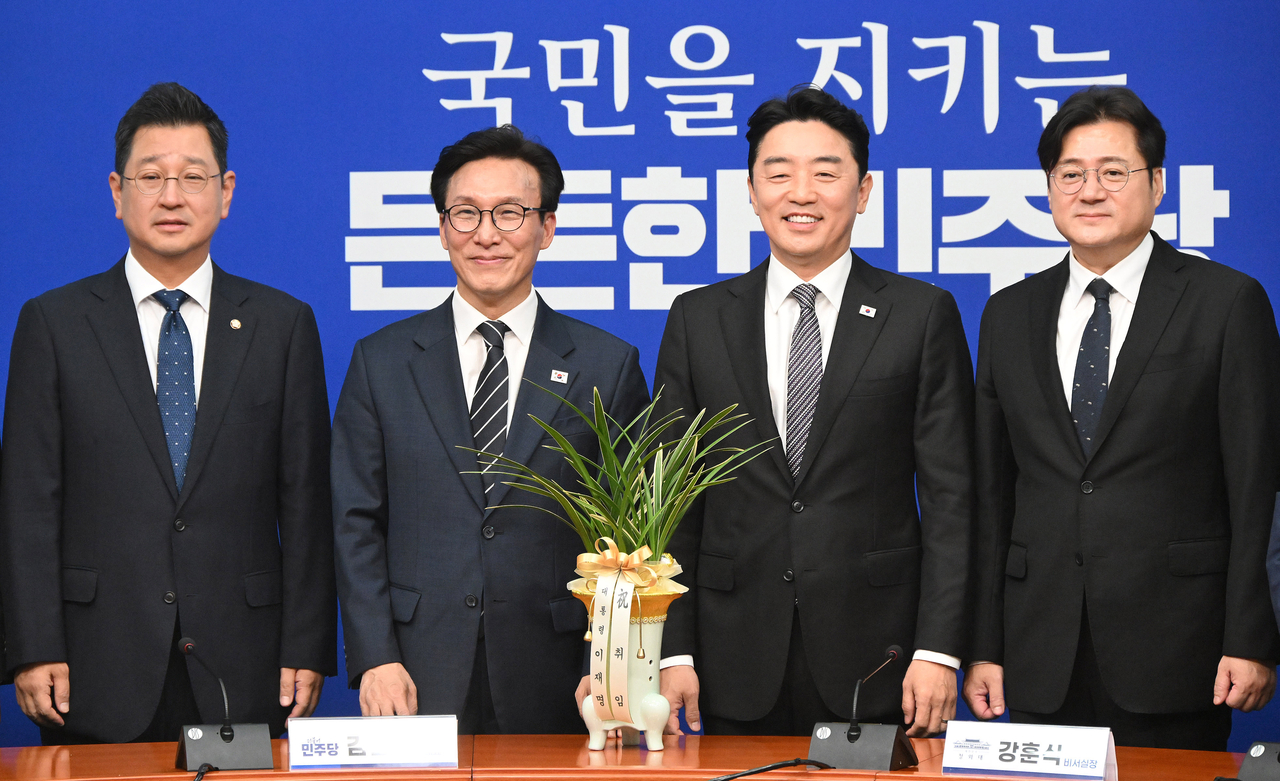
Newly elected Democratic Party of Korea leader Kim Min-seok has placed cooperation with the presidential office front and center, and party members appear to have backed that vision — delivering him the nomination over former leader Jung Chung-rae, led by strong support from the party's traditional stronghold of the Jeolla provinces. Kim now faces the task of shoring up President Lee Jae Myung's sliding approval rating while refining a contentious real estate tax overhaul and steering the Honam mega-projects to completion.
Meeting with Presidential Chief of Staff Kang Hoon-sik and Senior Presidential Secretary for Political Affairs Hong Ik-pyo at the Democratic Party leader's office in the National Assembly on Tuesday, Kim said he felt "a sense of expectation and responsibility that a truly seamless one-team relationship — with no walls — will be achieved."
He added that President Lee's emphasis on security — "S" — combined with the party's "ABC" framework spells "CABS," and said the Democratic Party would become "a livelihood taxi that races from dawn, moving with speed."
In his acceptance speech on Monday, Kim had introduced what he called the party's new "ABC Plan": Affordability ("bread-and-butter politics"), Broadening ("expansive, inclusive politics") and Competence ("capable governance"). He said the party-government relationship would be "a creative, horizontal partnership of full cooperation in support of the president and the government, who stand at the center of state affairs."
Some analysts say the decision by party members to elect Kim — a former prime minister — as leader in the second year of the Lee administration reflects a demand for unity. Concerns had grown during the Aug. 17 party convention that deepening divisions within the Democratic Party's base over the pace of reform and outreach could split the party.
Kim won with 54.08 percent of the final vote after preference balloting was applied. Though he and Jung fought closely in most regional primary rounds, Kim pulled ahead decisively by taking 57.04 percent in South Jeolla Province and Gwangju and 58.39 percent in North Jeolla Province.
With that mandate, Kim is expected to move quickly in lockstep with the government on legislation. The senior party-government consultative council — suspended during the convention period — is set to reconvene soon, with the real estate tax reform package among the items on the table. Newly appointed chief spokesperson Park Seong-jun told reporters after Tuesday's meeting with Kang and Hong that "we are preparing a senior party-government meeting following the party leader's inauguration — it looks like it will be held Sunday morning." He added, "It will be an introductory session, but I expect that going forward, pressing issues will be resolved at the senior party-government level before things escalate."
Kim had previously described the tightening of tax rules for non-resident single-homeowners as a tax increase, raising expectations that significant revisions could emerge during the National Assembly's legislative process. At a Democratic Party caucus meeting last Thursday, lawmakers from Seoul in particular called for addressing the tax burden and related financing issues. Kim himself had written on social media that "abolishing the holding deduction for non-resident single-homeowners on capital gains tax is, in effect, a tax increase for non-resident single-homeowners of homes valued at 1.2 billion won ($848,000) or more."
The Honam mega-projects are another immediate challenge. During the convention campaign, Kim argued that his election was essential for the projects' success, warning that "if Jung Chung-rae becomes party leader, the Honam mega-projects championed by the Lee Jae Myung government will be thrown into uncertainty." He also pledged that his first act as party leader would be to form a special committee to support the three major mega-projects.
Whether Kim's election and inauguration can reverse the slide in President Lee's approval rating is also being closely watched. Pollster Realmeter's survey released Monday put positive assessments of Lee's job performance at 43.0 percent — a fifth consecutive week of decline. (The survey covered 2,511 respondents from Aug. 10 to Aug. 14, with a margin of error of plus or minus 2.0 percentage points at the 95 percent confidence level and a response rate of 4.0 percent.) Some analysts attribute the drop to public resistance to the real estate tax overhaul and eroding confidence in the government's policy direction, while others point to the factional tensions laid bare during the convention.
Now that the convention is over and a new leadership team is in place, observers expect the party's base to rally and Lee's approval rating to begin recovering. President Lee is scheduled to host Kim along with Jung Chung-rae and Song Yeong-gil — the other convention candidates — for a dinner at Cheong Wa Dae on Wednesday. In his acceptance speech, Kim said he would "run together with Jung Chung-rae and Song Yeong-gil," pledging to "open that space wide and bring everyone in." He added that he would "break through this crisis of internal and external challenges together with my comrades and the new leadership, drawing on the patience and small wisdom accumulated over decades."
addressh@heraldcorp.com