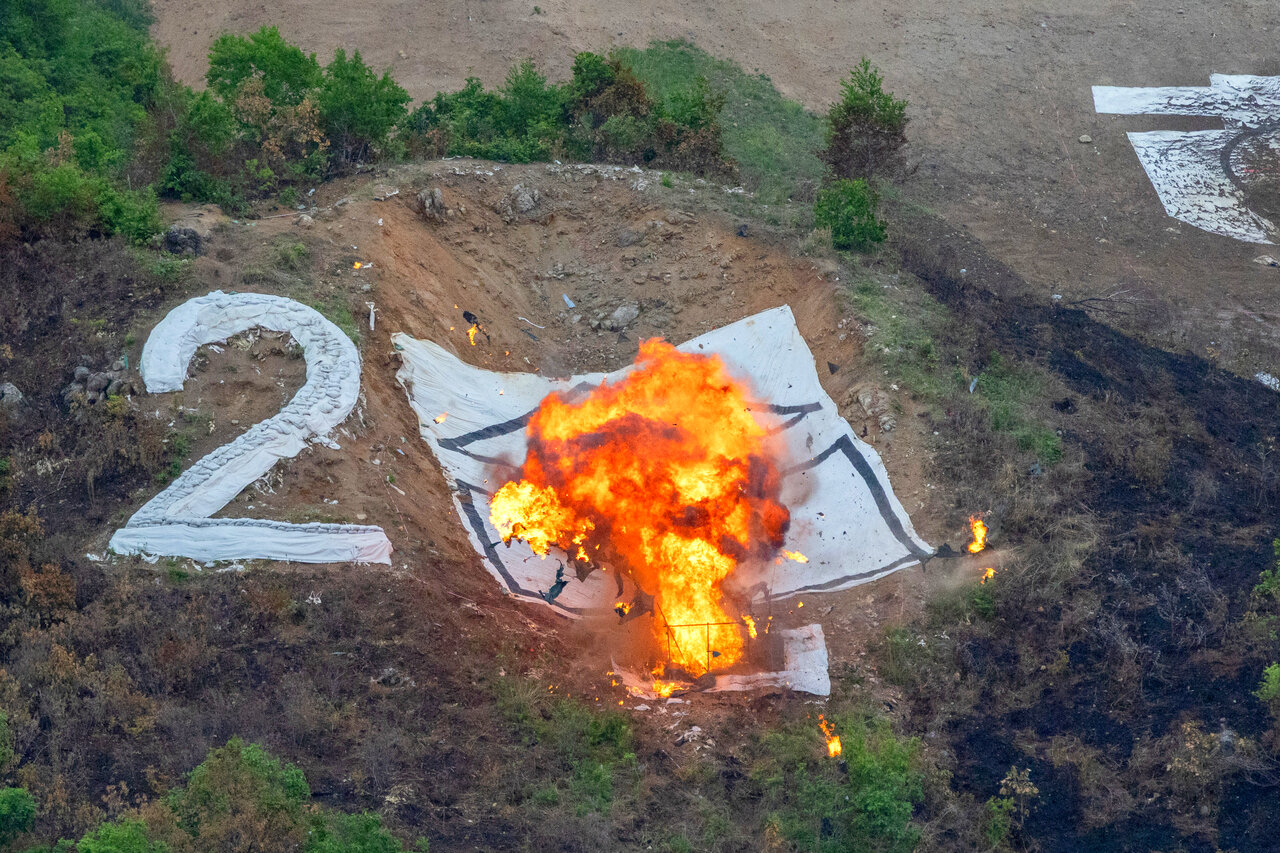
The 2026 Ulchi exercise, a nationwide emergency preparedness drill, kicked off Tuesday for a four-day run, with Gangwon Province — which borders North Korea — conducting integrated civilian-government-military drills to strengthen regional defense capabilities.
Gangwon Province said it is reinforcing training to counter new security threats that exploit advanced technology, including cyberattacks, drone terrorism and GPS jamming.
The province also plans to improve coordination with related agencies through joint civilian-government-military counterterrorism drills and exercises focused on soft-terror threats such as cyberattacks.
"The Ulchi exercise is an important opportunity to assess and strengthen our capacity to respond to a changing security environment," Gov. Woo Sang-ho said. "All public officials will approach the training with the same mindset as a real emergency to protect the safety of residents and national security."
On Thursday, civil defense drills will be held in every city and county across the province. Starting with an air-raid alert at 2 p.m., residents will practice evacuation and clearing the way for emergency vehicles, and traffic on some roads will be restricted.
Gangwon Province's Ulchi exercise runs through Friday, day and night without interruption, beginning with an initial situation briefing chaired by Gov. Woo on Tuesday.
All participating agencies will practice transitioning to a wartime administrative footing and carrying out national all-out-war mission procedures. The exercise will assess and improve emergency preparedness through three formats: a tabletop exercise simulating complex scenarios and processing various incident plans, a discussion-style exercise chaired by agency heads to develop practical solutions to wartime challenges, and a field drill mobilizing personnel, supplies and equipment.
The Ulchi exercise is an annual nationwide emergency preparedness drill held to review and refine contingency plans and sharpen wartime operational procedures in preparation for war, armed conflict or equivalent national emergencies. It was launched in 1968 following an armed North Korean commando raid on Cheong Wa Dae.
Now in its 58th year, this year's exercise involves some 580,000 participants from more than 4,000 civilian, government and military agencies nationwide, including central and local government bodies, public institutions and organizations, and key managed enterprises.
abc@heraldcorp.com