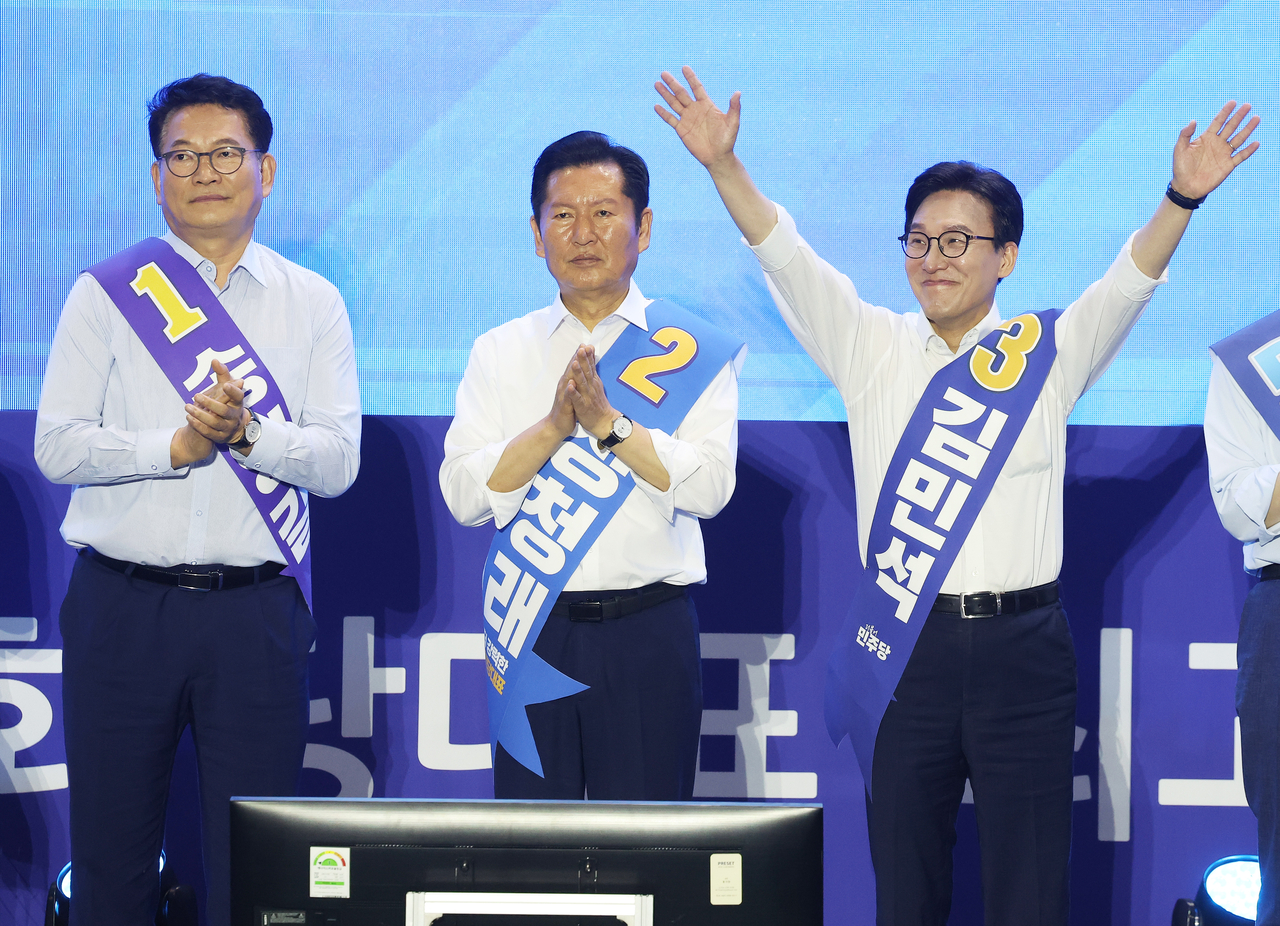
The Democratic Party of Korea will elect its new leadership Monday.
All eyes are on whether Kim Min-seok, who has extended his lead through the Honam region and Greater Seoul circuits, can secure the party leadership with a first-round majority — or whether Jung Chung-rae can stage a last-minute comeback.
The party is holding its third regular national convention at the Daejeon Convention Center on Monday, where it will elect a party leader and five supreme council members.
The final results will combine the tally of rights-member votes announced through the regional primary circuit with delegate votes, a public opinion poll, and a 5 percent weighting for votes from the Yeongnam region, all to be announced Monday.
Under the one-person, one-vote system, the electorate breakdown is 70 percent rights members and delegates, and 30 percent the general public.
The party leader race — featuring candidates Song Young-gil, Jung Chung-rae and Kim Min-seok, listed in ballot order — will use a preferential voting system.
Under that system, voters rank all three candidates in order of preference. If no candidate wins a majority, the second-choice votes of those who ranked the last-place candidate first are added to determine the winner.
In the cumulative vote tally so far, excluding the Yeongnam weighting, Kim leads with 49.91 percent. Jung follows at 41.51 percent, with Song at 8.58 percent.
The gap between Kim and Jung stands at 64,567 votes, or 8.40 percentage points.
The key variables are the preferential voting mechanism and the public opinion poll, which accounts for 30 percent of the final result.
Kim held onto first place after the Honam and Gyeonggi Province-Seoul circuits over the past weekend, widening his lead over Jung — but fell just short of a majority.
Kim's camp is banking on the public opinion poll pushing his total above 50 percent, allowing him to clinch victory without triggering the preferential voting process.
Jung, who has lost two consecutive regional rounds, must close the gap significantly in Monday's delegate vote and public opinion poll to have any chance of winning.
In the rights-member vote for supreme council seats, candidates Choi Min-hee, Park Seon-won, Seo Mi-hwa, Lee Sung-yoon and Han Min-su — listed in order of cumulative votes — have placed within the top five qualifying positions.
The race for senior supreme council member, a post that goes to the top vote-getter, is razor-thin between Choi, aligned with the pro-Jung faction, and Park, aligned with the pro-Lee Jae Myung faction — separated by just 0.31 percentage points, a margin that could flip depending on the delegate vote and public opinion poll results.
The contest further down the rankings is equally tight: pro-Jung candidate Lee Sung-yoon at 13.94 percent and Han Min-su at 13.77 percent are locked in a near-dead heat with pro-Lee Jae Myung candidate Kim Yong at 13.62 percent, keeping the final outcome in flux.
Adding another variable, pro-Lee Jae Myung candidates Im Mi-ae and Kim Young-ho — who ranked seventh and eighth in the cumulative tally as of Sunday — withdrew from the race and urged their supporters to back Kim Yong, raising the question of whether he can consolidate their votes and break into the top five.
gil@heraldcorp.com