
![[123RF]](https://wimg.heraldcorp.com/news/cms/2026/08/17/news-p.v1.20260817.c3b78d32e2ec41909a56a14e46709b68_P1.jpg)
Only about half of South Korea's local governments have enacted living wage ordinances, and even among those that have, many set their living wage at the legal minimum — rendering the ordinances effectively meaningless, a new study has found.
A living wage is a practical wage standard set above the statutory minimum wage, calculated to allow workers to support their families and maintain a basic standard of dignified living. Unlike the minimum wage, which the central government sets uniformly, living wages are determined separately by each local government through ordinances and apply to directly employed workers as well as those at publicly invested or commissioned institutions and private contractors.
According to a report released Monday by the Narasallim Research Institute titled "The Spread of Living Wage Ordinances Nationwide and Challenges for Improvement," 117 of 243 local governments — 52 percent — had enacted living wage ordinances as of 2025. The total includes 17 metropolitan governments and 226 basic local governments.
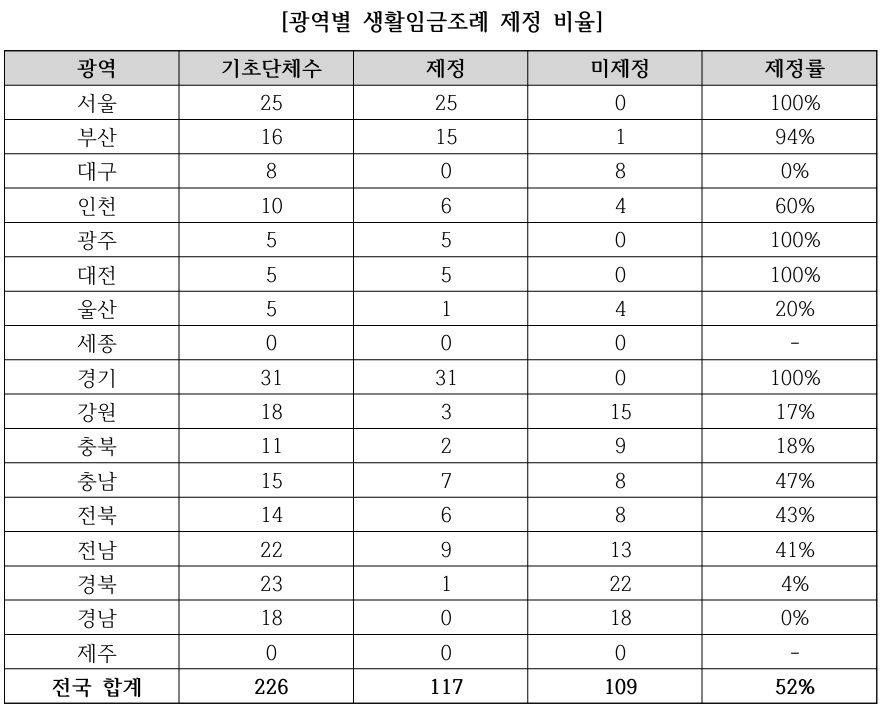
All 17 metropolitan governments have enacted ordinances, completing full adoption at that level. However, the enactment rate among basic local governments under Daegu and South Gyeongsang Province stands at zero, and only one of 23 basic local governments in North Gyeongsang Province — 4 percent — has passed an ordinance, highlighting a stark gap between metropolitan and basic local governments.
Even among local governments that have enacted ordinances, the scope of coverage varies widely — from those covering only directly employed workers to those extending protections to workers at publicly invested or commissioned institutions, service contractors and subcontractors.
According to a survey by the Democratic Labor Research Institute, seven local governments have enacted ordinances but are not actually operating a living wage system: Hoengseong in Gangwon Province, Gyeryong in South Chungcheong Province, Jangsu and Namwon in North Jeolla Province, Suncheon and Jindo in South Jeolla Province, and Uljin in North Gyeongsang Province. Two cases each emerged in North Jeolla Province and South Jeolla Province where enacted ordinances have become dead letters, suggesting that passing an ordinance alone is insufficient to protect vulnerable workers or ensure the system's effectiveness.
Among local governments that do operate a living wage, metropolitan governments generally set rates at 115.6 to 128.9 percent of the minimum wage as of 2025. Donghae in Gangwon Province, however, set its living wage at the same hourly rate as the minimum wage — 10,030 won ($7) — making its ordinance in effect meaningless. The gap between Donghae and the highest-paying jurisdiction, Gwangju, amounted to 2,900 won per hour, or roughly 606,000 won per month.
![[Source: Research on Establishing 2026 Living Wage Guidelines for Seongnam (Lee Shin-woo)]](https://wimg.heraldcorp.com/news/cms/2026/08/17/news-p.v1.20260817.5d12b946ff1946a095c19a970f903c9e_P1.jpg)
Ten metropolitan and 74 basic local governments have explicitly codified worker participation in their living wage committees, while six metropolitan and 42 basic local governments either exclude worker representation entirely or leave the rules vague, the study found.
Jang Sang-hwa, a visiting research fellow, said that when the share of worker representatives on a committee exceeds 20 percent, living wage levels rise meaningfully, confirming that genuine worker representation is a key factor influencing the living wage level.
Jang said the challenge ahead for the living wage system lies not simply in whether an ordinance exists, but in improving the substance and operational effectiveness of those ordinances. To that end, she recommended expanding the system to basic local governments, standardizing and broadening the scope of coverage, securing worker representation of at least 20 percent on living wage committees, strengthening transparency in the decision-making process, and having the central government develop a model ordinance template.
thlee@heraldcorp.com




