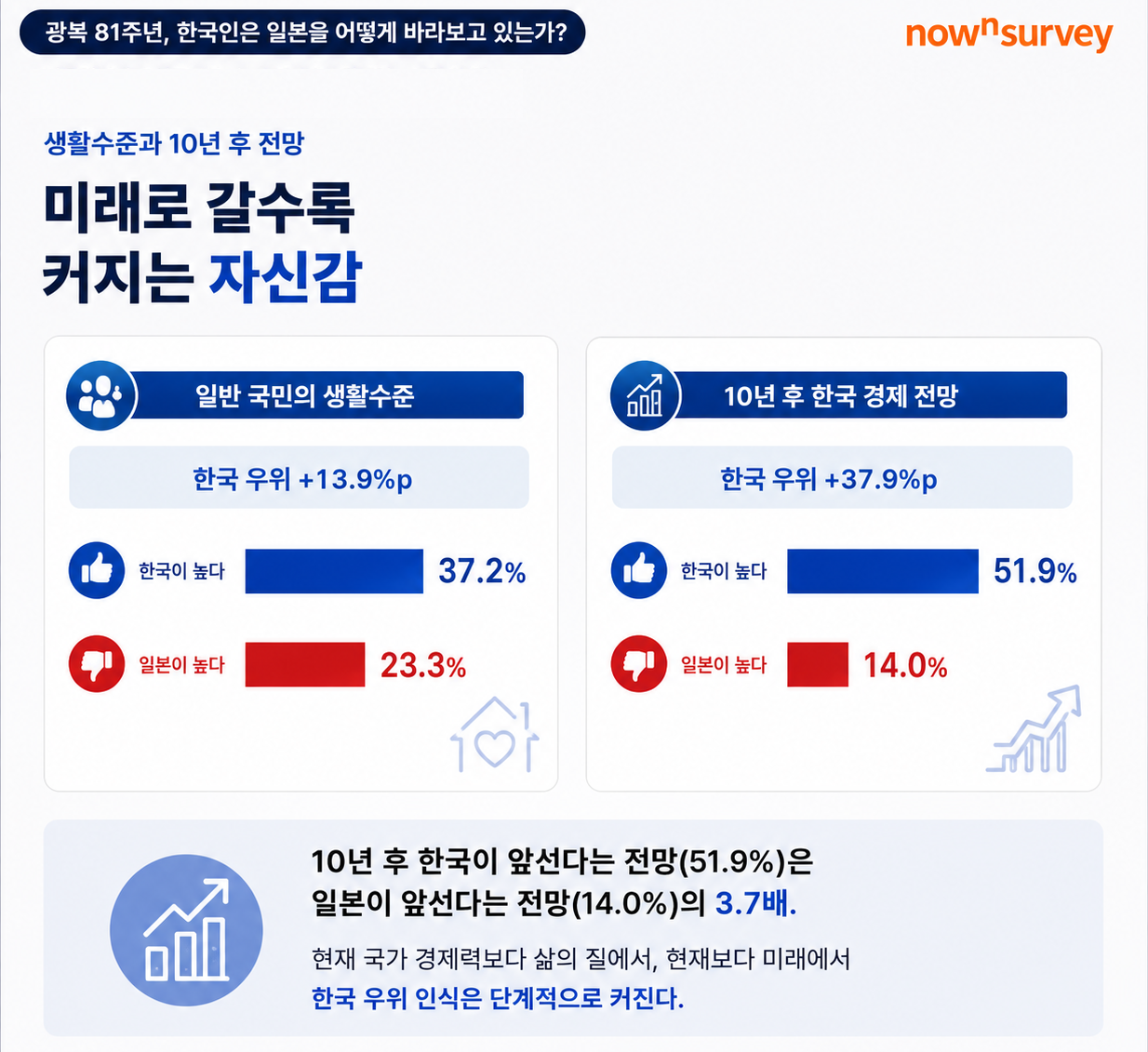
South Koreans feel their standard of living surpasses that of the Japanese, a new survey released Thursday shows.
Respondents rated the two countries' overall economic strength as roughly equal, while judging South Korea to be ahead in 9 of 13 major industries.
Elim Net's online survey platform NowNSurvey announced the findings Thursday to mark the 81st anniversary of Korea's liberation from Japanese colonial rule. The survey questioned 1,007 adults aged 20 and older nationwide from Friday through Monday, with a margin of error of plus or minus 3.1 percentage points at the 95 percent confidence level.
The gap was wider on personal living standards: 37.2 percent of respondents said Koreans live better, compared with 23.3 percent who said the Japanese do — a difference of 13.9 percentage points.
On national economic strength, 33.5 percent said South Korea's was higher and 30.0 percent said Japan's was, a razor-thin gap of 3.5 percentage points. The largest share — 36.5 percent — said the two were about equal.
Looking a decade ahead, 51.9 percent of respondents said South Korea would outpace Japan economically, 3.7 times the 14.0 percent who said Japan would come out ahead.
South Korean confidence was especially pronounced in the industry-by-industry competitiveness assessment. Using a five-point scale — where 1 indicated Japan as strongly superior and 5 indicated South Korea as strongly superior — semiconductors topped the list at 4.25, followed by cultural content at 4.07 and shipbuilding and marine industries at 4.01. All three were classified as areas of strong Korean advantage.
AI and software (3.73), secondary batteries (3.72), electronics and home appliances (3.71), defense industries (3.59), biotech and healthcare (3.26), and automobiles and mobility (3.24) were all rated as areas of Korean advantage, bringing the total to 9 of 13 industries where South Korea was seen as ahead.
Basic science and foundational technology was the only category rated as a Japanese advantage, scoring 2.69. Advanced materials, components and equipment (3.17), precision machinery and robotics (3.17), and aerospace (3.09) — all industries rooted in foundational technology — were rated as in effect even between the two countries.
Respondents expressed strong confidence in South Korea's finished products and content sectors while acknowledging Japan's edge in basic science and core technology.
Even as respondents viewed Japan as a rival, there was broad consensus on the need for cooperation. Seventy percent said expanding South Korea-Japan economic cooperation was necessary for Korea's continued growth, while only 4.2 percent were opposed.
When asked to name South Korea's greatest achievement since liberation, economic growth ranked first by a wide margin at 49.4 percent. The globalization of Korean content came in second at 31.0 percent, edging out industrialization and export growth (29.7 percent) and the development of democracy (27.0 percent).
abc@heraldcorp.com