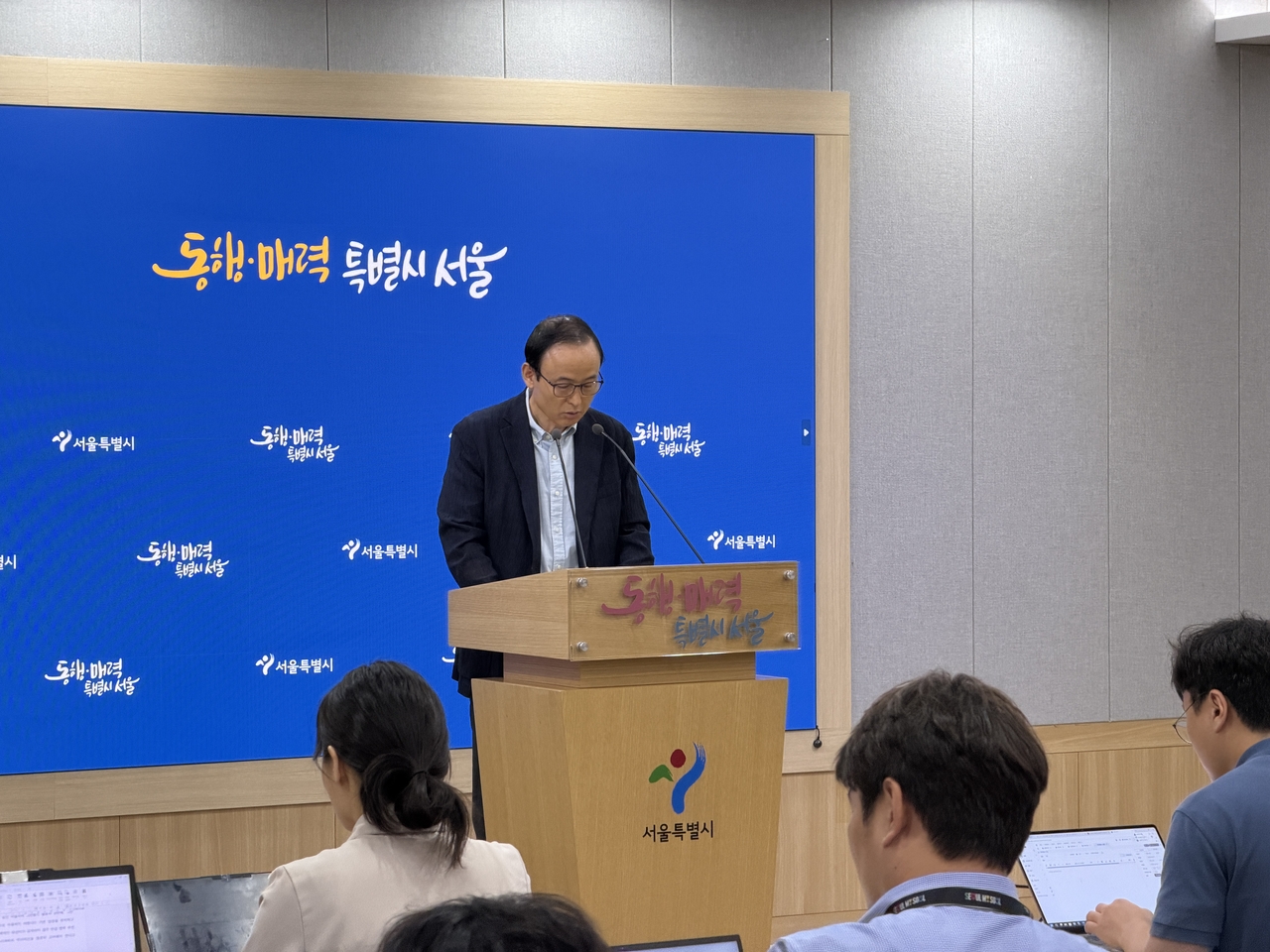
The Seoul Metropolitan Government said Thursday that the central government's Aug. 13 housing supply package would "provide some breathing room" for urban renewal projects, but called for additional policy changes — including easing restrictions on the transfer of union member status, raising floor-area ratios for private redevelopment projects, and adjusting the mandatory rental housing ratio for redevelopment sites.
The city also expressed regret that the measures were drawn up without sufficient prior consultation with Seoul. It said it cannot in principle accept proposals such as the additional release of greenbelt land, and that further talks with the central government will be needed.
Myeong No-jun, head of the city's housing bureau, said at a briefing held at Seoul City Hall that while some of the regulatory improvements the city had repeatedly requested were reflected in the package, "easing only some regulations is not enough to resolve the difficulties facing urban renewal project sites," and that "further deregulation is needed for rules that directly affect project viability and transaction conditions."
The government's announcement included easing the consent rate required to form a redevelopment union to 70 percent, improving the loan-to-value ratio calculation method for relocation loans, relaxing the conditions for sole-source contracts when selecting contractors, and partially easing mandatory park and green space requirements. The city also assessed the realization of acquisition prices for publicly contributed rental housing and the expansion of project financing support as factors that would ease the burden on urban renewal projects. However, measures such as easing restrictions on the transfer of union member status, raising floor-area ratios for private renewal projects, and adjusting the mandatory rental housing ratio for redevelopment sites were not included.
Myeong said it was positive that changing the basis for calculating relocation loans from pre-project asset valuations to post-project asset valuations would effectively raise the loan-to-value ratio to around 70 percent, partially easing financing difficulties. However, he cautioned that "as long as the mortgage loan cap — limited to between 200 million and 600 million won ($144,000 to $432,000) depending on housing price — and the overall household lending ceiling remain in place, it will be difficult to fully resolve the financing burden on project sites."
He added that relocation loans should be recognized as "project costs" for urban renewal rather than household loans, so that separate borrowing can be arranged to secure sufficient relocation funding. He said it remains to be seen how Korea Housing Finance Corp. will set separate guarantee and loan limits for additional relocation financing.
On the approach and target sites for new supply, the city reaffirmed its divergence from the central government. It said public housing land development and inner-city supply projects can only translate into actual housing supply if urban planning, infrastructure and local community acceptance are all taken into account.
On the use of greenbelt land, the city said follow-up consultations are needed as the details have not yet been shared with Seoul. Myeong said "Seoul's urban planning and residential conditions must be fully considered in the implementation process."
Ministry of Land, Infrastructure and Transport Minister Kim Yun-deok, speaking at a briefing after the supply package announcement, said the government intends to focus on grade-3 and grade-4 greenbelt areas — land that has already been significantly degraded — and is "actively preparing to supply housing" in those zones.
![A view of the Yongsan International Business District in Seoul. [Herald Business DB]](https://wimg.heraldcorp.com/news/cms/2026/08/13/news-p.v1.20260128.76792184c97540888cd787466da2004f_P1.jpg)
The scale of housing to be supplied at the Yongsan International Business District — one of the additional supply sites proposed by the central government — has also not yet been finalized with the Seoul Metropolitan Government.
Myeong said the city and the central government had originally agreed on 6,000 units for the Yongsan International Business District, but that the government's latest package mentioned 10,000 units. "You can understand it as ongoing negotiations somewhere between those two figures," he said.
On the government's stated plan to break ground in 2028, the city said the number of units must be confirmed first before detailed plans — including the scale of infrastructure and the proportion of housing — can be drawn up. The city said the existing land sale method has not changed.
The city also reaffirmed its opposition to additional housing supply on the Yongsan Park site. Myeong said the current Special Act on Yongsan Park prohibits the use of park land for housing development, meaning the law would need to be amended first. "From Seoul's perspective, there is a fundamental question of whether housing should be supplied at the cost of destroying green space," he said.
On the possibility that the central government could exercise approval authority depending on the project method, Myeong said the Ministry of Land, Infrastructure and Transport could hold direct approval authority if the project is classified as an urban development project or a public housing project, in which case "Seoul could be limited to the role of a consultative body."
About 44 sites in Seoul have been submitted to the central government as candidates for urban public housing complex projects, the city said. Myeong said Seoul would "actively cooperate under the direction of expanding housing supply," but noted that which sites are actually selected as project targets is a matter for the central government, with SH Corp. and related ministries currently in working-level consultations.
On the Yeomchang neighborhood park area in Gangseo-gu, which the government designated as a new public housing site, Myeong said the site includes private land but that he understands working-level consultations on it have already taken place.
On the Taereung Country Club supply plan, Myeong said issues related to transportation and infrastructure remain unresolved. He noted that a plan to supply 6,800 units had previously been announced but that the project had been delayed due to cultural heritage, transportation and infrastructure issues. "Since the infrastructure problems that local residents have demanded be addressed are still unresolved, sufficient communication will be needed in future procedures," he said.
Myeong said that with jeonse and monthly rent conditions serious, private rental operators are the entities best positioned to increase non-apartment supply in a relatively short period of time, but that the latest package alone cannot be seen as having rolled back all the regulations on private rental housing. He also said the temporary measure raising the acquisition price for rental housing from the standard construction cost to the basic construction cost level — applicable only through groundbreakings in 2028 — should "be continuously extended beyond that period for supply to proceed smoothly."
The city said that if heavier tax burdens and owner-occupancy requirements are maintained, the effect of the measures on private rental housing supply and jeonse and monthly rent market stability will be limited. It called on the government to "comprehensively review related policies, including the tax reform proposal announced Aug. 3, from the perspective of market stability and residential mobility."
Meanwhile, the city said it will proceed without delay with its existing plan to break ground on up to 310,000 units by 2031, adding that even after accounting for demolition of existing housing, a net increase of about 87,000 units is expected.
With the central government pledging to support the groundbreaking of 234,000 redevelopment and reconstruction units in the greater Seoul area by 2030, the city said it plans to request additional regulatory improvements and financial support to ensure its own 310,000-unit target proceeds on schedule.

lucky@heraldcorp.com
quq@heraldcorp.com