![The site around Yeomchang Park in Yeomchang-dong, Gangseo-gu, Seoul, where 1,000 housing units are to be supplied through a new public housing district designation. [Herald Business DB]](https://wimg.heraldcorp.com/news/cms/2026/08/13/news-p.v1.20260813.385ffb755a8941329e977cb700577aaa_P1.jpg)
The government has designated new public housing districts in Seoul's Gangseo-gu Yeomchang area and in Namyangju and Gwangju in Gyeonggi Province, covering about 27,000 units, and plans to announce an additional 73,000-plus units in preferred locations before the end of the year. With nearly 75 percent of a 100,000-unit new-site supply target still to be designated, the impact on core housing markets such as Seoul will depend heavily on where the follow-up sites land and how quickly projects move forward.
Under the "rapid housing supply plan" announced Thursday, the Ministry of Land, Infrastructure and Transport will designate new public housing districts centered on areas with strong transit access, including transit-oriented zones, to deliver an initial roughly 27,000 units. The government said it will apply a "fastest-track ground-breaking model" to the new districts — streamlining permitting, compensation and other procedures — with the aim of breaking ground within three to four years of the announcement.
In Seoul, 1,000 units will be supplied on a roughly 51,000-square-meter site in Yeomchang-dong, Gangseo-gu. The land is the former Yeomchang Park site, which sat idle for about 20 years after a private development project was canceled in 2006. Korea Land and Housing Corporation is set to serve as the project developer. The plan calls for creating green space linked to the existing Yeomchang Park and integrating the district designation, district planning and site preparation phases to break ground in 2029 — about 33 months after Thursday's announcement.
The largest of the three sites is the "Namyangju Dosim" district. The government plans to supply 21,700 units — a new-town-scale development — on a 2.28-million-square-meter greenbelt in Wabu-eup, Namyangju, adjacent to Dosim Station on the Gyeongui-Jungang Line. The site includes Korea University's Deokso Farm. The government intends to establish a metropolitan transportation plan linked to the existing rail network and to develop an agri-biotech cluster alongside the housing to give the district economic self-sufficiency. The district designation is targeted for the second half of 2027, with land compensation to be completed by the second half of 2029 and ground-breaking in the first half of 2030.
In Jangji-dong, Gwangju, Gyeonggi Province, a 480,000-square-meter site will become the "Gyeonggi Gwangju Transit Zone 2" district, supplying 4,500 units. The site is close to Gyeonggi Gwangju Station on the Gyeonggang Line, and its Seoul accessibility is expected to improve once the Suseo–Gwangju line opens, currently scheduled for 2031. The district will be developed as a youth-oriented residential complex linked to an industrial network connecting Pangyo Techno Valley and the Yongin semiconductor cluster. Like the Namyangju Dosim district, it targets a district designation in the second half of 2027 and ground-breaking in the first half of 2030.
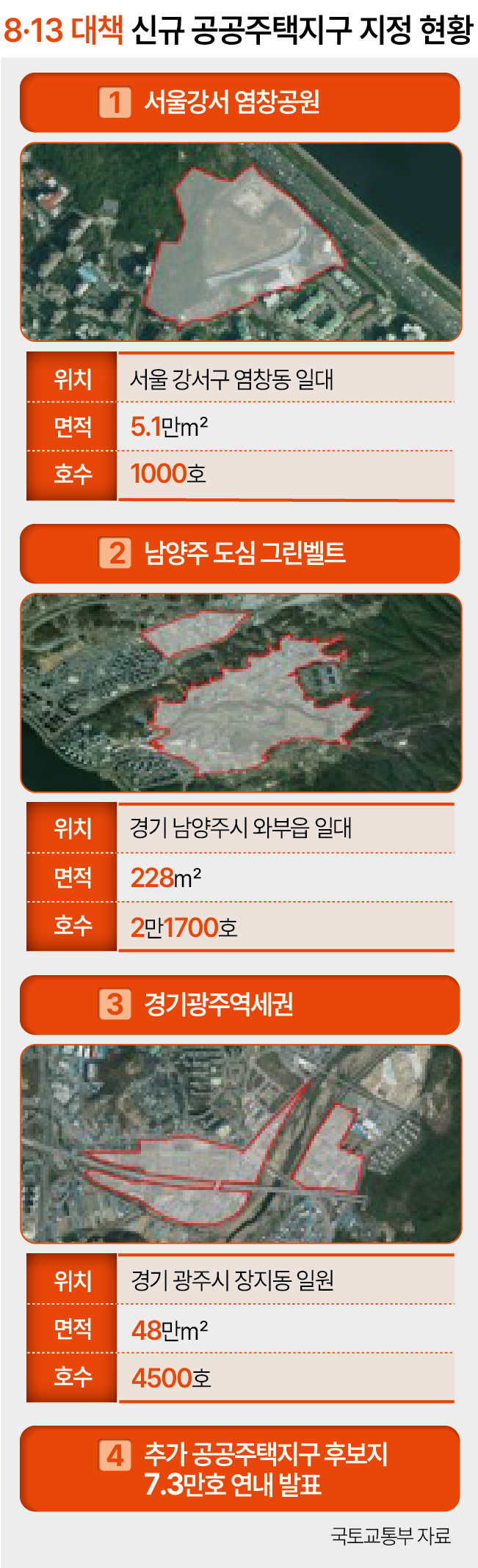
The government said it will announce additional candidate sites as quickly as possible this year, following consultations with relevant agencies. In the meantime, it will temporarily designate all greenbelt areas in Seoul and greenbelt zones adjacent to Seoul in the greater metropolitan area as land transaction permit zones. While the measure does not pinpoint specific sites, it signals that a significant share of the follow-on 73,000-plus units could come from greenbelts in and around Seoul.
Before Thursday's announcement, the market had been circulating several names as likely candidates for new housing sites: the reserve training ground area in Naegok-dong, Seocho-gu; remaining greenbelt land in Segok-dong and Jagok-dong, Gangnam-gu; the area near the Suseo vehicle depot; and the vicinity of the Olympic Athletes' Village apartment complex in Bangi-dong, Songpa-gu. In Gyeonggi Province, Gambuk-dong in Hanam — which borders Seoul's Gangdong-gu and Songpa-gu — was also mentioned. All of those areas were left out of Thursday's announcement, making it worth watching whether they appear in the follow-up supply plan due before year's end.
Sites put forward as urban supply candidates in last year's Sept. 7 measures and this year's Jan. 29 supply plan — including the Yongsan International Business District and Taereung Country Club — will also have their supply scale finalized through consultations with local governments and other relevant agencies.
The new land supply is unlikely to immediately fill the shortfall in Seoul's near-term move-in inventory. Even the fastest site, Gangseo Yeomchang, is not set to break ground until 2029, with actual move-ins coming later still. The government's new fastest-track ground-breaking model is itself focused on cutting the time from announcement to ground-breaking — from an average of 68 months for the third-generation new towns to around 37 months for the new districts.
In the short term, the more immediate effect is therefore likely to come not from an actual increase in housing supply but from the plan's role as a supply signal — easing anxiety about future availability and redirecting some purchase demand toward apartment subscription waiting. Local government and residents' opposition, along with interagency consultations, have been identified as the main variables affecting project pace.
Reconciling competing interests with existing local development projects is one early hurdle. In the Jangji-dong area where the Gyeonggi Gwangju Transit Zone 2 district is to be built, Gwangju city has been separately pursuing a "Gwangju Transit Zone Phase 2 urban development project" for years, receiving conditional approval from the Gyeonggi Province urban planning committee in May. How quickly the government can resolve conflicts between the existing project plan and landowner compensation in the course of designating the public housing district could also determine when ground is broken.
"Even if roughly 22,000 units are added through new housing sites in Namyangju, the Wangsuk new town is already being built there, so this is essentially an expansion of the existing new town into the surrounding area," said Yun Ji-hae, head of the research lab at Real Estate R114. "Enlarging the new town's scale could have some effect in absorbing part of Seoul's housing demand."
The long project timelines and the compensation and community consultation processes involved in greenbelt new-site development are a chronic variable as well. "Supply through greenbelts requires considerable time from announcement to move-in, which limits its effectiveness in resolving the short-term housing supply shortage in the greater Seoul area," said Park Hap-su, an adjunct professor at Konkuk University's Graduate School of Real Estate.
quq@heraldcorp.com