[The Herald Business = Lee Tae-hyung] Local tax revenue has grown every year, but the share of discretionary funds that local governments can spend freely has continued to shrink, weakening fiscal autonomy at the local level. Key autonomy indicators have deteriorated even since the Lee Jae Myung government took office, running counter to the 54th item among its 123 state affairs agenda items — "strengthening local fiscal authority." Experts say the government needs to move quickly on fiscal decentralization to achieve a 7-to-3 national-to-local tax ratio.
According to an analysis of the revenue decentralization index and fiscal decentralization levels released Wednesday by the Korea Institute of Local Finance, the revenue decentralization index fell to 94.7 in 2014, recovered to 103.6 in 2022 following fiscal decentralization efforts in the late 2010s, but has slipped again this year to 98.5.
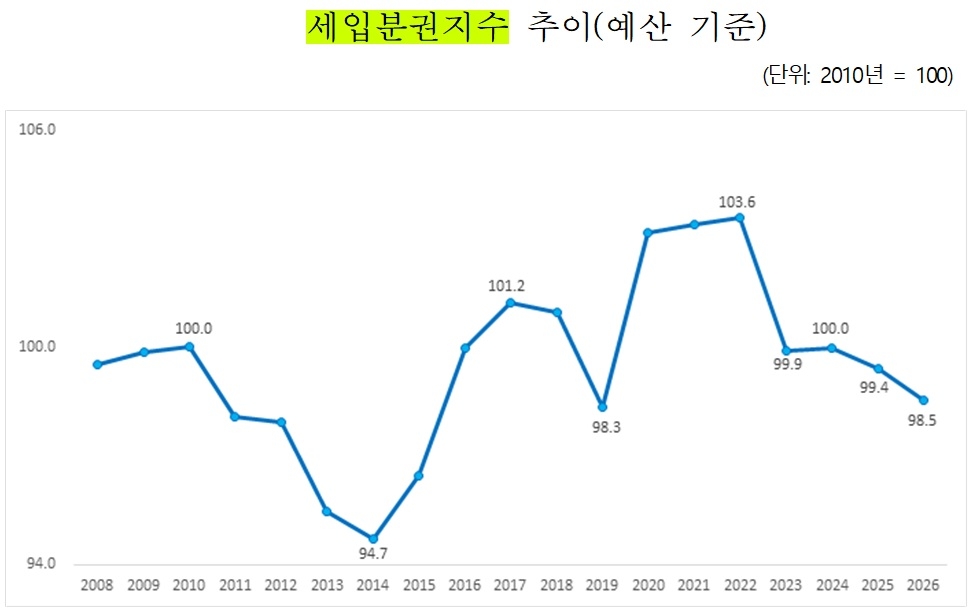
The revenue decentralization index assigns equal weight to the local tax share and the discretionary fund share, reflecting both the distribution of tax revenue between national and local governments and the broader fiscal relationship between central and local authorities.
The index rises when the local tax share expands and when the combined growth rate of local taxes and local allocation taxes outpaces that of national subsidies. A reading above 100 indicates an improvement in revenue decentralization compared with the base year; a reading below 100 signals deterioration.
From 2008 to 2026, the local tax share fluctuated but trended upward, while the discretionary fund share declined steadily. The local tax share, measured against the budget, rose 2.4 percentage points from 20.8 percent in 2008 to 23.2 percent this year, while the discretionary fund share fell 9.2 percentage points over the same period, from 74.1 percent to 64.9 percent. During this period, the compound annual growth rate of national subsidies was 8.27 percent, outpacing the 5.68 percent CAGR of discretionary funds by 2.59 percentage points — dragging down the discretionary fund share.

Park Sang-su, a senior research fellow at the Korea Institute of Local Finance, said the rapid growth of national subsidies driven by the expansion of nationally subsidized projects has increased the burden on local governments to provide matching funds, reducing discretionary resources and acting as a major constraint on local fiscal autonomy. He added that this suggests the expansion of the local consumption tax in the late 2010s may have done little more than offset the rising local cost-sharing burden from nationally subsidized projects, rather than strengthening the autonomous revenue base of local governments.
Park called on the government to swiftly advance fiscal decentralization aimed at achieving the 7-to-3 national-to-local tax ratio — a stated agenda item of the People's Sovereignty Government. "It should not stop at simply expanding the local tax share," he said. "The government must also transfer a portion of high-growth national taxes, such as income tax and value-added tax, to local governments, and improve intergovernmental fiscal relations so that the growth rate of discretionary funds — including local taxes and local allocation taxes — consistently outpaces that of national subsidies."
thlee@heraldcorp.com