
![Asiana Airlines CEO Song Bo-young delivers opening remarks at the airline's extraordinary general meeting held Wednesday at the Asiana Airlines Training Center in Osoe-dong, Gangseo-gu, Seoul. [Asiana Airlines]](https://wimg.heraldcorp.com/news/cms/2026/08/12/9/news-p.v1.20260812.ba97cd71093b4b3bab65d9e9c89f99e2_P1.jpg)
Asiana Airlines has cleared the final hurdle toward becoming part of a unified Korean Air, closing the chapter on 38 years as an independent carrier. Shareholders approved the merger in just 10 minutes, and Asiana will begin a new journey as part of the combined airline in December.
Asiana held an extraordinary general meeting Wednesday morning at the basement level of its training center in Osoe-dong, Gangseo-gu, Seoul. About 180 shareholders gathered to witness what is expected to be the airline's last shareholder meeting as an independent company.
The meeting had a single item on the agenda: approval of the merger contract with Korean Air — the vote that would formally end Asiana's existence as a standalone legal entity through absorption into its larger rival.
"This has been a long journey that began in November 2020 and has stretched on for more than five years," CEO Song Bo-young said. "On Dec. 17, Asiana Airlines will successfully complete the merger process with Korean Air and be reborn as the unified Korean Air."
Song said the merger would mark "the first step in writing a new chapter in South Korea's aviation industry as a mega-carrier," and added that the airline would "thoroughly prepare all necessary steps for a successful launch of the unified Korean Air based on the resolution passed today."
Song also acknowledged the challenges ahead, noting that the airline faces "many difficulties and uncertainties as negative external conditions — including a rapidly shifting international landscape, high oil prices and a high exchange rate — continue." He said all employees would work together to ensure both a successful launch of the combined carrier and a meaningful conclusion to Asiana's final chapter.
"I would like to once again express my deepest gratitude to our shareholders, who have offered unwavering support and encouragement throughout the merger process over the past five years and more, and who have waited so long," Song said.
Shareholders stamp final approval — merger passes with 99% support
The merger contract was approved with 99.33% of votes in favor, satisfying the supermajority threshold required for a special resolution at a general meeting.
When Song declared the resolution passed at 9:10 a.m., shareholders responded with measured applause. One shareholder said they hoped "the synergies between the two airlines will be maximized through this merger, further strengthening competitiveness in the global aviation market."
Korean Air currently holds a 63.9% stake in Asiana, making it the largest shareholder. The two carriers each held board meetings on May 13 to approve the merger and signed the merger contract the following day. Because the transaction qualifies as a small-scale merger under Korean law, Korean Air was able to approve it through a board resolution without holding its own shareholder vote.
With the shareholder vote cleared, about four months of follow-up procedures remain before the unified carrier officially launches. The merger ratio is set at 0.2736432 Korean Air shares for every one Asiana share. Shareholders who do not exercise their appraisal rights and continue to hold Asiana shares will receive 0.2736432 Korean Air shares per Asiana share, based on a record date of Dec. 15.
Shareholders who oppose the merger may exercise appraisal rights. The company has set the share buyback price at 7,030 won per share, with the exercise period running from Wednesday through Sept. 1.
Asiana shares will be suspended from trading starting Dec. 14. The merger will be finalized on the effective date of Dec. 16, and new Korean Air shares issued in connection with the merger are scheduled to list on the Kospi on Jan. 4 next year.
Founded in 1988 — 38 years of the 'rainbow wing' reach their final stop
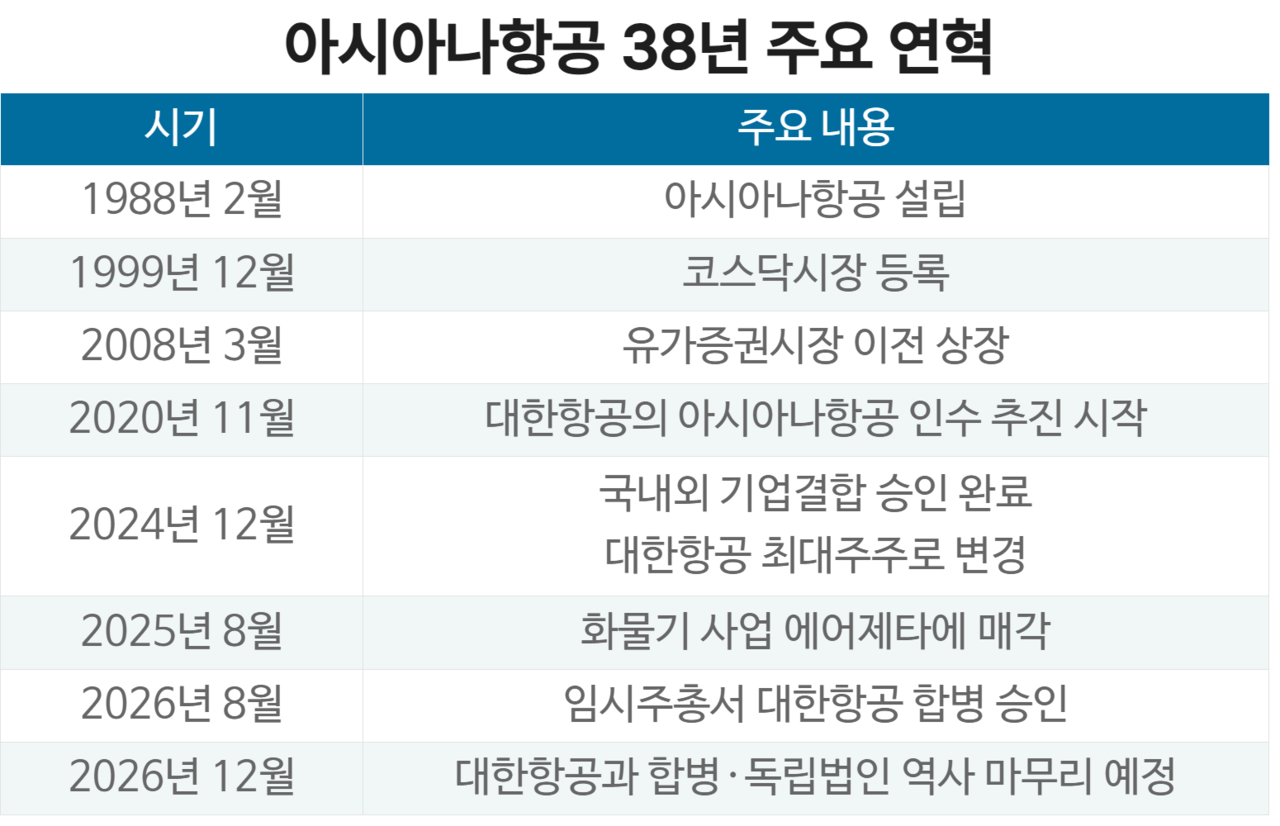
Asiana Airlines was founded on Feb. 17, 1988. It listed on Kosdaq in 1999 before transferring to the Kospi in 2008, establishing itself alongside Korean Air as one of South Korea's two full-service carriers. As of the end of last year, the airline operated 68 passenger aircraft and served six domestic cities and 53 cities in 22 countries. It carried about 4.72 million domestic passengers and about 12.16 million international passengers last year.
The turning point came in 2020. In November of that year, Asiana decided to raise 1.5 trillion won ($1.06 billion) through a third-party allotment rights offering directed at Korean Air, in a bid to improve its financial structure and secure liquidity. Merger filings with competition authorities at home and abroad followed from the next year, and the regulatory approval process was completed in December 2024. Korean Air paid in the capital increase proceeds that same month, becoming Asiana's largest shareholder, with a 63.9% stake as of the end of last year.
As a condition of regulatory approval, Asiana spun off its cargo aircraft business last August through a physical division and transferred it to Air Incheon. Asiana subsequently restructured its freight operations around belly cargo — freight carried in the lower holds of passenger aircraft.
In addition, Asiana moved to Terminal 2 at Incheon International Airport in January and has been working to attract connecting passengers by leveraging its joint network with Korean Air, while pursuing operational efficiencies through integrated management. The ultimate goal is to bring passenger and cargo services, flight and cabin operations, maintenance standards, mileage programs and IT systems all under a single corporate entity.
After the merger, synergies from economies of scale are expected across passenger, cargo and maintenance operations. Asiana projects annual merger synergies of more than 300 billion won. On the passenger side, the airline anticipates revenue gains from eliminating overlapping schedules, expanding connecting flights and joining the Korean Air–Delta Air Lines transpacific joint venture. On the cargo side, combining dedicated freighter and belly cargo networks is expected to generate additional efficiencies. Bringing maintenance operations in-house to the standard of Korean Air is also expected to gradually improve the cost structure for aircraft and upkeep.
Speaking with reporters after the meeting, Song identified staff unity and minimizing customer disruption as the two key tasks for the remaining four months. "We will review once more everything we have prepared so far and get ready to generate synergies when the combined carrier launches," he said. "We are thoroughly preparing to ensure that employees work together harmoniously and that customers do not experience any inconvenience or confusion." On the question of integrating mileage programs, Song said the airline was also waiting on the outcome: "The Korea Fair Trade Commission has not yet made an announcement, so we are waiting as well."
kwater@heraldcorp.com




