
![Attendees pose for a group photo at "Kosdaq Connect 2026," an event marking the 30th anniversary of the Kosdaq market, held at the Conrad Hotel in Yeouido, Seoul, on July 1. From left: Kim Se-wan, president of the Korea Capital Market Institute; Song Byung-jun, chairman of the Korea Venture Business Association; Oh Ki-hyung, chairman of the Korea Premium K-Capital Market Special Committee; Jeong Eun-bo, chairman of Korea Exchange; FSC Chairman Lee Eok-won; Lee Dong-hun, chairman of the Kosdaq Association; Kim Hak-gyun, chairman of the Korea Venture Capital Association; and Hwang Seon-o, deputy governor of the Financial Supervisory Service. [Korea Exchange]](https://wimg.heraldcorp.com/news/cms/2026/08/11/news-p.v1.20260701.081a2f8740fc438aa0e13fbe18f932ec_P1.jpg)
The Kosdaq surged nearly 7 percent in a single session to reclaim the 850 level Monday, but a closer look at the stocks that hit the daily upper limit reveals a troubling pattern: many are loss-making companies or firms on the verge of being placed on a watchlist for failing to meet listing-maintenance requirements. Of the 11 stocks that reached the price ceiling, eight posted operating losses in the first quarter of this year. Companies that had already received disclosure notices warning of a possible watchlist designation — due to share prices or market capitalization falling short of listing standards — also joined the upper-limit rally. The broad recovery in investor sentiment across the Kosdaq appeared to draw short-term funds into individual catalysts and thematic plays rather than earnings, lifting even fundamentally weak stocks.
According to Korea Exchange, the Kosdaq closed Monday up 55.66 points, or 6.97 percent, at 854.47. A buy-side sidecar — suspending program buy orders for five minutes — was triggered around 9:50 a.m. Monday after the Kosdaq 150 futures price and the Kosdaq 150 index both surged sharply.
Individual stocks also posted steep gains. Wing YIP Food, Abion, Haesung Optics, Vitzro Nextech, China Crystal New Material, BK Holdings, LK Samyang, Parataxis Ethereum, QuantaMatrix, From Bio and E8 — 11 Kosdaq-listed companies in all — simultaneously hit the daily upper limit.
On Tuesday, the Kosdaq opened lower before turning positive. As of 10:07 a.m., the index was trading up 11.98 points, or 1.40 percent, at 866.45. It had opened down 5.88 points, or 0.69 percent, at 848.59 and slipped as low as 840.45 intraday before rebounding. At the same time, the Kospi was down 68.70 points, or 1.09 percent, at 6,230.96.
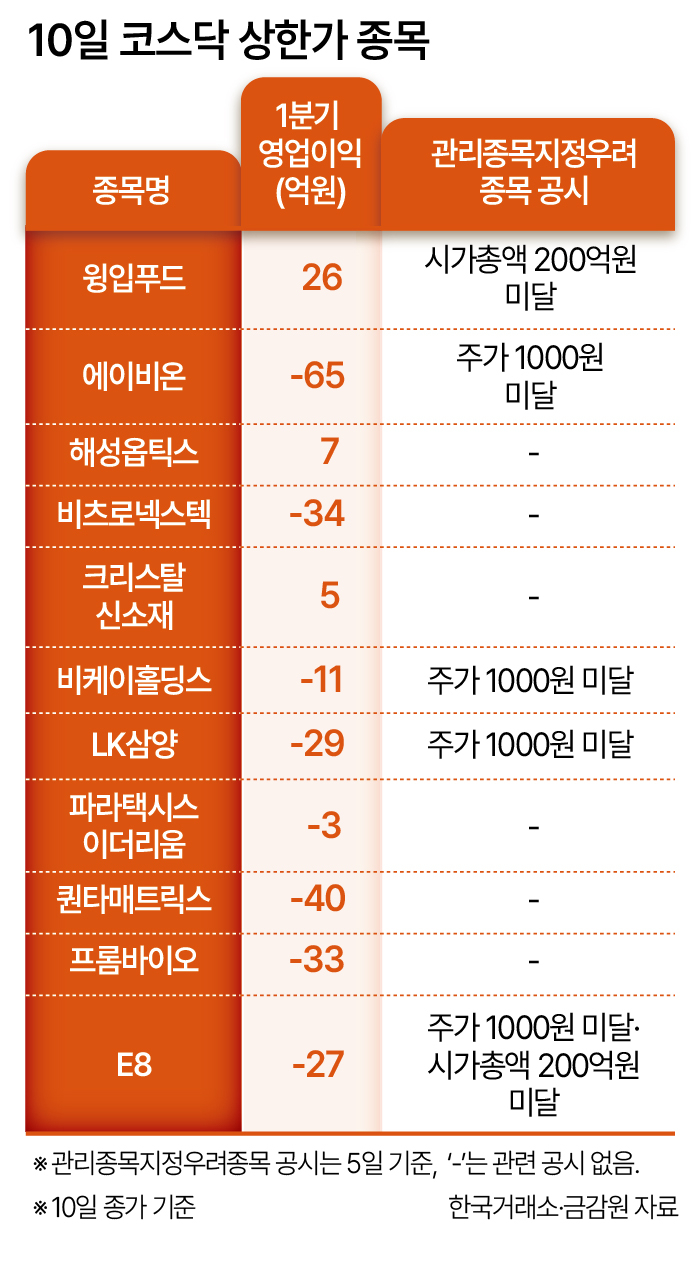
Some of the stocks that hit the daily upper limit Monday continued to climb Tuesday. LK Samyang and From Bio both reached the upper limit again around 9:25 a.m., rising 29.93 percent and 29.88 percent, respectively. From Bio subsequently fell back from the ceiling and was up 19.67 percent as of 10:07 a.m., while LK Samyang held its upper-limit gain. Abion was trading up 23.31 percent at 1,037 won, and Wing YIP Food was up 10.40 percent at 2,230 won.
A breakdown of the upper-limit stocks shows that loss-making companies made up the majority. According to DART, eight of the 11 companies that hit the daily price ceiling Monday posted operating losses in the first quarter of this year: Abion (6.5 billion won ($4.7 million)), Vitzro Nextech (3.4 billion won), BK Holdings (1.1 billion won), LK Samyang (2.9 billion won), Parataxis Ethereum (300 million won), QuantaMatrix (4 billion won), From Bio (3.3 billion won) and E8 (2.7 billion won).
For some of these companies, the losses have been mounting for several consecutive quarters. Abion posted operating losses of 4.4 billion won in the third quarter of last year, 5.6 billion won in the fourth quarter and 6.5 billion won in the first quarter of this year. QuantaMatrix recorded losses of 3.7 billion won, 4.6 billion won and 4 billion won over the same three periods. LK Samyang, From Bio, BK Holdings and E8 also logged operating losses for three consecutive quarters.
Companies teetering on the edge of a watchlist designation under tightened listing-maintenance rules also joined the upper-limit rally. Korea Exchange on Aug. 5 issued a wave of disclosure notices warning companies that had failed to meet listing-maintenance standards for 25 consecutive trading days of a possible watchlist designation. A total of 68 such notices were issued across the Kosdaq and Kospi combined.
Among the stocks that hit the upper limit Monday, Wing YIP Food had received a watchlist-warning notice for its market capitalization falling below 20 billion won, while Abion and LK Samyang had received notices for their share prices falling below 1,000 won. BK Holdings received a notice warning of an additional watchlist-designation ground related to its share price falling below 1,000 won. E8 triggered both criteria — a share price below 1,000 won and a market capitalization below 20 billion won — and received two separate disclosure notices on Aug. 5.
Under the tightened listing-maintenance standards that took effect last month, Kosdaq-listed companies can be placed on the watchlist if their share price stays below 1,000 won or their market capitalization remains below 20 billion won for 30 consecutive trading days. The notices Korea Exchange issued Aug. 5 served as advance warnings for companies that had already failed to meet those thresholds for 25 consecutive trading days. Companies that continue to fall short of the standards after that point face a formal watchlist designation.
Despite the listing pressure, what drove these stocks higher was not improved earnings but individual catalysts and thematic momentum. Wing YIP Food, which had received a watchlist-warning notice for insufficient market capitalization, hit the daily upper limit for two consecutive trading days — Friday and Monday — after its largest shareholder participated in a rights offering and its chief executive bought back company shares. E8 was lifted by a decision to raise 4 billion won through a third-party allotment rights offering to acquire securities in another company, while Abion was boosted by news that a core foundational technology for its next-generation immuno-oncology platform had been granted a US patent.
Aerospace-related stocks including Vitzro Nextech and LK Samyang attracted buying interest on expectations that the government would push ahead with building a second space center. From Bio hit the daily upper limit on the first day trading resumed after completing a 5-to-1 share consolidation. In many cases, individual catalysts — patents, policy expectations, rights offerings and share consolidations — rather than improved earnings drove the sharp price gains.
Analysts say the combination of a broader recovery in Kosdaq investor sentiment and an influx of speculative funds amplified gains even in loss-making and low-priced stocks.
"The fact that loss-making companies and watchlist-risk stocks are heavily represented among the top upper-limit gainers suggests that price itself, rather than fundamentals, has become the basis for buying," said Kim Min-gi, a research fellow at the Korea Capital Market Institute. "If this were a fundamentals-driven rebound, buying pressure should be selectively concentrated in stocks showing confirmed earnings improvement — but that selectivity is not working." He added that "the recovery in risk appetite across the broader market is clearly also a factor, so it is reasonable to view this as a structure in which sentiment recovery pulled the trigger and speculative funds amplified the move."
Analysts also flagged the risk of heightened volatility in watchlist-risk stocks. "These stocks have thin float, so even small amounts of money can move prices significantly — and when short-term buying piles in, the amplitude of swings in both directions grows," Kim said. "Measures to avoid a watchlist designation, such as rights offerings, asset sales and capital reductions, generally dilute existing shareholders' stakes, so news that a company has avoided designation is not necessarily a positive catalyst for the share price."
He also warned that "if trading is suspended, investors face liquidity risk — they cannot sell their shares when they want to," and advised investors to verify directly through official disclosures whether the basis for a sharp rally is a filing or a rumor, paying particular attention to disclosures related to listing-maintenance criteria such as audit opinions, capital impairment and sales requirements.
hajun825@heraldcorp.com



