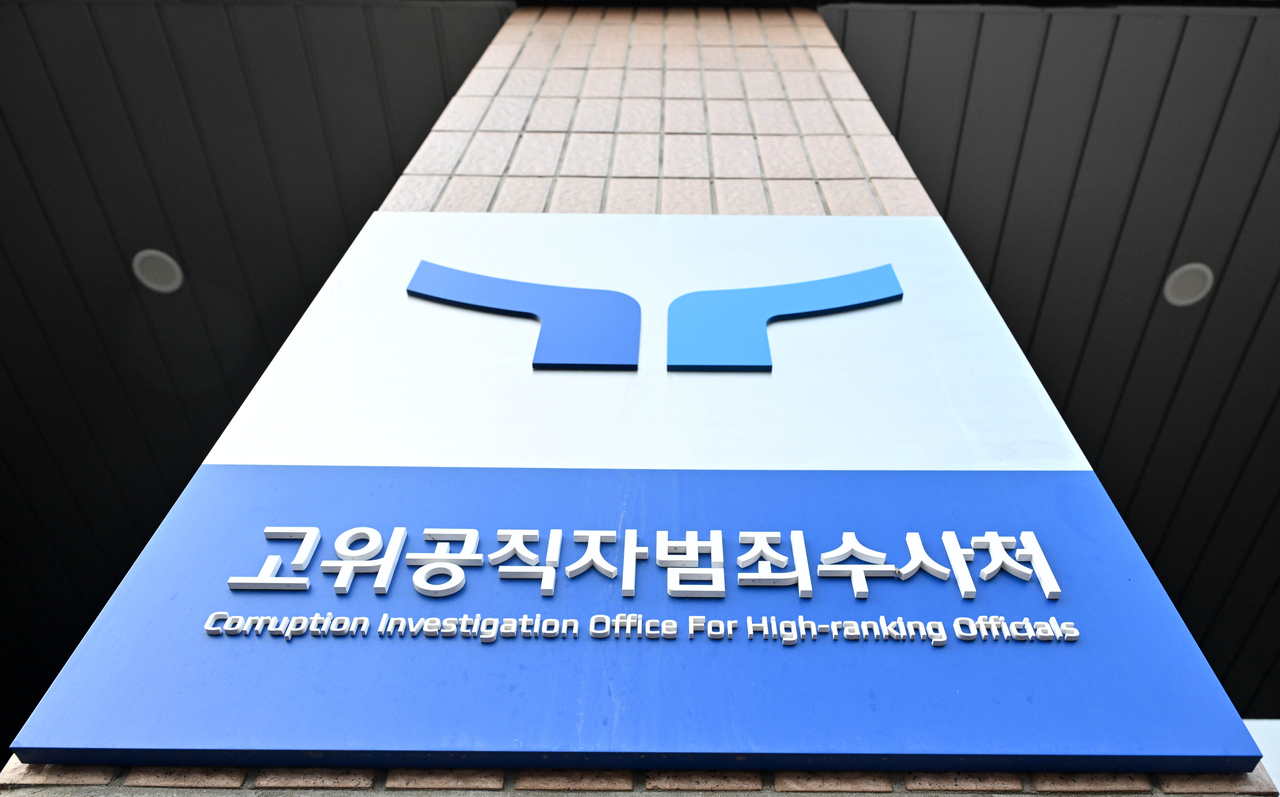
The Corruption Investigation Office for High-ranking Officials (CIU) doubled down Tuesday on its call to embed investigative procedure rules directly into its governing law, amid sweeping changes set to take effect in October that will abolish the prosecution service and strip prosecutors of their investigative authority under a revised Code of Criminal Procedure.
At a briefing held Tuesday at its Gwacheon, Gyeonggi Province office, the CIU said it had already conveyed to the National Assembly its view that investigative procedure provisions must be written into the CIU Act, citing concerns that grounding the agency's investigative authority in a supplementary clause of the criminal procedure code creates legal instability. The agency also said the amended CIU Act must take effect simultaneously with the revised Code of Criminal Procedure — on Oct. 2.
The National Assembly passed the revised Code of Criminal Procedure on July 31, with the overhaul centered on the complete abolition of prosecutors' investigative authority, including their power to demand supplementary investigations. The Cabinet reviewed and approved the bill Tuesday and promulgated it the same day.
The CIU had raised similar concerns at briefings on July 14 and July 28, arguing that amendments to the CIU Act were necessary because its prosecutors have been operating under provisions that mirror those governing prosecutors at the prosecution service.
CIU spokesperson Kim Baek-gi said Tuesday that statutory provisions must clearly spell out the investigative procedures — including arrest, detention, and search and seizure — that CIU prosecutors carry out. "It does not have to be the CIU Act specifically; whether it is the Code of Criminal Procedure or the CIU Act, what matters is that the investigative standing of CIU prosecutors is preserved," Kim said. He added that the agency plans to hold a related forum if the opportunity arises.
The CIU also said its investigative jurisdiction should be expanded to cover officials at the new Serious Crime Investigation Agency (SCIA) at Grade 4 and above. Under the restructuring, incumbent prosecutors who move to the SCIA will be classified as Grade 1 if they hold a chief district prosecutor-level post, Grade 2 if they are deputy or division chief-level, Grade 3 if they have 10 or more years of legal experience, and Grade 4 if they have fewer than 10 years. On the police side, the CIU said its jurisdiction should be broadened to cover officers at the rank of senior superintendent and above, rather than being limited to superintendent general and above as at present.
The CIU also called for removing the six-year renewable term limit for its investigators, noting that SCIA investigators face a mandatory retirement age of 60 with no term restrictions. "Both agencies employ national civil servants and share the same basic structure overall. There is no reason only CIU investigators should be subject to a term limit," Kim said. "There may have been a legislative intent behind it, but circumstances have changed significantly."
The agency doubled down on its call to resolve the friction that arose with the prosecution over demands for supplementary investigations. At the July 28 briefing, the CIU had proposed introducing a system of "additional investigation requests," arguing that the concept of supplementary investigation demands arose from the relationship between prosecutors and judicial police officers — not between prosecutors of equal standing.
Kim said Tuesday that "from a prosecutor-to-prosecutor standpoint, 'additional investigation' is the appropriate term," adding that the agency wants to establish procedures through CIU rules and work cooperatively. He also said there should be a statutory basis allowing CIU prosecutors to support the maintenance of a prosecution by submitting written opinions at trial.
In addition, the CIU said an appeals process — such as a petition for a court ruling on non-prosecution — is needed for cases in which a prosecutor at the new Public Prosecution Service decides not to indict, noting that no such provision currently exists. "If there is an additional investigation request on a case referred for indictment and the investigation proceeds, there is no problem. But if no such arrangement is reached and the Public Prosecution Service decides not to indict, there is no avenue for appeal," Kim said. "We are proposing that a provision allowing for a petition for a court ruling on non-prosecution be established."
bell@heraldcorp.com