Seoul Mayor Oh Se-hoon has reaffirmed his opposition to housing supply plans that would use the Yongsan Park site or release greenbelt land.
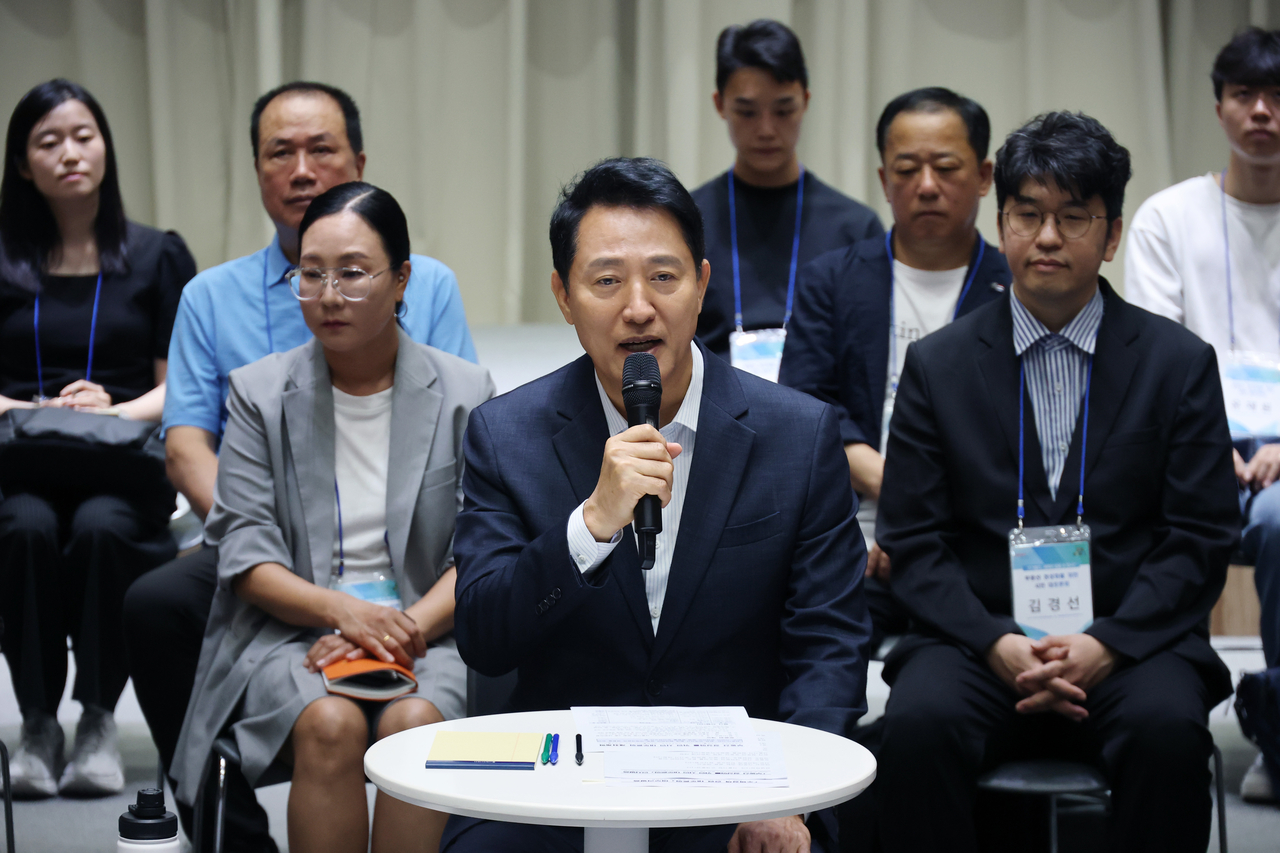
Oh first staked out the position Thursday at a public forum on real estate normalization held at Seoul City Hall. In closing remarks, he said the possibility of using the Yongsan Park children's garden site for housing had recently come up in discussion. "Not even a portion of it can ever be used that way for housing supply. I cannot agree to this," he said.
Appearing on KBS's "Sasageongeon" on Monday afternoon, Oh was asked again about the prospect of building housing near the Yongsan Park children's garden. "Seoul does not have permitting authority over that site," he said. "I am not opposing this because I have jurisdiction — I am speaking on principle."
He said Seoul had suffered from a severe shortage of green space since its earliest urban planning days. "People may assume there is plenty of greenery because they can see Namsan, Bukhansan and Bugaksan, but in fact residential green space is extremely scarce compared with the average for major cities worldwide," he said.
Oh added that the former US military base in Yongsan had offered a rare opportunity to create green space in the city, and that a special law had even been enacted to preserve it. "Now, because the housing situation is difficult, there are moves to touch the only green space left in the heart of the city," he said. "There is no mayor anywhere in the world who would agree to that."
Oh also noted that two years ago, under the Yoon Suk Yeol administration, Seoul had already approved greenbelt release for Seoripul Districts 1 and 2, a project covering about 20,000 homes, and had at that time made clear it did not want further greenbelt land touched. "Even that project is not moving forward properly because resident consultations have not been completed," he said.
He questioned whether any urban administrator could accept further greenbelt releases while the already-approved 20,000-home project remained stalled. "Preserving green space is the most fundamental principle of city management," he said. "We agreed to land that could accommodate 20,000 homes, and that is not even progressing — yet there is now talk of releasing more greenbelt for another 10,000 or 15,000 homes. Is there any responsible city official who could agree to that?"
Seoul projects that if ongoing redevelopment projects break ground on 310,000 homes by 2031, roughly 220,000 existing units will be demolished in the process, yielding a net increase of about 87,000 homes.
Oh said the analysis had already been shared with the presidential office as part of Seoul's assessment of the housing supply impact of its redevelopment pipeline, and urged the central government to lend its support. "If the government simply does not obstruct — and better yet, actively helps — the redevelopment and reconstruction projects Seoul is pushing hard, that will do far more to stabilize the real estate market," he said.
ken@heraldcorp.com