
Prices for edible oils including sunflower oil and palm oil have continued to climb under the pressure of extreme heat worldwide. Edible oils are a key raw material used across the processed food industry.
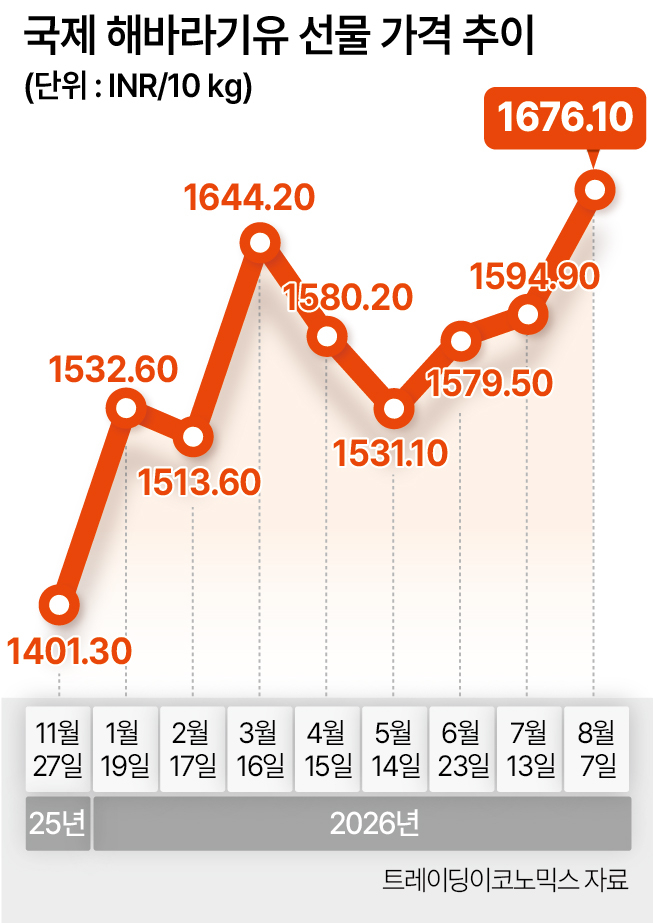
According to global market research firm Trading Economics, international sunflower oil futures stood at 1,676.10 rupees per 10 kilograms as of Aug. 7 — up 5.4 percent from the previous month and 28.9 percent higher than a year ago. Sunflower oil was trading in the 1,400-rupee range last November, but supply disruptions in Ukraine and the Black Sea region pushed prices into the 1,500-rupee range earlier this year. After breaking through 1,600 rupees in March before pulling back, prices have been rising again since June.
The latest leg higher was driven by a heatwave across Europe. The continent endured record heat, drought and wildfires throughout June and July, cutting vegetable and grain output in France, Spain and other countries. The EU has lowered its sunflower harvest forecast for this year by 7 percent from its earlier projection.
Other edible oil markets are also trending higher. Palm oil futures reached 4,677 ringgit per ton as of Aug. 7, up 9.9 percent from the same period last year, driven by rising global crude oil prices and growing demand for biofuels. Palm oil is used in the deep-frying process for ramyun and snack products. Soybean and rapeseed futures — the raw materials for soybean oil and canola oil — rose 15.8 percent and 13.9 percent, respectively, from a year earlier.
Rising olive oil prices have also pulled up the broader edible oil market through a spillover effect, as consumers shift demand toward substitutes such as sunflower seed oil and rapeseed oil. According to Investing.com, international olive oil prices reached $6,200 per ton last month, up 22.1 percent from a year ago. Major producing regions in Spain, Italy and other European countries have struggled with below-normal rainfall since last winter, compounded by recent heatwaves exceeding 40 degrees Celsius.
A high exchange rate is adding to the import cost burden at home. According to Korea Customs Service trade statistics, the import price of soybean oil stood at 2,243 won per kilogram in June, up 21.9 percent from a year earlier. Olive oil came in at 13,814 won per kilogram in June, up 17.3 percent year-on-year, while palm oil jumped 28.9 percent.
The industry is watching closely whether the global heatwave will push edible oil prices broadly higher across international markets. Nongshim earlier raised factory prices of major cup ramyun products — including Yukgaejang Bowl Noodles and Shin Ramyun Cup — by an average of 6.0 percent, and snack products such as Shrimp Crackers by 5.5 percent, effective Aug. 1, citing rising raw material costs.
If the trend persists, it could put additional upward pressure on domestic consumer prices for processed foods and other goods. "Edible oil prices have risen sharply across the board since June as the heatwave drags on," an industry official said. "Companies have been absorbing the cost pressure so far, but more will find it impossible to hold out in the second half of the year."
![Cooking oil on display at a hypermarket in Seoul. [Yonhap]](https://wimg.heraldcorp.com/news/cms/2026/08/10/rcv.YNA.20260708.PYH2026070812030001300_P1.jpg)

korean@heraldcorp.com




