
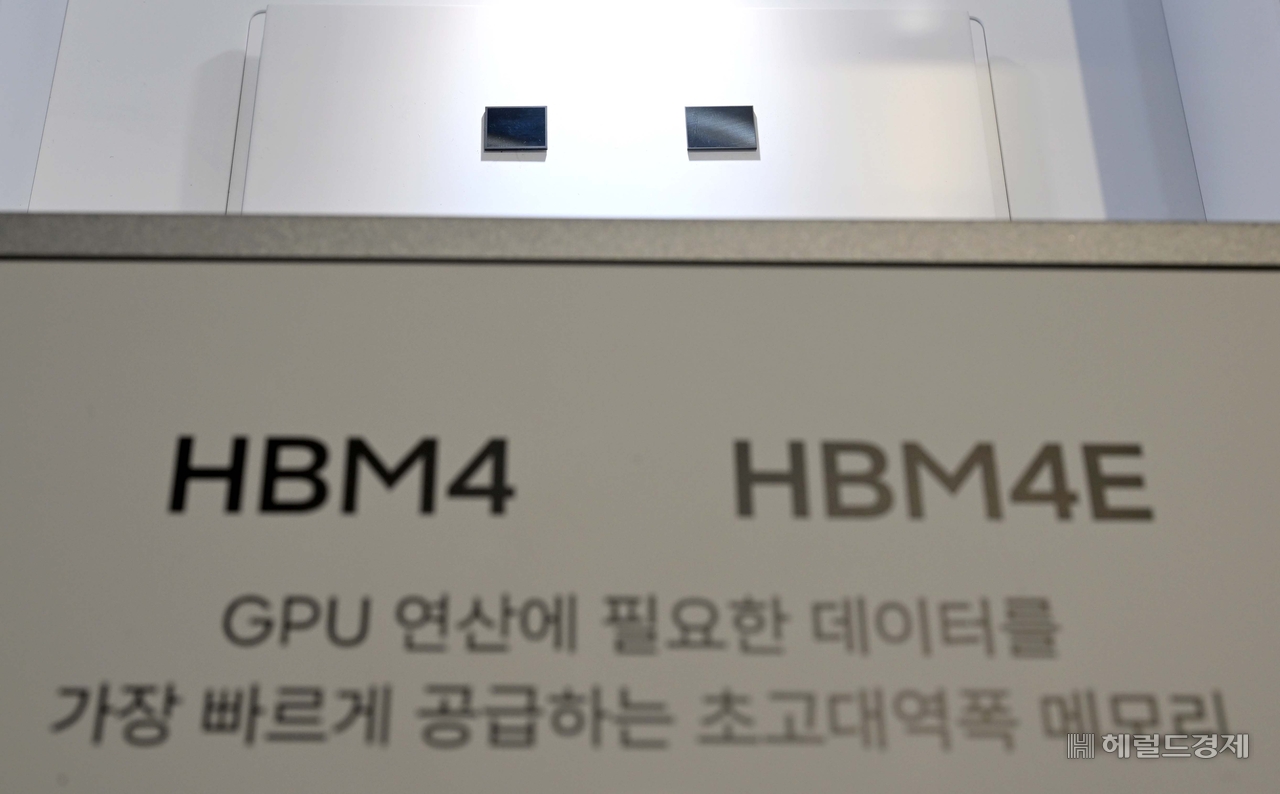
A global memory chip shortage is reshaping the AI accelerator strategies of Nvidia and AMD. As high-bandwidth memory supplies from Samsung Electronics and SK Hynix fail to keep pace with surging demand, both chipmakers are exploring lower-spec HBM alternatives.
According to industry sources, Nvidia had originally planned to equip its next-generation AI accelerator, Rubin Ultra — slated for release in the second half of next year — with seventh-generation HBM4E 12-layer chips. Samsung Electronics and SK Hynix delivered HBM4E samples to Nvidia in the first half of this year and have been working through the certification process.
However, market research firm TrendForce said Nvidia has recently been considering equipping Rubin Ultra with lower-spec options, including sixth-generation HBM4 in 8-layer and 12-layer configurations, as well as HBM4E in an 8-layer stack.
The HBM4E 12-layer chip offers 48 gigabytes of capacity, while the HBM4 12-layer version provides 36 GB. The HBM4 also trails the HBM4E in energy efficiency and thermal resistance.
In terms of bandwidth — the volume of data transferable per second — the HBM4E delivers 3.6 terabytes per second, compared with 3.3 TB for the HBM4 based on Samsung Electronics' product specifications. Operating speeds also differ: the HBM4E reaches up to 16 gigabits per second, while the HBM4 tops out at 11.7 Gbps.
![Samsung Electronics Chairman Lee Jae-yong (from left), SK Group Chairman Chey Tae-won, Hyundai Motor Group Chairman Euisun Chung and Nvidia CEO Jensen Huang meet at the San Francisco AI Summit held at The Midway in San Francisco on July 24 (local time). [Yonhap]](https://wimg.heraldcorp.com/news/cms/2026/08/07/rcv.YNA.20260725.PYH2026072503010001300_P1.jpg)
Nvidia's consideration of lower-spec HBM4 for its next-generation AI accelerator stems from the ongoing supply crunch. The company appears to have concluded that it cannot secure enough HBM4E 12-layer units next year to meet its needs, given the broader DRAM supply disruption.
Analysts also point to rising manufacturing complexity as a contributing factor. Each successive generation of HBM demands tighter yield control and more sophisticated thermal management. The yield uncertainty surrounding HBM4E 12-layer chips means the validation period could run longer than for previous generations.
TrendForce said Nvidia's top priority for Rubin Ultra is improving input/output speeds, with higher shipment volumes a secondary goal. "If Nvidia ultimately decides to lower HBM specifications, it will likely do so by reducing the number of stacked DRAM layers," the firm said.
TrendForce added that big tech companies developing their own AI accelerators are also exploring the use of lower-capacity HBM chips.
![A model of SK Hynix's HBM4E chip on display at Computex 2026 in Taipei, Taiwan, in June. [SK Hynix]](https://wimg.heraldcorp.com/news/cms/2026/08/07/news-p.v1.20260618.72b86f1210904b729a293354e48286af_P1.png)
AMD CEO Lisa Su, whose company has been expanding its AI accelerator business to challenge Nvidia, also signaled flexibility on memory specifications. Speaking at AMD's second-quarter earnings call on Monday (local time), she said the company "could adjust memory configurations if the total cost of ownership advantages of higher-capacity, higher-bandwidth memory are not significant."
AMD's recently launched Instinct MI455X AI accelerator carries 432 GB of HBM4 — 50 percent more than the 288 GB in Nvidia's Rubin. Despite pursuing performance gains through high-capacity HBM, Su indicated the company could scale down to lower-spec memory depending on the AI model, citing memory pricing and supply pressures.
The semiconductor industry expects that big tech firms' shift toward lower-spec HBM could reduce total HBM capacity per AI accelerator below earlier projections, but analysts believe Samsung Electronics and SK Hynix will retain their pricing power.
If the trend of using HBM4 as an interim solution continues until HBM4E reaches full production, the competition between Samsung Electronics and SK Hynix to supply HBM4 is expected to intensify further.
TrendForce said AI chip suppliers facing the dual pressures of limited HBM supply and high procurement costs will have growing incentives to adopt lower-capacity HBM.

joze@heraldcorp.com



