As public frustration over the government's proposed tax reform package continues to simmer, political battles over housing policy are intensifying. With the government set to announce a new housing supply plan imminently, the ruling and opposition parties are sharpening their attacks over who bears responsibility for the supply shortage.
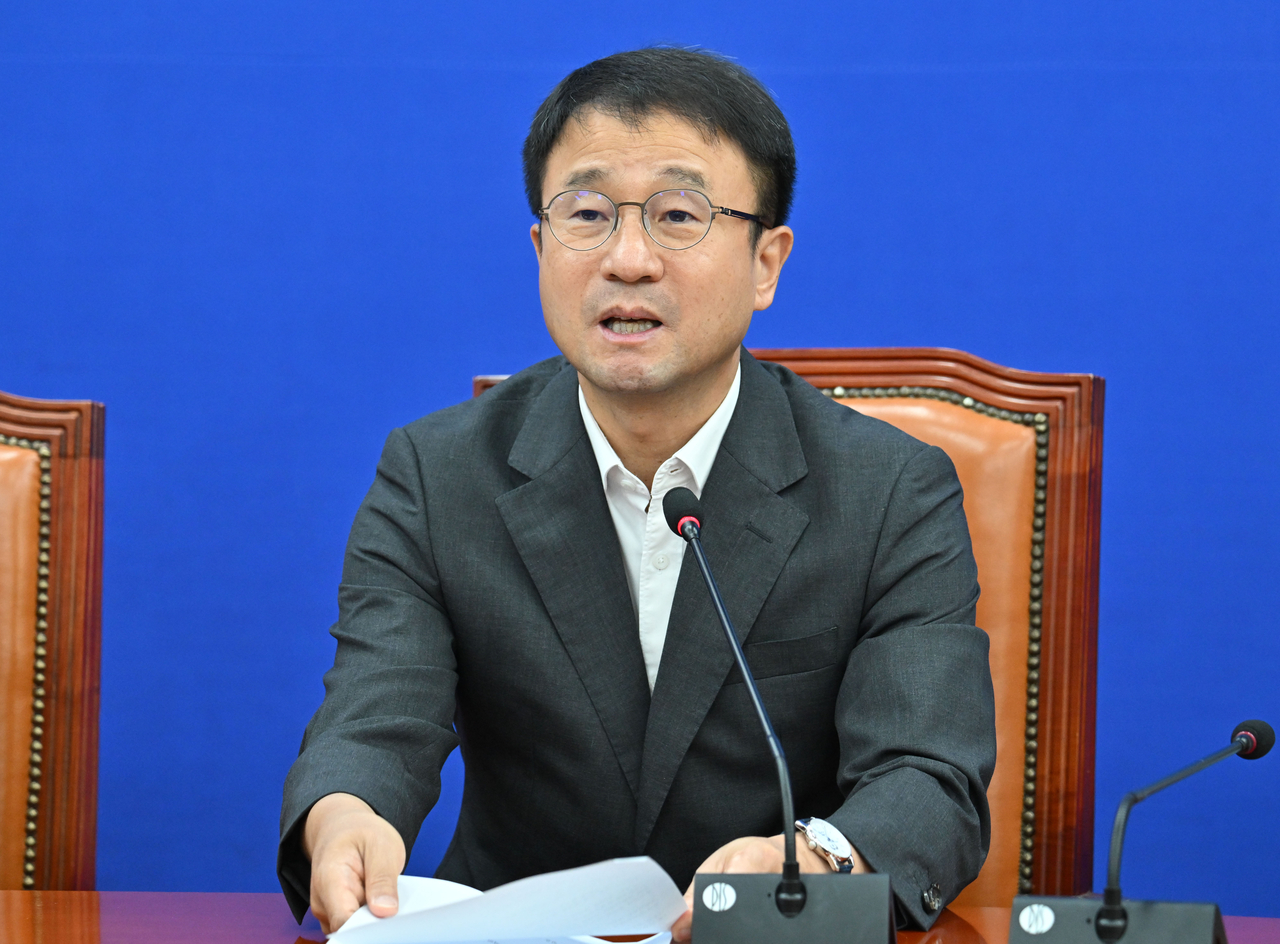
Han Byung-do, acting leader and floor leader of the Democratic Party of Korea, took aim at the People Power Party at a floor strategy meeting Friday, saying the party appeared to have forgotten that housing ground-breakings fell sharply under the Yoon Suk Yeol administration and that construction of third-generation new towns was repeatedly delayed. "Blind criticism without any alternative will not move market normalization forward by a single step," he said.
Han also said Seoul Mayor Oh Se-hoon "is the very person who sowed market confusion by lifting and then reinstating land transaction permit zones last February, and is now raising his voice against the government." He pressed the People Power Party to cooperate in holding a plenary session and passing related legislation on Aug. 13.
Democratic Party policy committee chairwoman Han Jeong-ae said a real estate forum hosted by Mayor Oh on Thursday was "dominated by criticism for criticism's sake." While agreeing that measures to ease the jeonse and monthly rent crisis were needed, she said she regretted that the forum had been used solely to promote private redevelopment projects and attack the government's tax reform plan.
"The housing supply cliff in Seoul is also a product of Mayor Oh's own making," she added, saying the party and government would do their utmost to prepare measures — including rental housing that can be supplied quickly — to ease hardship in the jeonse and monthly rent market.
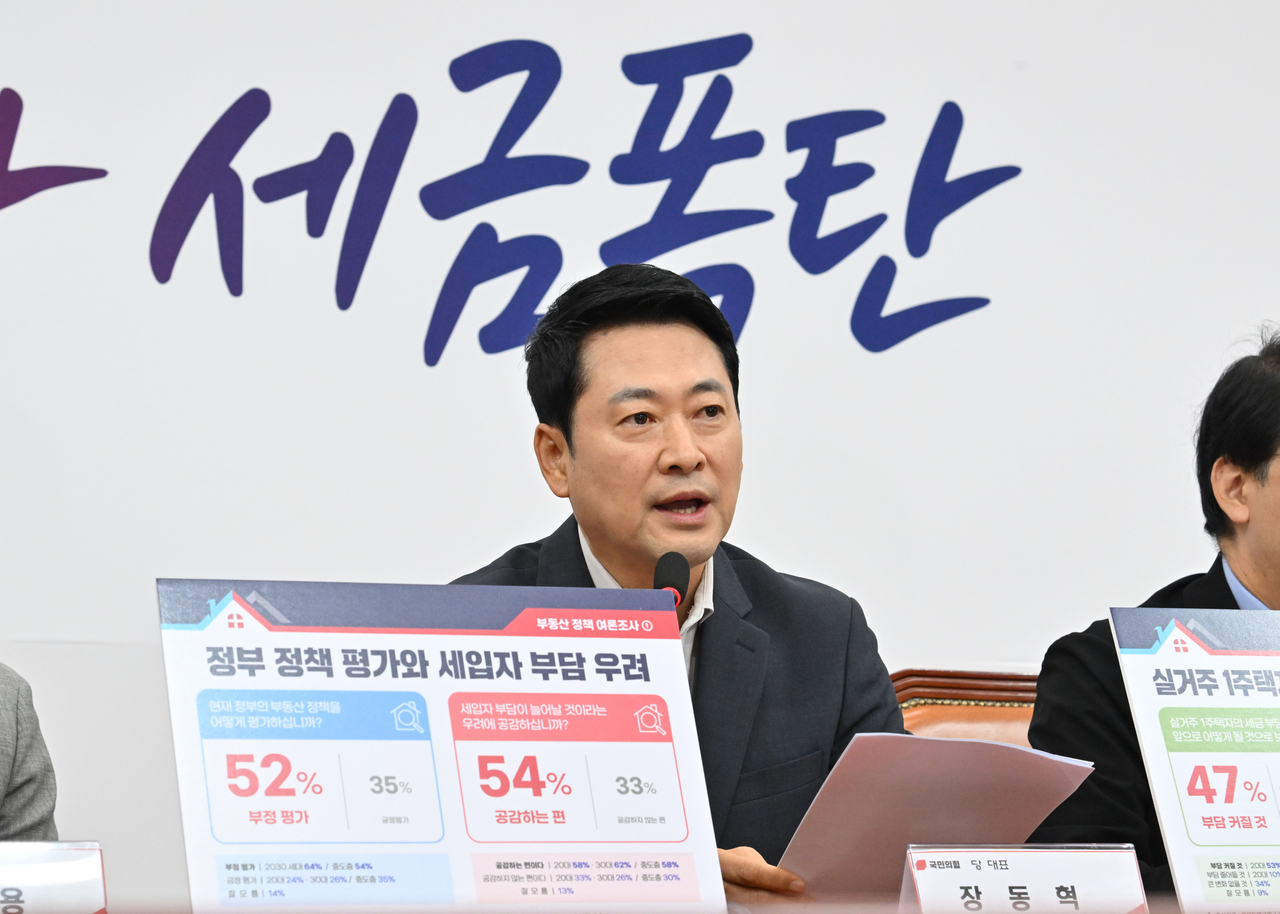
The People Power Party, meanwhile, convened a plenary session of its special committee on real estate policy normalization at the National Assembly on Friday and launched a sweeping offensive against the government and the ruling party.
Party leader Jang Dong-hyeok said Seoul apartment prices had risen 11 percent over the first year of the Lee Jae Myung administration — surpassing the Moon Jae-in government's record and ranking first among all administrations. "The cause of this real estate crisis is President Lee Jae Myung himself — the root of all the trouble," Jang said.
Jang said the public had been gripped by confusion and fear since the tax reform plan was announced, and dismissed the expected supply measures as "pathetic." He said the government was reportedly planning to convert commercial buildings and offices into residential units. "They live in palatial homes in Gangnam while forcing ordinary citizens to live in converted retail spaces," he said.
Amid the political sparring, President Lee held a second housing policy review meeting Friday, focusing on measures related to housing supply.
The meeting came just four days after the first, as Lee sought to personally review individual candidate sites and project timelines ahead of a housing supply announcement expected as early as next week.
Lee is firmly convinced that expanding supply is the top priority for stabilizing the housing market.
The administration's view is that a large-scale supply plan targeting areas preferred by end-users must be announced quickly to achieve a stabilizing effect and address market concerns about a supply shortage.
To that end, the government is reviewing a plan to supply more than 50,000 new homes, centered on the greater Seoul area. A proposal under active discussion would combine that figure with the 60,000 units announced under the Jan. 29 measures — including sites at Taereung Country Club and the Gwacheon Racecourse — to achieve a total supply effect of around 110,000 units.
As part of that effort, measures to revitalize reconstruction and redevelopment projects and ease regulations on semi-industrial zones are also likely to be included to boost housing supply in prime Seoul locations.
After returning Monday from an 11-day overseas trip, Lee went straight to Cheong Wa Dae and held a seven-and-a-half-hour marathon meeting on housing policy, ordering officials to "secure the maximum possible supply volume so that as many homes as can be supplied are delivered as quickly as possible, and to find ways to realize rapid supply through all available administrative, financial, fiscal and deregulatory measures."
He also directed officials to arrange follow-up reporting and review sessions on financing and housing supply within the following two days, "however difficult that may be."
raining@heraldcorp.com
sang@heraldcorp.com
thanks@heraldcorp.com