![Headquarters of the four major financial holding companies [Each company]](https://wimg.heraldcorp.com/news/cms/2026/08/06/news-p.v1.20260806.7787ba0d57f74814bc5e089acb9d1a9f_P1.png)
South Korea's financial regulator has finalized a governance reform plan that would legally ban the CEOs of financial holding companies from serving more than two consecutive terms, but has yet to set a date for its release. Concerns within the ruling party about the plan's constitutionality, combined with worries that announcing it during a prolonged stock market correction could send a negative signal to markets, appear to have stalled the rollout. Some observers say parts of the plan could be revised before it is made public.
According to financial industry sources Thursday, the Financial Services Commission has in effect postponed the announcement of the governance reform plan indefinitely. "It looks like it will take some time," an FSC official said. "For the time being, it is difficult to say when we will announce it."
The governance reform initiative was set in motion after President Lee Jae Myung criticized the reappointment practices of financial holding company chairmen in December last year. "If you leave them alone, a corrupt inner circle forms and a small group keeps rotating to exercise control as they please," Lee said at the time.
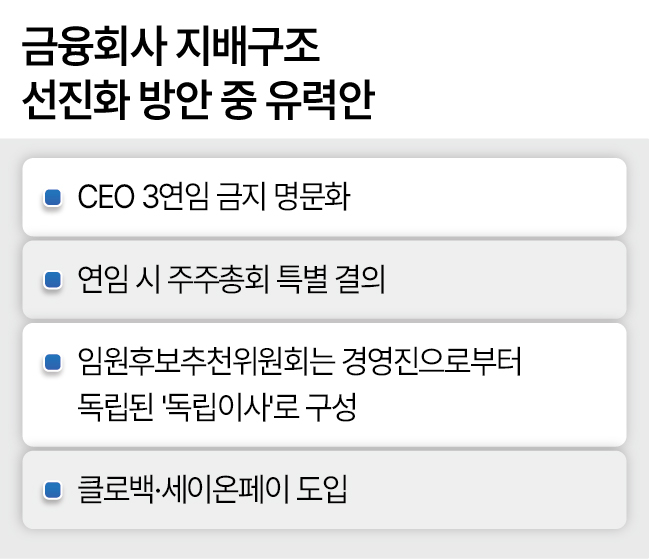
The centerpiece of the plan is a legal ban on what is known as a "third term" — where a financial holding company CEO completes an initial term and is then reappointed twice. The leading proposal would amend the Act on Corporate Governance of Financial Companies to cap CEO reappointments at one, and would require reappointment to be approved by a special resolution at a shareholders' general meeting, raising the threshold for renewal.
The FSC had originally planned to announce the governance reform package on July 31 and hold a meeting between the FSC chairman and the CEOs of eight major financial holding companies. Working-level officials had also visited the offices of ruling party lawmakers on the National Assembly's Political Affairs Committee to brief them on the key details. However, the announcement was put on hold just days before the planned meeting.
The shift in momentum appears to trace back to a closed-door meeting with ruling party members of the Political Affairs Committee held on July 27. At that session, ruling party lawmakers were reportedly divided over the FSC's governance reform plan, with no clear consensus emerging. In particular, some lawmakers are said to have raised concerns that the three-term restriction could be unconstitutional.
"The concern was about using legislation — rather than a shareholder resolution — to forcibly cap the number of terms, and the message, as I understand it, was to make sure there are no constitutional issues," a ruling party official said. Another official described the internal debate as ongoing and intense. "There are arguments that this would excessively constrain the private sector, and counter-arguments that the government can impose such limits given that it protects the financial industry through regulation," the official said.
The prolonged stock market correction has also added to the FSC's hesitation. With foreign investors holding stakes of up to nearly 80 percent in some domestic financial holding companies, there are significant concerns that legislating a CEO term limit — a measure with few precedents anywhere in the world — could send a negative signal to markets.
"Given that capital market issues such as leveraged ETFs keep coming up, the governance reform plan may have slipped somewhat in the policy priority queue," a financial industry official said.
FSC Vice Chairman Kwon Dae-young also faced questions on the matter at a full session of the National Assembly's Political Affairs Committee on July 29. People Power Party lawmaker Park Sung-hoon asked whether the FSC had sufficiently reviewed a recommendation by ISS — the world's largest proxy advisory firm — that strengthening board independence and shareholder oversight was preferable to capping CEO terms. Kwon replied that the FSC was "reviewing it with great weight."
The FSC says further consultations are needed on the substance of the governance reform plan. Financial industry watchers are cautiously speculating that some elements of the plan may be revised as a result. There is also growing speculation that the announcement could be delayed until after the ruling party's national convention.
The debate over the three-term limit is seen as a significant test of how broadly South Korea is willing to define the public interest obligations of financial companies. The argument for legally capping the tenure of financial holding company CEOs — who lead private-sector firms — rests on the premise that financial institutions carry a public interest dimension that sets them apart from ordinary businesses.
"If a three-term limit is enshrined in law, it would signal that the government intends to interpret the public role of financial companies more assertively than it does now," a financial holding company official said. "It would be hard to rule out the possibility of stronger regulation and pressure across management as a whole going forward."
A former senior FSC official said an outright ruling of unconstitutionality was unlikely. "The Constitution allows the law to restrict the freedoms and rights of citizens when necessary for the public good, so limiting the tenure of financial holding company CEOs — who lead institutions with a public interest dimension — would probably not be struck down," the official said. "That said, given how much social controversy surrounds this issue, going through a process of thorough debate is itself a good thing."
hyuk@heraldcorp.com
forest@heraldcorp.com