![Workers load semiconductors made by Samsung Electronics and SK hynix bound for export onto an aircraft at Korean Air's cargo terminal at Incheon International Airport on Thursday. [Yonhap]](https://wimg.heraldcorp.com/news/cms/2026/08/06/ams.V01.photo.HDN.P.20260731.P12026073107133146777651755_P1.jpg)
Despite lingering fears of a "memory peak-out," global Big Tech companies continue to signal that they need more memory chips, sending fresh tremors through the market's competitive landscape.
The high-bandwidth memory (HBM) market, long dominated by SK hynix, is gradually diversifying as Samsung Electronics enters the fray, while China's CXMT closes the gap — a combination that analysts say will rapidly redraw the boundaries of the broader memory chip industry.
Big Tech firms building massive AI data centers are expected to spend even more on memory chip purchases next year than this year, setting the stage for an intensified battle for market share among the established Big Three — Samsung Electronics, SK hynix and US-based Micron Technology.
According to market research firm SigmaIntel, global memory chip sales this year are projected to reach approximately $960 billion, a 290% increase from a year earlier. Memory chips are expected to account for roughly 60% of total semiconductor revenue, including foundry and fabless segments.
Orders from Big Tech have flooded in this year, keeping all three major memory chipmakers running at full tilt, yet supply still cannot keep pace with surging AI demand. Industry observers expect the memory chip shortage to persist for the foreseeable future.
Elon Musk, CEO of SpaceX — whose ventures span self-driving cars, humanoid robots and space exploration — has identified the memory chip supply crunch as the single biggest challenge facing the AI industry.
Speaking at SpaceX's earnings conference call on Tuesday, Musk said memory chip output grows about 20% a year while demand is rising 200% annually — "maybe more." "If demand is growing much faster than supply, memory prices will inevitably go up," he said.
AMD CEO Lisa Su, speaking at her own conference call the same day, said the company is working closely with memory chipmakers "across all areas — not just HBM for GPUs, but also general-purpose memory going into data centers" — underscoring efforts to lock in supply ahead of time.
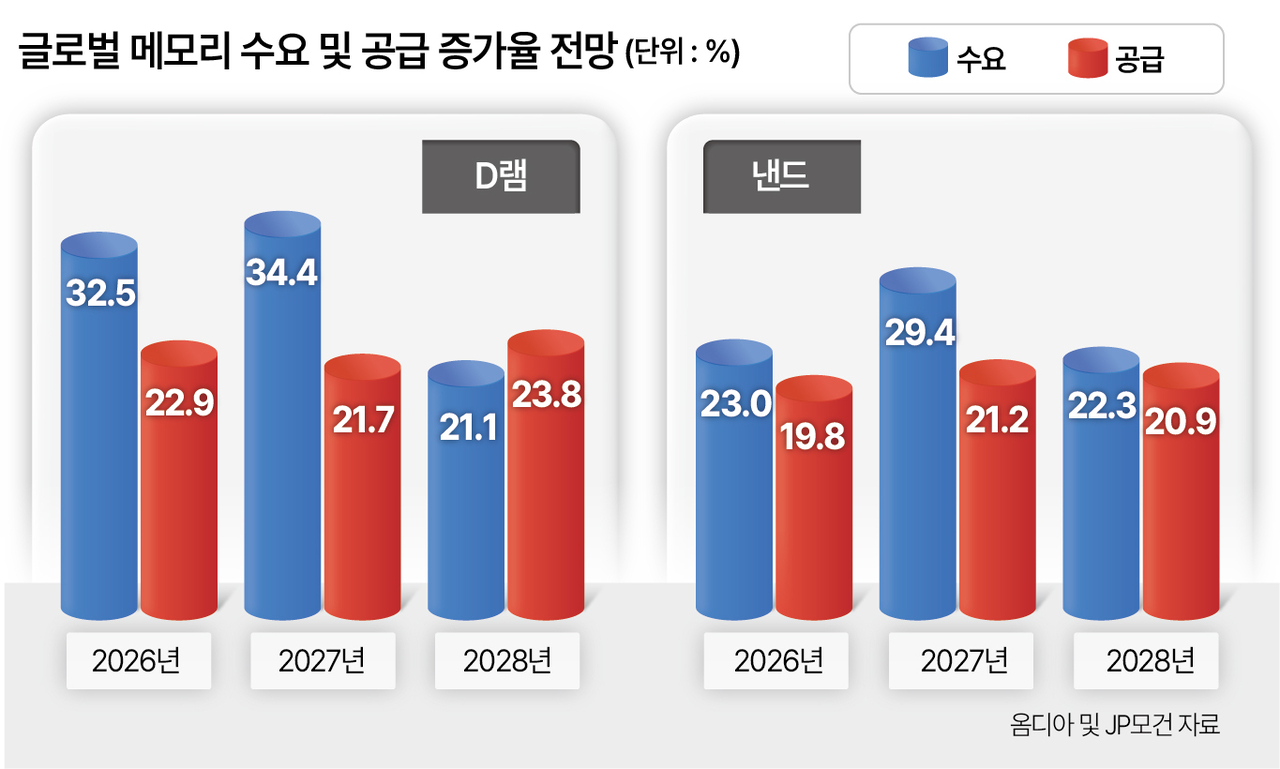
According to market research firms Omdia and JPMorgan, global DRAM demand growth is forecast to accelerate from 32.5% this year to 34.4% next year, while supply growth is expected to lag at just 21.7 to 22.9 percent over the same period, pointing to a severe supply shortfall.
NAND flash, long overshadowed by DRAM, has also entered a supply-deficit phase as it rapidly emerges as a key storage medium for AI data centers. Supply growth for NAND is projected at 21.2 percent next year, well below the 29.4 percent demand growth forecast.
Big Tech companies ramping up AI data center investment are voraciously consuming both DRAM and NAND. Deloitte estimates that Big Tech will allocate 30 percent of their data center capital expenditure to memory chip purchases in 2026, rising to 36 percent in 2027.
The surge in AI-driven memory demand is also reshaping market share dynamics. According to Counterpoint Research, Samsung Electronics held 39 percent of the DRAM market in the second quarter to retain the top spot, while the gap between SK hynix at 26 percent and Micron at 25 percent narrowed to just 1 percentage point. Fourth-ranked CXMT posted the highest growth rate of any player — up 716 percent year on year — to reach a 7 percent share, driven by robust domestic demand for general-purpose DRAM and an aggressive capacity expansion.
Samsung Electronics, which holds the largest production capacity in the memory chip industry, has raised its prospects for market share gains as its previously sluggish HBM business enters a phase of full-scale growth. At its second-quarter conference call on July 30, the company projected that its HBM market share in the second half of the year would reach a level on par with its overall DRAM market share.
Micron similarly signaled ambition at its fiscal third-quarter (March–May) earnings call, saying it is targeting an HBM market share "close to our DRAM share."
If both companies deliver on those pledges and bring their HBM share in line with their DRAM positions, the HBM market — where SK hynix currently commands a 58 percent share — could shift dramatically. Adding to the uncertainty, CXMT, which recently completed its initial public offering, is moving to expand capacity and is reportedly on the verge of mass-producing its latest low-power LPDDR6 DRAM, drawing close attention to the potential impact on overall DRAM market share.
Counterpoint Research said Tuesday that if CXMT can scale its production capacity and capabilities — starting with PCs — to meet both domestic and overseas demand from global tier-one customers, "its market share a year from now will look very different from today." The firm added: "The question is not 'how' but 'when' CXMT will enter the memory Big Three club."

joze@heraldcorp.com