![A night view of Deoksugung Palace [Korea Tourism Organization]](https://wimg.heraldcorp.com/news/cms/2026/08/05/news-p.v1.20260805.3b16f8c04c22492f9c7757807a8a9dd3_P1.jpg)
Admission fees at Korea's palaces and royal tombs, frozen for two decades, may finally be adjusted. The Cultural Heritage Administration is reviewing a plan to announce a revised fee structure in November and apply it from Jan. 1, 2027. Critics have long argued that the current rates are so low they undermine the perceived value of the heritage sites and have contributed to mounting deficits, lending weight to the discussion.
CHA's second-half agenda: international cooperation, safety and community

The Cultural Heritage Administration on Wednesday released its key second-half agenda for 2026. The three priority areas are enhancing South Korea's brand value, building a year-round safety network, and fostering community engagement and regional development.
The agency said it successfully hosted the 48th UNESCO World Heritage Committee in the first half of the year, raising South Korea's profile in global heritage policy. It cited the adoption of the "Busan Declaration," the expanded inscription of the Getbol Korean Tidal Flats, and more than 137,000 visits to the Korea Pavilion as major achievements.
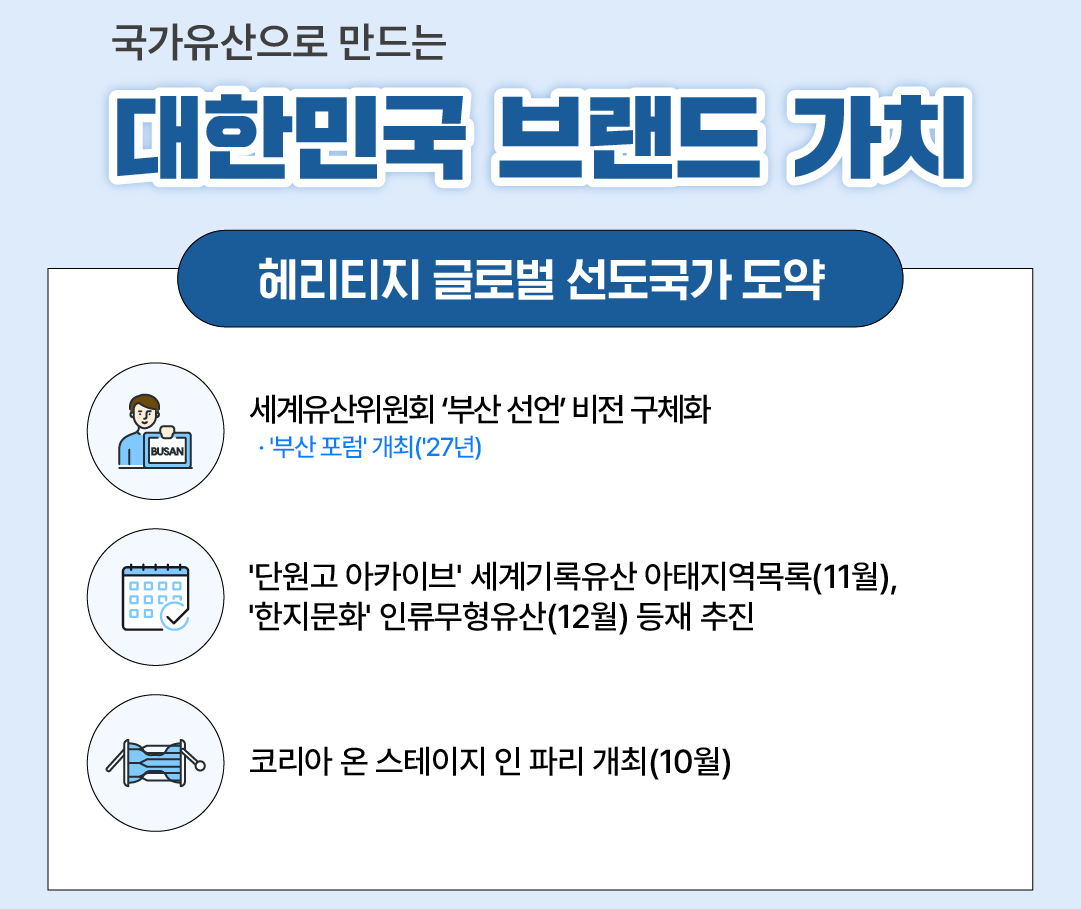
The administration plans to build on those achievements in the second half. To strengthen South Korea's brand value, it will actively pursue international cooperation and new UNESCO inscriptions. A "Busan Forum" — designed to advance the Busan Declaration adopted at the 48th World Heritage Committee — is set for 2027 to cement the country's leadership in global heritage policy. In November, the agency will seek Asia-Pacific regional listing on the UNESCO Memory of the World Register for the Danwon High School April 16 Archive and the culinary manuscripts "Suunjapbang" and "Eumsik dimibang." In December, it will pursue UNESCO Intangible Cultural Heritage inscription for the traditional knowledge, technology and cultural practices of hanji papermaking. The administration will also provide heritage conservation and management support to eight countries — including Egypt's Ramesseum temple — through official development assistance programs drawing on its preservation and restoration expertise.
![Cultural Heritage Administration Commissioner Heo Min briefs President Lee Jae-myung at a ministry policy report session held at Cheong Wa Dae's Yeongbingwan on Wednesday. [Yonhap]](https://wimg.heraldcorp.com/news/cms/2026/08/05/news-p.v1.20260805.12bbe24ae6ed4ea98ce86f4be3cd857d_P1.jpg)
Safety measures will also be strengthened. Large automated wildfire sprinklers will be installed on a trial basis by 2027 at five major Buddhist temples, including Bongjeongsa in Andong. Starting in September, an AI-based intelligent detection system will be introduced across 358 CCTV channels covering 180 nationally designated cultural heritage sites, including national treasures and treasures. An emergency protection program will also provide up to 20 million won ($14,000) in immediate support for heritage sites damaged within areas declared special disaster zones.
Programs to expand public enjoyment of heritage and support regional communities are also in the works. A project called "Swiumpyo" will open green spaces at five major historic sites, including Hyeonchungsa Shrine, on a trial basis in 2027. A new cultural heritage overnight stay program, "K-Heritage Stay," will also be introduced. In addition, the National Palace Museum of Korea will open its outdoor spaces as wedding venues from October through November under a program called "Weddings amid Cultural Heritage."
Palace and royal tomb fees frozen for 20 years — a reckoning looms
![Tourists visit Gyeongbokgung Palace. [Korea Tourism Organization]](https://wimg.heraldcorp.com/news/cms/2026/08/05/news-p.v1.20260805.7ccae1768fda47469ddb0308fc4427ee_P1.jpg)
The admission fee overhaul is among the most closely watched items in the announcement. Visitor numbers at palaces and royal tombs rose 6 percent in the first half of this year compared with the same period last year, with foreign visitors up 29 percent. Yet admission prices have not changed since 2005. Gyeongbokgung and Changdeokgung charge 3,000 won for adults, Changgyeonggung, Deoksugung and Jongmyo charge 1,000 won, and Joseon royal tombs range from 500 to 2,000 won. Critics have long argued that the fees are far too low relative to inflation and the cost of upkeep.
Major heritage sites abroad have been raising fees or introducing tiered pricing for foreign visitors to secure conservation funding. France's Palace of Versailles raised peak-season admission for visitors from outside the European Economic Area from 32 euros ($37) to 35 euros — a roughly 9.4 percent increase — effective Jan. 14. Japan's Osaka Castle doubled its main tower admission from 600 yen to 1,200 yen from April 1 last year, while Himeji Castle raised adult admission for non-Himeji residents and foreign visitors from 1,000 yen to 2,500 yen — a 150 percent increase — from March 1.
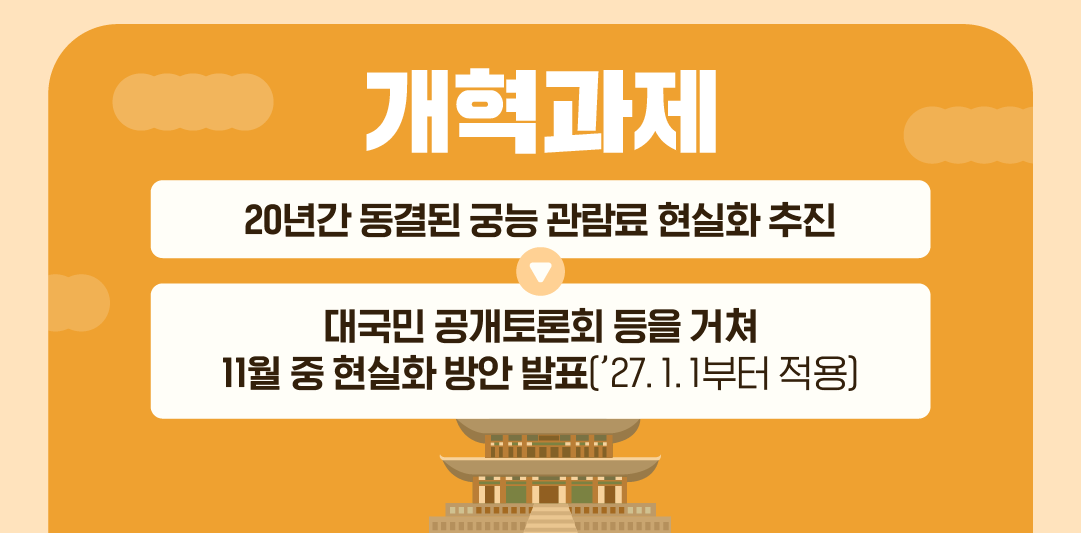
Having formally committed to the fee adjustment, the Cultural Heritage Administration plans to hold a public forum before announcing the new admission standards in November, with the revised rates taking effect Jan. 1, 2027, to secure stable funding for the conservation and management of palaces and royal tombs and to improve visitor services.
"Following the successful conclusion of the 48th UNESCO World Heritage Committee with strong international interest and participation, we will continue to spread the brand value of Korea's cultural heritage around the world in the second half of this year," Commissioner Heo Min said. "We will pursue proactive administration — advancing heritage enjoyment programs that people can feel in their daily lives and pushing forward with regulatory reform."
terry@heraldcorp.com