Domestic hybrids sell 200,329 units in H1
Hybrids prop up Korean brands amid EV slowdown
1 in 3 EVs sold this year made in China
Chinese EV push rattles Korean market; domestic IRA excludes EVs
![The underside of the rear seat in the new Grandeur Hybrid. Hyundai Motor adjusted the seat mounting position and battery frame structure to reduce interference between the high-voltage battery and the seats, enabling reclining and ventilated rear seats. [Provided by Hyundai Motor]](https://wimg.heraldcorp.com/news/cms/2026/08/05/news-p.v1.20260709.41d552d120364767ae63a45065f34b5c_P1.jpeg)
Starting next year, hybrid car buyers in South Korea will effectively pay 1 million won ($700) more per vehicle. The government is ending its individual consumption tax exemption — worth up to 700,000 won per hybrid — at the close of this year, and the linked education tax and value-added tax breaks will disappear along with it.
The change comes as Chinese electric vehicles intensify their push into the Korean market, prompting concern in the industry that reduced purchase incentives for hybrids could further erode the standing of domestic automakers.
Domestic brands lean on hybrids; imports ride EV wave
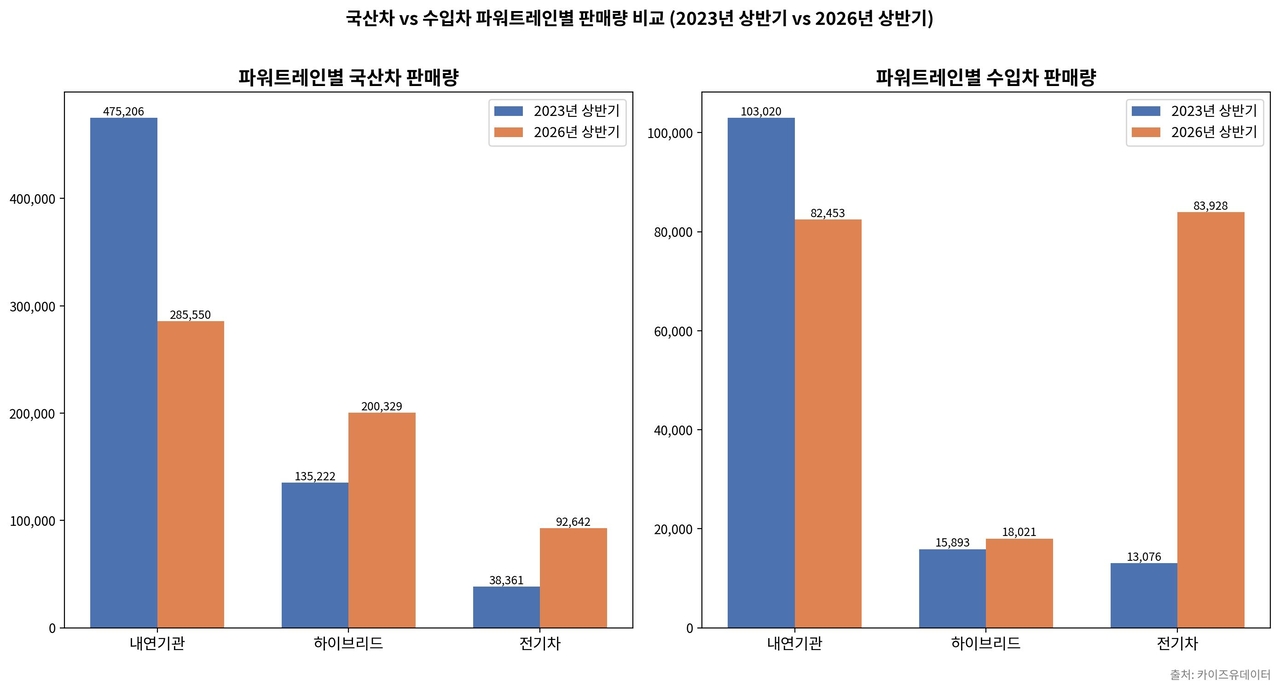
Domestic hybrid car sales reached 200,329 units in the first half of this year — a 48.2 percent increase over three years — according to data from Carisyou Data released Wednesday. Sales of internal combustion engine vehicles, by contrast, fell sharply from 475,206 units in the first half of 2023 to 285,550 units this year. Electric vehicle sales more than doubled over the same period but remain at roughly half the hybrid total, with 92,642 units sold.
Korean automakers have focused on defending their earnings by rolling out key models with hybrid powertrains as the EV market stagnates. Hyundai Motor sells eight hybrid models, including its flagship sedan the Grandeur, while Kia offers a lineup of seven. Renault Korea launched its new Filante this year exclusively as a hybrid.
Hybrids have in practice served as the backbone of domestic automakers' sales. Through July, Hyundai Motor and Kia sold 219,444 hybrid vehicles in the domestic market, accounting for 30 percent of their combined total sales. At Renault Korea, hybrids made up 71.5 percent of domestic sales in July, with 1,219 units sold.
Among imported passenger cars, Chinese-made EVs are rapidly expanding their footprint. Sales of imported internal combustion engine vehicles fell 20 percent to 82,453 units in the first half, while hybrid imports rose 13.4 percent to 180,021 units. Imported EVs surged more than sixfold to 83,928 units.
As the powertrain landscape shifts rapidly on the back of eco-friendly vehicle demand, a two-track structure has emerged: domestic brands anchored in hybrids, imported brands riding the EV wave. With Korean brands slowing their new model launches, Tesla and BYD have been aggressively importing China-made models and quickly building sales in the Korean market.
![The new Grandeur, Hyundai Motor's flagship sedan. [Provided by Hyundai Motor]](https://wimg.heraldcorp.com/news/cms/2026/08/05/news-p.v1.20260605.ff9cc9cde13743a9b42caf31de3a883a_P1.jpg)
'Include EVs in domestic IRA, keep hybrid tax breaks,' industry urges
Industry officials warn that scaling back tax benefits for hybrids could accelerate the Chinese EV advance. When the 700,000-won individual consumption tax exemption is removed along with the linked education tax and VAT relief, consumers will face an effective price increase of 1 million won per vehicle. The government plans to phase out and eventually eliminate the consumption tax exemption for EVs and hydrogen vehicles, replacing it with direct fiscal support.
Concern is also growing over the exclusion of electric vehicles from the domestic production tax credit — a measure dubbed Korea's Inflation Reduction Act. The credit is designed to encourage domestic manufacturing in advanced industries by reducing corporate and income taxes based on domestic production and sales volumes. The domestic auto industry has long argued that EVs must be included in the scheme to counter the influx of low-cost Chinese electric vehicles.
![The Tesla Model Y. [Captured from Tesla Korea website]](https://wimg.heraldcorp.com/news/cms/2026/08/05/news-p.v1.20260305.9420f39fc11f4803b5bb8e164830f9c4_P1.png)
In practice, one in three electric vehicles sold in South Korea in the first half of this year was made in China. According to the Korea Automobile Manufacturers Association (KAMA), 69,513 Chinese-made EVs were newly registered in the first half, accounting for 35 percent of all new EV registrations. The figure reflects sales of Tesla Model Y and Model 3 units built at the Shanghai Gigafactory, along with BYD's mass-market models and Polestar's premium offerings.
The industry is calling on the government to include EVs in the domestic production tax credit while maintaining consumption tax exemptions for eco-friendly vehicles, including hybrids.
"The relentless advance of Chinese-made EVs — not only in global markets but in the domestic market as well — poses a serious threat to the manufacturing base and supply chain competitiveness of Korea's auto industry," KAMA Chairman Jeong Dae-jin said. "Electric vehicles must be included in the domestic production incentive tax regime to strengthen the competitiveness of the entire domestic production infrastructure and ecosystem, and tax benefits for eco-friendly vehicles including hybrids must be maintained to sustain the momentum of the transition to future mobility."
eyre@heraldcorp.com