
"Let us recognize that independence without bloodshed is independence without worth." "Our independence lies in unity."
These words were written on Jan. 10, 1946, by more than 70 members of the 2nd Squad, 3rd Battalion of the Korean Liberation Army, operating on Chinese soil. They inscribed them as a farewell message and independence pledge for their comrade Moon Su-yeol — also known as Moon Ung-myeong — who was being transferred to another unit.
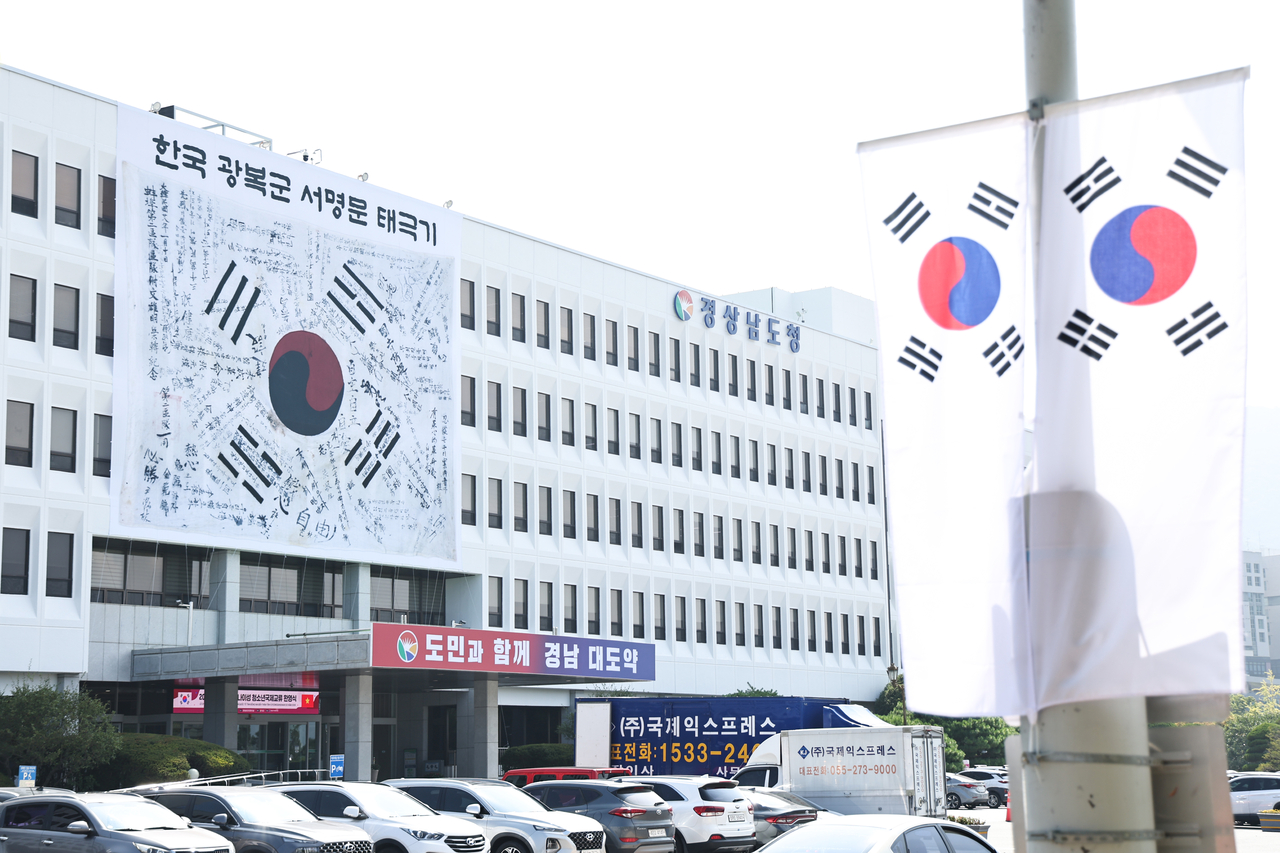
To mark the 81st Liberation Day, a massive Taegeukgi banner — 17.5 meters wide and 14.2 meters tall — has hung on the outer wall of the South Gyeongsang Provincial Government building since Tuesday. The flag carries a special significance: Moon, the original owner of the artifact, was a native of Sacheon, South Gyeongsang Province.
The Korean Liberation Army, the regular military force of the Korean Provisional Government established in 1940, continued its activities in China even after liberation in 1945, working to restore full national sovereignty. As Moon prepared to transfer to another unit, his fellow fighters took up brushes and filled the margins of a Taegeukgi with their words.
The margins are packed with declarations of fierce resolve and heartfelt wishes for a comrade's safe return: "Koreans are free people," "Let us become the cornerstone of the three-thousand-ri land," "Fight on with cheer," "Let us build our beautiful three-thousand-ri homeland," and "Let us shed blood for our country." The flag stands as the final testament left by comrades who had shared life and death in a distant land — a vivid historical record of the struggle for liberation.
Moon preserved the flag, soaked in the blood and sweat of his comrades, for the rest of his life before donating it to the Independence Hall of Korea Construction Promotion Committee in 1986. Now housed and displayed in Exhibition Hall 5 of the Independence Hall of Korea, the artifact was recognized for its historical value and in 2008 became the first Taegeukgi in South Korea to be designated a nationally registered cultural heritage.
The occasion carries a note of sadness as well. South Gyeongsang Province sought to officially invite Moon's surviving family members to this year's Liberation Day ceremony, but confirmed that his descendants had relocated outside the province, and the invitation could not be extended.
A total of 1,521 independence fighters hailed from the South Gyeongsang region, which at the time included Ulsan. Today, 362 of their descendants continue to live in the province, carrying on the spirit of their forebears.
The province's message in hanging the oversized Taegeukgi at the center of its government complex is unmistakable: a solemn commitment to remember, together with the province's 3.3 million residents, the names and independence spirit of the local patriots who shed their blood for their country on distant foreign soil 81 years ago.
ook967@heraldcorp.com



