
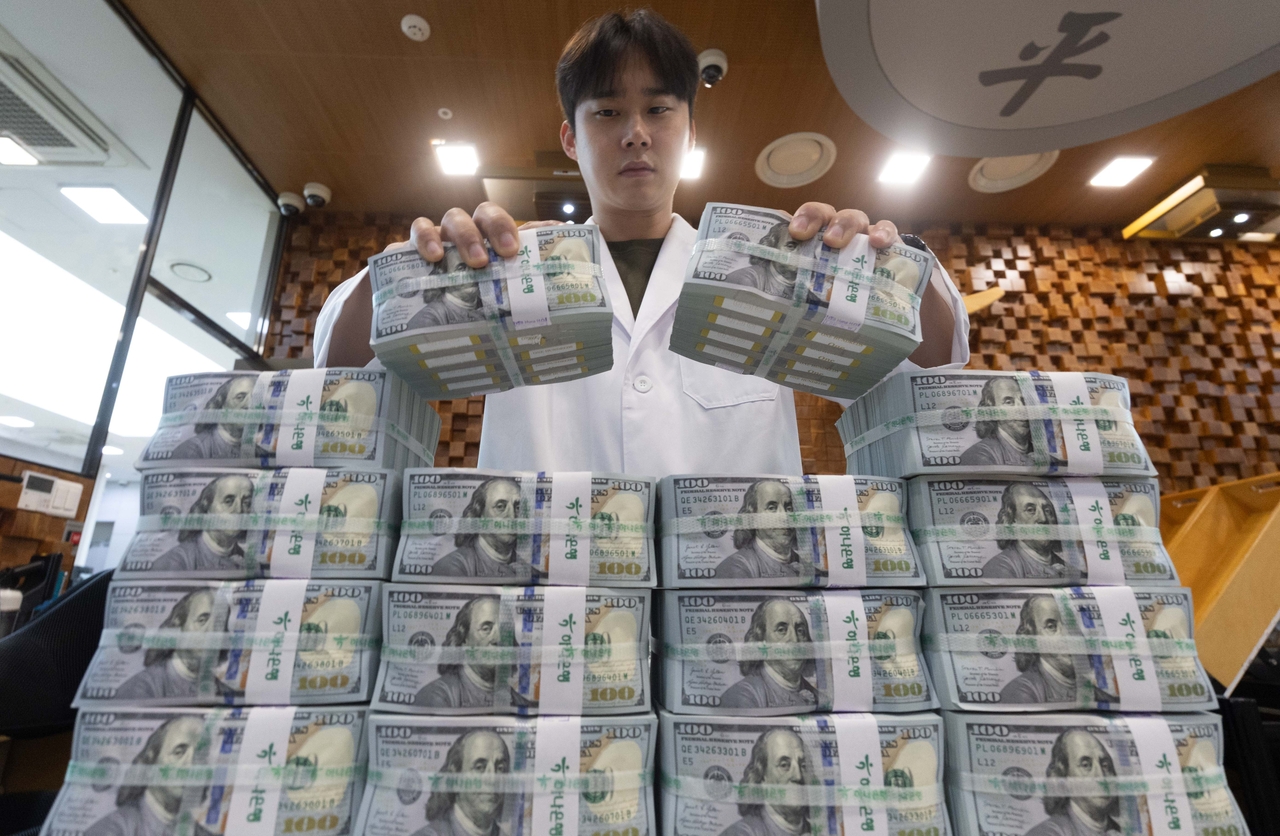
South Korea's foreign exchange reserves rose for a second consecutive month in July, as a stronger dollar lifted the value of foreign-currency assets.
The Bank of Korea said Wednesday that reserves stood at $427.95 billion as of the end of last month, up $590 million from the previous month's $427.36 billion.
Reserves have fluctuated in the low-to-mid $400 billion range this year. They rose in February on new issuances of foreign-currency stabilization bonds, then fell in March as the central bank intervened to defend against a high exchange rate. Reserves surged again in April on higher investment returns, dipped in May, and have since risen for two consecutive months through July.
The Bank of Korea said the modest increase reflected new foreign-currency stabilization bond issuances, higher investment returns and a rise in the dollar-equivalent value of assets held in other currencies — even as foreign exchange swap transactions with the National Pension Service weighed on the total.
The won-dollar exchange rate opened last month in the mid-1,500 won range, then gradually fell to close at 1,424 won on Friday, the last trading day of the month. The monthly average for July came in at 1,488.9 won per dollar, the lowest since April, when it averaged 1,485 won.
The dollar index, which measures the greenback's average value against six major currencies, averaged 100.9 last month, up 0.6 points from the previous month's 100.3.
By asset class, deposits — the most liquid component — rose $860 million to $23.13 billion. Securities, including US Treasury bonds, government agency debt and corporate bonds, fell $340 million to $380.01 billion. IMF Special Drawing Rights increased $60 million to $15.7 billion, while the IMF reserve position rose $10 million to $4.32 billion. Gold holdings were unchanged at $4.79 billion.
Based on end-of-June figures of $427.4 billion, South Korea ranked 10th globally in foreign reserves — three places higher than the previous month's 13th — marking its return to the top 10 for the first time in four months after being pushed out in February by Italy, France and others.
kimstar@heraldcorp.com



