![A policy director at North Korea's Foreign Ministry Japan Research Institute condemned Japan's recently published defense white paper, calling it a "war script" to realize its ambitions of reinvasion and denouncing it as a move by a "war criminal state" to build itself into a major military power. File photo. [Japan Ministry of Defense website]](https://wimg.heraldcorp.com/news/cms/2026/08/04/news-p.v1.20250718.1c4c4b9500864c469e4ab7e9728634e8_P1.jpg)
Japan's first defense white paper under Prime Minister Sanae Takaichi repeated the country's longstanding claim that Dokdo is Japanese territory, while describing South Korea for the third consecutive year as "an important neighboring country and partner with which we must work together to address various challenges in the international community."
The Defense Ministry released the 2026 defense white paper Tuesday after cabinet approval. It states that "the territorial issues of the Northern Territories and Takeshima — inherent territories of our country (Japan) — remain unresolved." Takeshima is the name Japan uses for Dokdo.
Japan has made the same claim in its annual defense white paper every year since 2005, making this the 22nd consecutive year.
As in last year's edition, the white paper labeled Dokdo as "a territorial issue surrounding Takeshima" on a map of the security environment around Japan, and depicted the waters around Dokdo as Japanese territorial sea on a map of maritime and airspace surveillance zones. A map illustrating South Korea's Air Defense Identification Zone also used the name Takeshima for Dokdo.
The white paper's characterization of South Korea, however, was unchanged from last year.
It described South Korea as "an important neighboring country with which Japan must cooperate as a partner in addressing various challenges in the international community" — language first used in 2024 and retained for the third year running.
The document also said Japan-South Korea cooperation is growing more important across areas including responses to North Korea's nuclear and missile programs, maritime security, counterterrorism and natural disaster relief.
It cited as examples of bilateral cooperation Japan's defense minister's visit to Seoul last September, the subsequent "shuttle defense diplomacy" between the two countries' defense ministers, and the Black Eagles — South Korea's Air Force aerobatic team — making their first stopover at a Japan Air Self-Defense Force base in January.
On trilateral cooperation, the white paper stressed that "close cooperation is important" among South Korea, the United States and Japan, given their "shared interests in peace and stability in the Indo-Pacific region."

The white paper expressed sharper concern than last year's edition over security threats posed by China, North Korea and Russia.
On the deepening military cooperation among the three countries, it warned that "the international community is facing its greatest postwar ordeal and has entered a new era of crisis," adding that "there is a possibility that a serious situation similar to the invasion of Ukraine could occur in East Asia."
China was again labeled "the greatest strategic challenge ever seen" — the same language used in last year's white paper.
The document identified China's military pressure on Taiwan and its expanding activities around the Senkaku Islands — known in China as the Diaoyu Islands — as major threats. It also included maps showing the range of Chinese ballistic missiles capable of striking Japan and the current state of Chinese military activity around Japan.
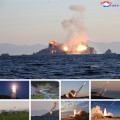
North Korea was described as "a more grave and imminent threat to Japan's security than ever before," with the white paper noting that the country's missile development is advancing rapidly. It also warned that North Korea's military capabilities could strengthen over the medium to long term through its military cooperation with Russia.
This year's edition also added a new chapter on trends in emerging forms of warfare.
Japan pointed to the expanded military use of drones, unmanned systems and AI in the war in Ukraine, and said it would actively harness advanced technologies — including AI, quantum technology and semiconductors — to strengthen its defense capabilities.
The white paper also outlined plans to bolster capabilities for modern warfare, covering cyber operations, space and electronic warfare, dual-use civilian-military technology, and the stockpiling of defense equipment.
The government also released a visual edition of the white paper this year — featuring significantly more photographs and illustrations aimed at the general public — along with a summary booklet and short-form promotional videos. A dedicated section on improving the pay and welfare of Self-Defense Forces personnel, amid persistent recruitment shortfalls driven by Japan's declining population, was included as part of a broader public outreach effort.
sjy@heraldcorp.com