
![Representatives from the Rights-Seeking Union and the Korea Maru Labor Union hold a press conference Wednesday in front of the Seoul Employment and Labor Office in Jongno-gu, Seoul, calling for heat safety measures at indoor construction sites. The groups said workers at indoor construction sites are laboring in enclosed spaces with temperatures exceeding 38 degrees Celsius and heavy dust, without even the basic conditions needed to follow the five core heat-safety rules — drinking cool water, access to air conditioning, a 20-minute rest break every two hours, provision of cooling gear, and calling 119 in emergencies. [Yonhap]](https://wimg.heraldcorp.com/news/cms/2026/08/04/rcv.YNA.20260729.PYH2026072911200001300_P1.jpg)
Regional employment and labor offices covering areas under extreme heat alerts — including all of Seoul — have activated a heat-wave work-suspension reporting system targeting construction sites with project values of 5 billion won ($3.5 million) or more.
Labor authorities directed each site to prepare a heat-wave work-suspension compliance plan and report whether work stoppages were carried out, stepping up their response to the highest level of heat emergency.
The Korea Meteorological Administration said extreme heat alerts were extended Tuesday morning to Seoul's northeastern and northwestern districts, bringing the entire city under the highest-level heat advisory as of 11 a.m.
Extreme heat alerts also took effect at the same time across multiple areas of Gyeonggi Province, including Osan, Hanam, western Yeoju, Goyang, Anseong, southern Paju, northeastern Yongin, northwestern Yongin and southeastern Yeoju, as well as Jeonju in North Jeolla Province and Jangseong and northern Gokseong in South Jeolla Province. Alerts have been in place since Saturday in Boseong, Yeosu and Gwangyang in South Jeolla Province, and since Monday in Suncheon, southern Gokseong and eastern Gwangju.
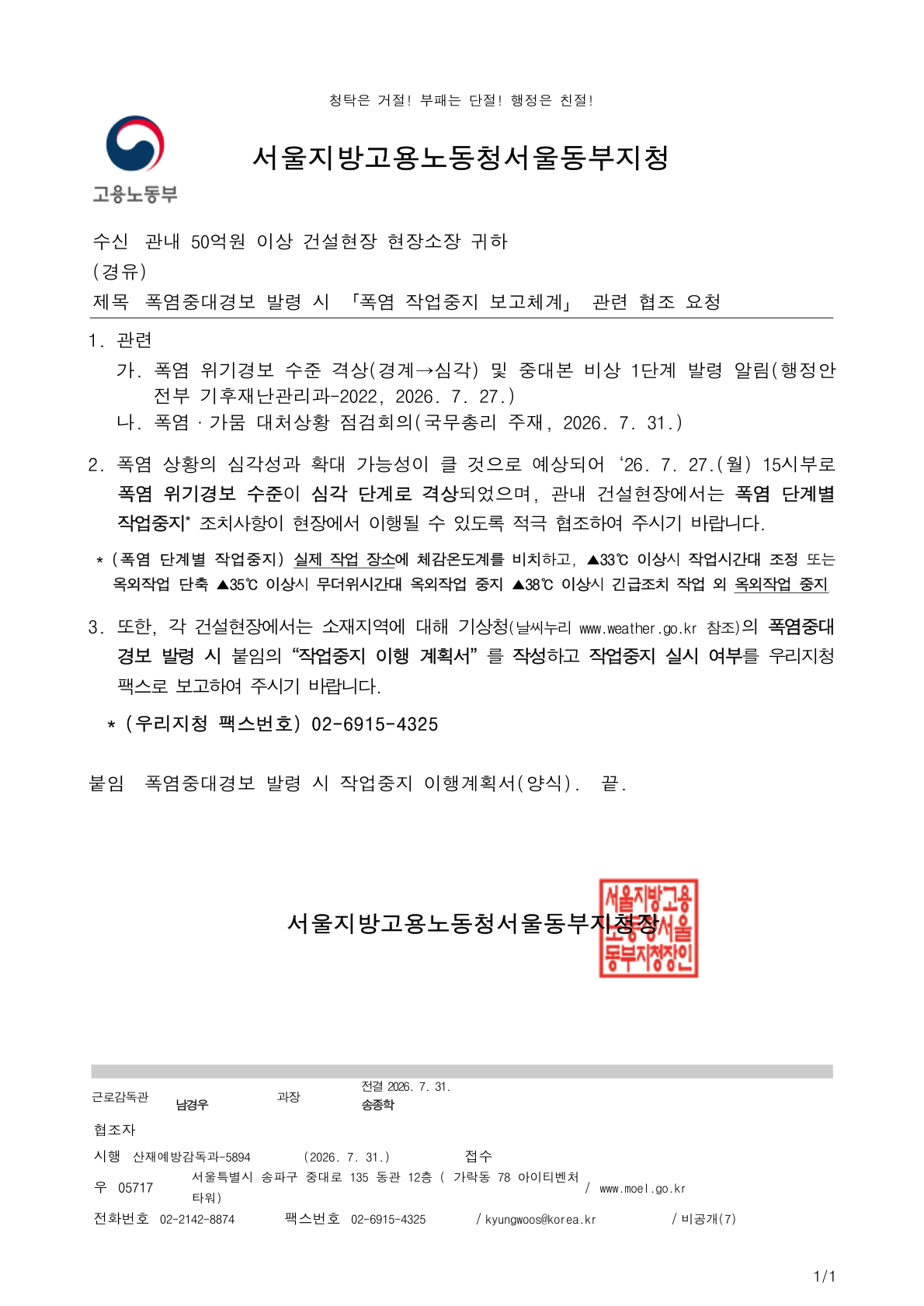
In response, regional employment and labor offices covering areas under extreme heat alerts sent official directives to construction sites valued at 5 billion won or more, requesting cooperation with the heat-wave work-suspension reporting system.
The directives require each site to prepare a heat-wave work-suspension compliance plan when an extreme heat alert is issued and to report to the relevant labor office on whether work was halted. A form distributed by the Seoul East District Office requires sites to fill in a site overview, heat response framework, daily work status and work-suspension implementation plan.
Labor authorities also instructed sites to keep heat-index thermometers on hand and adjust work schedules based on the readings.
When the heat index reaches 33 C, sites must adjust working hours or shorten outdoor work. At 35 C, outdoor work during the hottest part of the day must stop. At 38 C or above, all outdoor work except emergency operations is strongly recommended to cease.
The measures are a follow-up management step to ensure employers effectively fulfill their legal obligations to prevent heat-related illness under the Occupational Safety and Health Act and its implementing regulations. Following last year's amendment to the act and this year's revision of the safety and health standards regulations, employers are now legally required to comply with the five core heat-safety rules — including providing at least 20 minutes of rest every two hours — whenever the heat index reaches 33 C or higher.
The Ministry of Employment and Labor this year also established a "2026 Heat Wave Worker Health Protection Plan," strongly recommending phased work stoppages in line with the Korea Meteorological Administration's extreme heat alerts and operating special heat-safety task forces at regional offices nationwide. The compliance plan submissions and work-suspension reporting system are administrative measures designed to monitor and manage the government's heat response on the ground.
Meanwhile, the ministry plans to conduct intensive inspections at construction sites throughout the heat wave, focusing on whether work-suspension recommendations are being followed and whether the five core heat-safety rules are being observed.
fact0514@heraldcorp.com




