
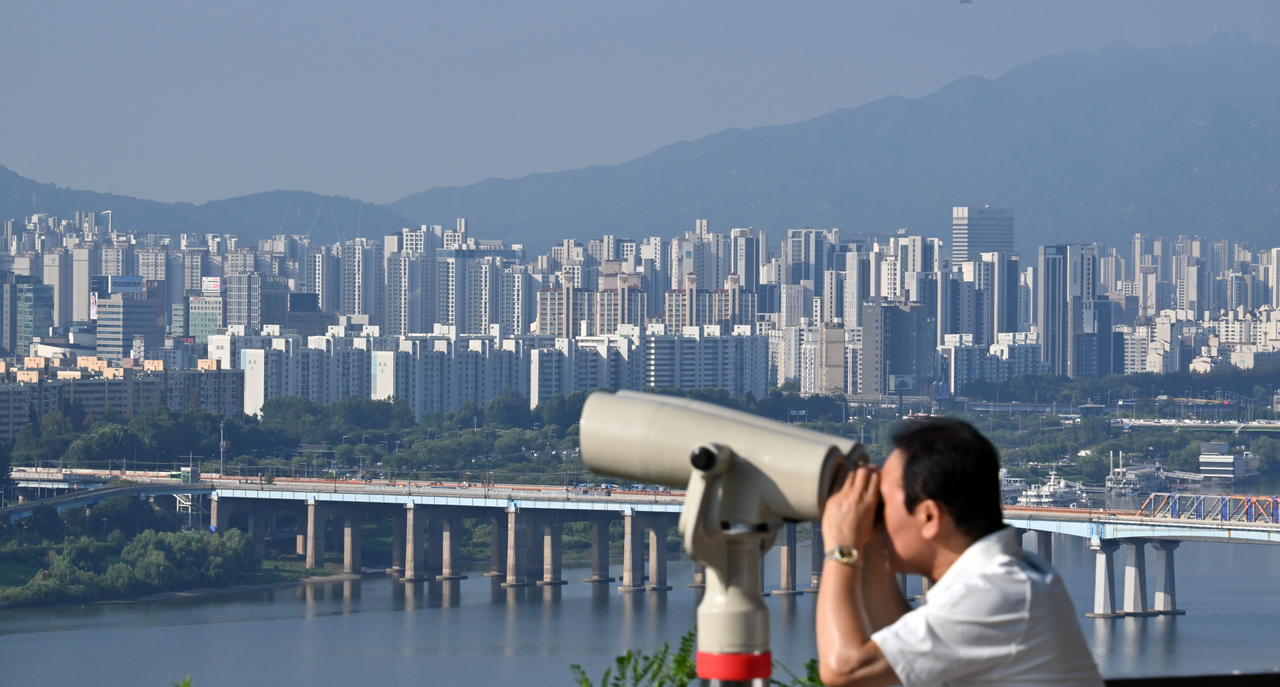
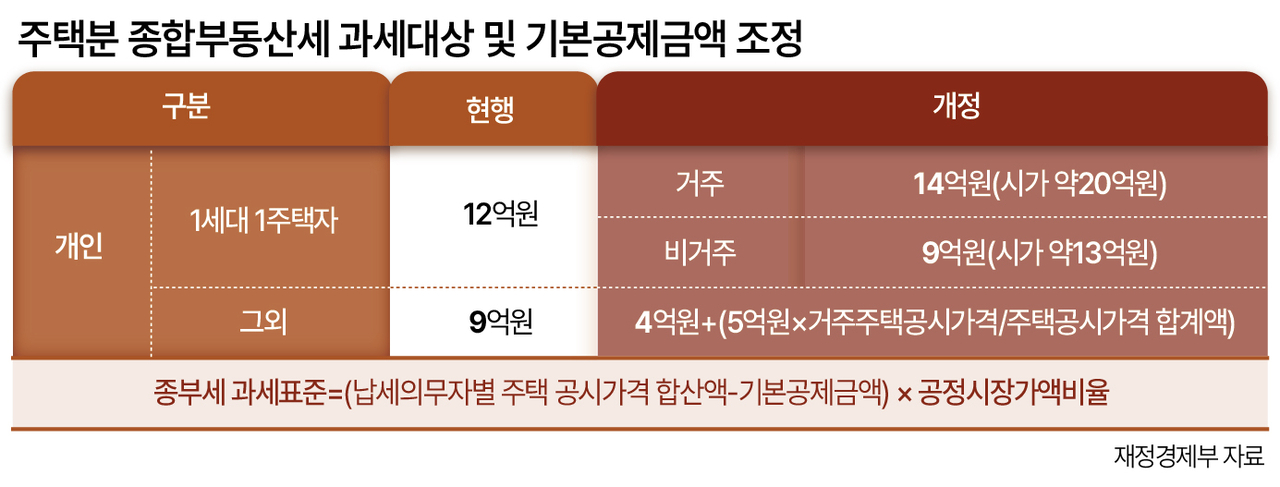
The government's decision to raise the comprehensive real estate tax exemption threshold — lifting the assessed value ceiling from 1.2 billion won ($839,000) to 1.4 billion won, equivalent to a market price of roughly 2 billion won — is expected to drive up prices for mid-range Seoul apartments that fall below that level. Just as the market previously rallied to align with the 1.5 billion won mortgage lending cap, analysts say the new 2 billion won tax threshold now provides a fresh price target. Attention is turning to whether liquidity will flow into non-Gangnam properties — the so-called "less prime, single-home" segment.
Under the government's 2026 tax reform plan announced Tuesday, the comprehensive real estate tax deduction threshold for owner-occupying single-homeowners will rise to an assessed value of 1.4 billion won starting next year. That corresponds to a market price of around 2 billion won — expanding the exemption by roughly 300 million won in transaction terms compared with the current assessed-value ceiling of 1.2 billion won.
Market watchers expect key apartment complexes in Seongbuk-gu, Dongdaemun-gu and Seodaemun-gu — where prices currently sit in the 1.5 billion to 1.7 billion won range — to push toward the 2 billion won mark. With mortgage lending restricted, buyers looking to upgrade from outer Seoul or Gyeonggi Province are expected to consider moving into Seoul properties priced below 2 billion won.
"It's not that the tax reform will directly cause prices to rise, but the new deduction threshold removes one of several hurdles that had been capping price gains — acting as a kind of kindling," said Yun Ji-hae, head of the research lab at Real Estate 114. "In effect, the groundwork has been laid for prices to move up smoothly to the tax-exempt ceiling."
Seoul apartment prices have in fact continued to climb despite a range of regulations. According to KB's housing price trend data, the average sale price of Seoul apartments last month reached the 1.59 billion won range, approaching the 1.6 billion won mark.
That is why analysts see room for owner-occupiers seeking to move up to push prices toward the 2 billion won level — a view reinforced by recent market movements.
Seongbuk-gu recorded the largest cumulative gain in apartment sale prices among Seoul's autonomous districts this year, rising 10.31 percent through July 27, according to the Korea Real Estate Board. The surge is attributed to strong demand from end-users drawn to apartments priced below 1.5 billion won, which qualify for the maximum 600 million won mortgage loan limit.
With demand concentrated in the area, transaction prices at major complexes in Seongbuk-gu and other northern Seoul districts are already approaching the 2 billion won tax threshold. According to the Ministry of Land, Infrastructure and Transport's actual transaction price disclosure system, an 84-square-meter unit at Lotte Castle Classier in Gileum-dong, Seongbuk-gu, set a record high of 1.91 billion won on June 25. That marks a gain of more than 400 million won from a market price of around 1.5 billion won a year earlier.
In Dongdaemun-gu, which offers convenient commutes to central Seoul, leading complexes are also posting notable gains. An 84-square-meter unit at Raemian Cresty traded at 1.8 billion won last month, setting a new high, with some market participants saying the revised tax threshold could push it even higher.
"To the extent that raising the holding tax on high-priced single homes puts downward pressure on expensive properties, there could be some cooling effect," said Woo Byung-tak, a senior specialist at Shinhan Bank's Premier Pathfinder unit. "But fundamentally, properties on the outskirts or along the Han River belt that have not yet reached the deduction threshold will move to align with it."
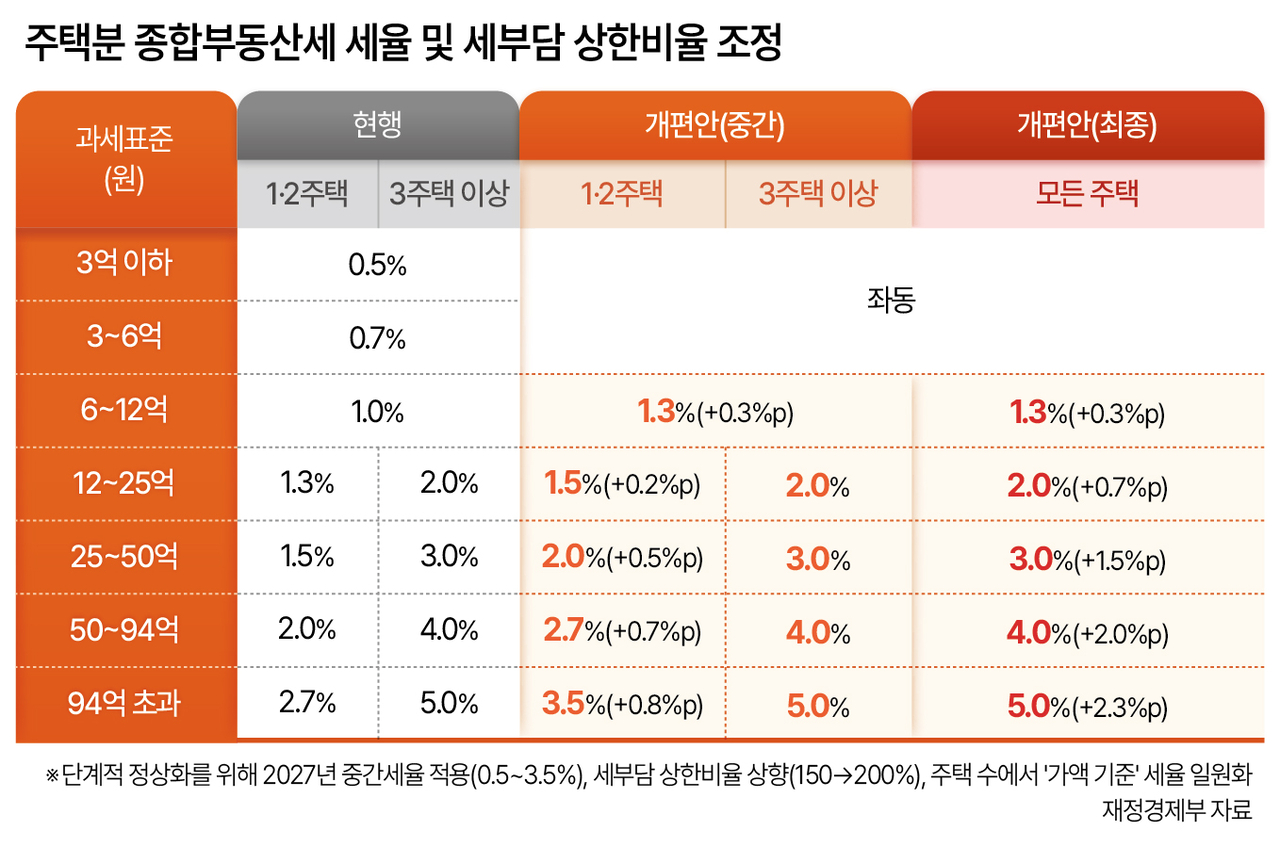
Some analysts also expect demand to increase for properties priced above 2 billion won but below the 3 billion won high-end threshold, once tax credits are factored in. As the tax base becomes more granular, buyers seeking to consolidate into a single, higher-quality home for tax efficiency may concentrate their demand in that bracket.
"Looking at the tax base — determined by multiplying the standard market value by the fair market value ratio — there is room for tax burdens to ease in parts of the three Gangnam districts, the Han River belt in Seoul, and key popular areas in southern Gyeonggi Province," said Nam Hyeok-woo, a real estate researcher at Woori Bank. "In that case, demand from buyers looking to upgrade could concentrate there." He added that over the medium to long term, the trend of chasing a single premium property may ease somewhat, but overall interest in alternative areas will likely grow.
Meanwhile, with the broad upward trend in home prices expected to continue, tax revenue from holding taxes is projected to expand. The government estimated that the overall tax reform package will generate an additional 3.44 trillion won in tax revenue, with the comprehensive real estate tax alone expected to bring in an additional 2.18 trillion won over the next three years.
"Even if some areas are not subject to the comprehensive real estate tax this year, the number of districts entering the tax zone will grow going forward," said Kim Hak-ryeol, director of the Smart Tube Real Estate Research Institute. "If outer-area prices keep rising, there will inevitably be pockets in Nowon, Dobong and Gangbuk where homeowners end up paying the tax."
hope@heraldcorp.com




