
A record-breaking heat wave gripping the Korean Peninsula is driving up domestic fruit prices. A shortened monsoon season and temperatures soaring to 40 degrees Celsius — particularly in southern regions — have directly disrupted fruit growth, raising concerns about further price increases for apples, pears and other fruits that see a surge in demand ahead of the Chuseok holiday.
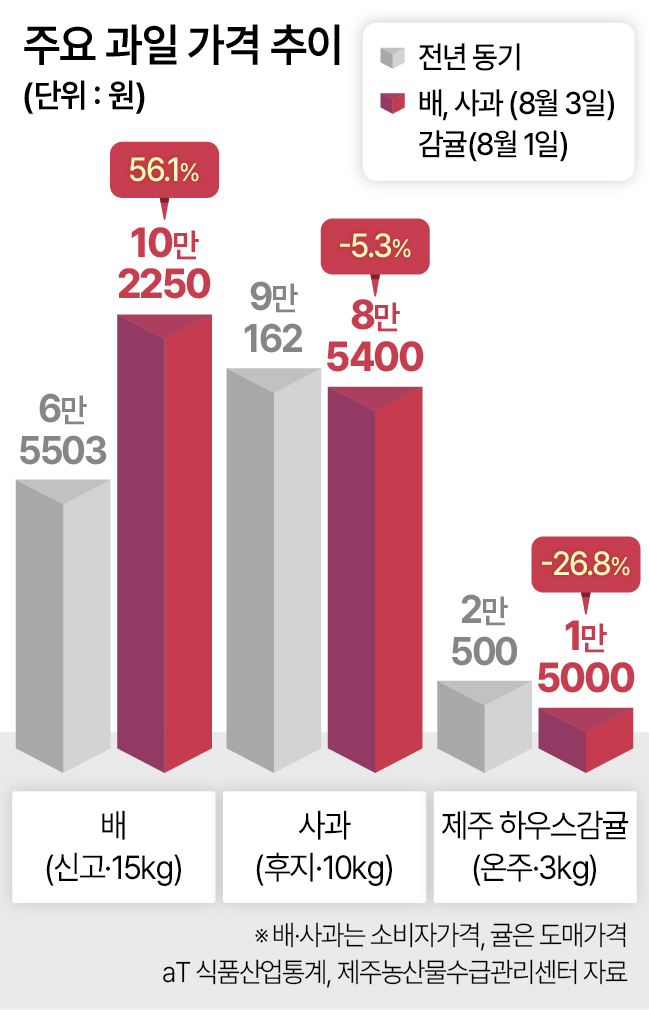
Fruit prices varied by product in early August, industry sources said Tuesday. Data from the Korea Agro-Fisheries and Food Trade Corporation (aT) showed the average consumer price for pears (Shingo variety, 15 kilograms) reached 102,250 won ($71), up about 56.1 percent from 65,503 won a year earlier. The price edged down 3.6 percent from 106,123 won the previous month but remains elevated.
Industry analysts attribute the high prices to frequent rainfall during last year's harvest season in October and November, which delayed picking and raised moisture content in the fruit, reducing its storability. The volume of stored pears currently in distribution with marketable quality is also limited, keeping prices relatively high. The Korea Rural Economic Institute projected that pear shipments after July this year would fall short of the seasonal average of 5,000 tons, citing a decline in stored inventory from last year's harvest.
Apple and tangerine prices, meanwhile, have fallen. Apples (Fuji variety, 10 kilograms) were priced at 85,400 won as of the same date, down 5.3 percent from 90,162 won a year earlier, as supplies of last year's stored crop and summer-harvested Aori (Tsugaru) apples increased. According to the Jeju Agricultural Products Supply and Demand Management Center, the average daily wholesale price of greenhouse tangerines (Unshu variety, 3 kilograms) stood at 15,000 won on Aug. 1, down 26.8 percent from 20,500 won a year ago.
The concern now is the second half of the year, when the direct effects of the heat wave will be reflected in prices. The industry expects prices for major fruits to trend upward around September, as abnormally high temperatures have been slowing fruit development at key growing regions through early this month. Demand for apples, pears and other traditional Chuseok offerings is also expected to spike ahead of the holiday, adding further upward pressure.
"Since the heat wave set in after the July monsoon, apple growth has been unstable, and some orchards in the Chungcheong and North Gyeongsang Province areas have reported fungal diseases including anthracnose," one industry official said. A hypermarket official said continued extreme heat would inevitably slow pear development, potentially pushing prices higher than last year. The official added that tangerine prices were also expected to rise due to lower production volumes, as the number of greenhouse farms has declined and recent tropical nights have slowed fruit growth.
Typhoon Dolphin, the 13th named storm of the season, currently moving northward in the southern seas, adds another layer of uncertainty. If the typhoon veers toward China, hot and humid tropical air could flow in and intensify the heat wave. If it continues north, temperatures may drop — but its strength has prompted warnings that it could cause damage on the scale of Typhoon Rusa in 2002 or Typhoon Maemi in 2003. "We need to keep a close eye on how the typhoon will affect fruit growth and supply going forward," an industry official said.
![A shopper selects watermelons at a hypermarket in Seoul. [Yonhap]](https://wimg.heraldcorp.com/news/cms/2026/08/04/rcv.YNA.20260730.PYH2026073012710001300_P1.jpg)

soho0902@heraldcorp.com




