
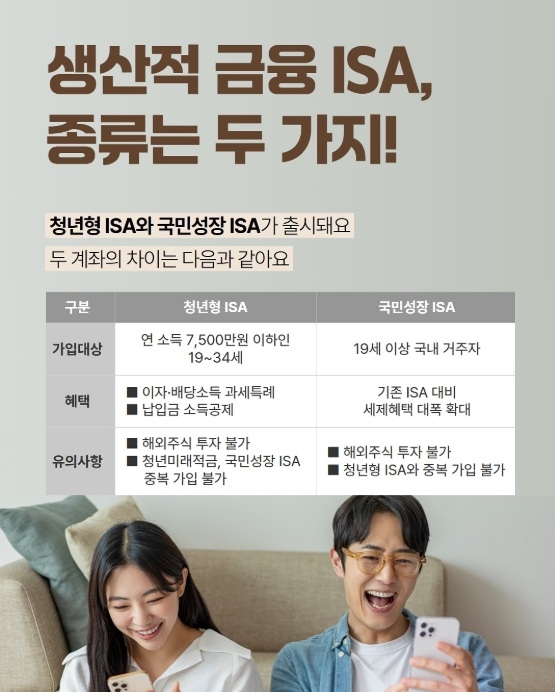
The government plans to introduce a "youth individual savings account" (ISA) to help young people build assets.
To eliminate what officials call a "marriage penalty," the income deduction for jeonse and monthly rent deposit repayments — previously available only to householders without a home — will be extended to both spouses in weekend couples living apart who own no home.
The Ministry of Economy and Finance announced the measure Monday as part of its 2026 tax reform proposal, which includes support for youth, marriage and childbirth.
The new youth ISA will offer a 10 percent income deduction on contributions for people aged 34 or under with an annual salary of 75 million won ($52,300) or less, or comprehensive income of 63 million won or less. The annual contribution limit is 20 million won, with a total cap of 200 million won.
As with the newly created productive finance ISA, interest and dividend income will be fully exempt from tax. The investment period is three years but can be extended in three-year increments for up to 10 years total.
Both spouses in homeless weekend couples to receive 40% income deduction on jeonse and monthly rent deposit repayments
The government will also revise the tax code to reflect the "marriage-friendly institutional reform plan" it announced in June.
Under the current system, the government provides a 40 percent income deduction on principal and interest repayments for jeonse deposits and monthly rent deposits paid by workers without a home who are the head of their household.
Going forward, both spouses in a weekend couple — defined as a married pair living separately without owning a home — will each be eligible for the 40 percent deduction on their respective jeonse and monthly rent deposit repayments.
The combined deduction ceiling for the couple remains unchanged at 4 million won per year.
Households formed when two minicar owners marry and end up with two minicars will be allowed a fuel tax refund on one of the vehicles. Under current rules, households with two or more vehicles are ineligible for the refund.
The tax-free period for childbirth support payments will be extended from "within two years after the child's birth" to "from the date of pregnancy through two years after birth," bringing the prenatal period within the scope of the exemption.

Youth income tax credit set at 17%; VAT exemption on meal services extended three years
Young workers will receive a 17 percent income tax credit on monthly rent payments.
Under the current system, workers earning up to 80 million won annually receive a 15 percent tax credit on monthly rent of up to 10 million won per year, while those earning up to 55 million won receive 17 percent. For youth, the higher 17 percent rate will apply regardless of income bracket.
To support retirement security for young people, the income tax credit rate on individual retirement pension (IRP) contributions will also be set at 15 percent for youth. Currently, the 15 percent rate applies only to those earning up to 55 million won annually; those above that threshold receive just 12 percent.
Value-added tax exemptions will be extended to dormitory services provided by the Korea Student Aid Foundation and the Korea Private School Promotion Foundation, potentially lowering dormitory fees and reducing housing costs for university students.
The VAT exemption on meal services supplied at schools, factories, construction sites and similar workplaces will also be extended by three years, easing the burden of meal costs for students.
Alongside this, the government will extend by three years the tax-free period on interest income from the military savings account, a deposit scheme soldiers can join during their service.
Foster children will be included among those eligible for the tax-free childcare allowance — a benefit workers receive from employers to cover care costs for children aged 6 or under. The tax-free limit remains 200,000 won per child per month.
thlee@heraldcorp.com




