![Boston Dynamics' humanoid robot Atlas lifts and carries a mini refrigerator, demonstrating full-body control by distributing weight and maintaining balance using its arms, legs and torso together. [Boston Dynamics]](https://wimg.heraldcorp.com/news/cms/2026/08/03/news-p.v1.20260519.6f42827668b84091906da7901456e4b3_P1.gif)
The government plans to introduce a new domestic production tax credit that would reduce taxes for companies that manufacture and sell in South Korea items deemed critical to economic security — including AI, robots, semiconductors and secondary batteries. Small modular reactors and micro modular reactors will also be added to the list of national strategic technologies, making their research and development costs eligible for tax credits of up to 50%. The initiative aims to meet surging power demand driven by AI adoption, reduce the advanced-industry supply chain's dependence on foreign sources and lift the country's potential growth rate.
The Ministry of Economy and Finance announced the "2026 Tax Reform Plan" on Monday. Deputy Prime Minister Koo Yun-cheol said the government would "establish a domestic production tax credit system that supports strategically important items — from the standpoint of global economic security and green transition — based on the volume produced and sold domestically," adding that it would "add future-oriented energy sources such as SMR and MMR to the national strategic technologies to address energy security and future power demand."
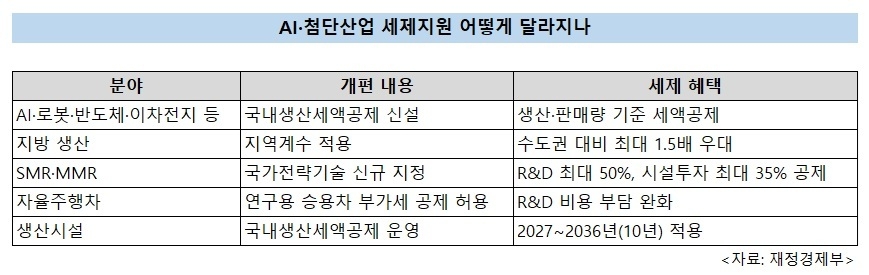
The government determined that, amid persistent external uncertainties — including US tariff policy and the war in the Middle East — it must act decisively to counter excessive foreign dependence in energy and supply chains and to compete in advanced industries. To that end, it will introduce the domestic production tax credit to strengthen the country's manufacturing base. When a company directly produces and sells domestically an item in which South Korea's production base is weak, a fixed amount will be deducted from its income or corporate tax in proportion to output.
Six sectors are eligible: solar power, wind power, secondary batteries, semiconductors, core materials, and AI and robot components. The government selected these fields through a comprehensive assessment of their strategic importance, growth potential and the need for domestic production; specific items within each sector and the standard credit amount per item will be finalized in enforcement decrees. Candidate items nominated by related ministries will also be evaluated by both experts and AI on importance, potential and necessity.
The credit amount is calculated by multiplying a company's domestic production and sales volume by the standard credit amount for each item and a regional coefficient. The standard credit amount is set based on production costs and selling prices. To prevent credits from growing excessively large, a cap applies: the lesser of 50 percent of eligible production costs or 50 percent of cumulative investment in the relevant production facility, minus any credits already received.
The further from the Greater Seoul area a company produces, the greater the benefit. The metropolitan area carries a regional coefficient of 1.0, while non-metropolitan cities receive 1.1, enterprise cities 1.3, and priority zones such as population-decline areas 1.5. A company with a factory in a population-decline area can receive up to 50 percent more in tax credits than a metropolitan-area counterpart producing the same volume. The government also plans to widen regional differentials in R&D and integrated investment tax credits to encourage companies to invest outside the capital region.
The domestic production tax credit will run for 10 years, from 2027 through 2036. To give companies time to prepare for the credit's expiration, the benefit will taper during the final three years: credits will fall to 75 percent of the base amount in 2034, 50 percent in 2035 and 25 percent in 2036. As a rule, the domestic production tax credit and the integrated investment tax credit cannot both apply to the same production facility. However, a transition procedure will allow taxpayers whose facilities already receive the integrated investment tax credit to switch to the new domestic production tax credit.
The government will also strengthen support for next-generation nuclear power to meet rising electricity demand in the AI era.
A new "future-oriented energy" category will be created under the national strategic technologies framework, with SMR and MMR included as qualifying technologies and commercialization facilities. The government defines SMR as small reactors with an electrical output of up to 300 megawatts and MMR as those in the 20–30 megawatt range or below, noting that both offer broader deployment options in terms of location and use than large conventional nuclear plants. Through tax support, the government aims to strengthen energy security, secure an early foothold in the global nuclear market and advance carbon neutrality goals. The existing hydrogen sector will also be expanded and reorganized under the future-oriented energy category.
Technologies designated as national strategic technologies qualify for R&D tax credits of 30–40 percent for large and mid-sized companies and 40–50 percent for small and medium-sized enterprises. Facility investment receives a base credit rate of 15–25 percent depending on company size; with an additional credit for incremental investment, the total can reach up to 35 percent. These rates exceed those for general technologies (2–25 percent for R&D) and new-growth and source technologies (20–40 percent).
The tax burden on AI and next-generation vehicle R&D will also ease. Currently, value-added tax paid on the purchase, lease or maintenance of passenger vehicles is generally not deductible unless the vehicle is used in transportation, automobile sales or rental businesses. Going forward, autonomous-driving passenger vehicles used for R&D that have received a temporary operating permit from the Ministry of Land, Infrastructure and Transport will also qualify for input VAT deductions. The measure is intended to encourage companies to participate in autonomous-driving technology demonstrations and expand R&D investment.
The tax reform package focuses on simultaneously supporting the domestic production base for AI and advanced industries and building future power infrastructure. The strategy goes beyond capitalizing on the AI-driven semiconductor boom — it aims to expand domestic production of advanced components and materials while proactively securing the power supply chain needed for the AI era.
fact0514@heraldcorp.com